TL;DR
You can usually sell a house or land in Dallas or Collin County without coming to Texas. A Texas title company can close by mail or with a Texas online notary, who can notarize for signers outside the state. Check that the taxes are paid, prove you are the owner, verify every buyer and title company yourself, and plan for federal taxes. FIRPTA withholding applies only to foreign sellers.
Why out-of-state owners sell
Many Texas properties are owned by people who live somewhere else. A lot bought years ago as an investment. A house inherited from a parent. A tract held by siblings who moved away. Owning from a distance means paying taxes and insurance, keeping up with mowing and city notices, and worrying about a property you rarely see.
Our guide to finding motivated sellers in public records explains why absentee ownership, tax delinquency and code cases often appear together. Selling can remove all of those problems at once.
Prove you can sell
Before anything else, confirm who owns the property on paper.
- If you bought it, your deed should be in the county records. In Dallas County that is the Dallas County Clerk, and in Collin County the Collin County Clerk.
- If you inherited it, a buyer's title company will need proof of who the heirs are. See who inherits when there is no will, our guide to probate and heirship affidavits, and transfer on death deeds.
- If several people own it, all of them usually sign. If they disagree, see when co-heirs disagree.
Property taxes from a distance
Texas property taxes are a lien on the property. Under Tax Code section 32.01, the lien attaches on January 1 each year to secure that year's taxes, penalties and interest. Bills sent to an old address are easy to miss, and delinquent taxes add penalties and interest each month.
Look up your account on the Dallas County Tax Office or Collin County Tax Assessor-Collector website and make sure your mailing address is current with the appraisal district. If you are behind, delinquent taxes are paid from the proceeds at closing. Our tax delinquency snapshot shows how common this is.
Pricing land you have not seen in years
Areas change. A lot that sat in a quiet area ten years ago may now be next to a new subdivision, or the city may have changed zoning or utilities. Texas is a non-disclosure state, so sale prices are not public.
Our guide to what a lot is worth explains pricing per square foot, per front foot and per acre. Ask a local agent for an MLS search, get written offers, and check the Dallas County or Collin County pages for land values by ZIP code. If the lot could suit a builder, see selling a vacant lot to a home builder.
Signing without traveling
Texas makes remote closings practical:
- Online notarization. Texas has allowed online notaries since July 1, 2018, under Government Code chapter 406, subchapter C. Section 406.110 says a Texas online notary may notarize for a signer regardless of whether the signer is physically in Texas, verifying identity over two-way audio and video. Ask your title company whether it closes this way.
- Mail-away closing. Many title companies send a signing package to you, and you sign before a notary where you live. Ask the title company which notaries it accepts.
- Power of attorney. If someone else will sign for you, Estates Code section 751.151 requires a durable power of attorney used for a real estate transaction that involves a recorded instrument, such as a deed, to be recorded in the county records. Get the title company's approval of the document before you sign it.
Sale proceeds are usually sent by wire. Confirm wiring instructions by phone using a number you found yourself, not one in an email.
Taxes and FIRPTA
- No Texas income tax on individuals. Article VIII, section 24-a of the Texas Constitution bars the legislature from taxing the net incomes of individuals.
- Federal and home-state tax. Federal tax may apply to your gain, and your home state may tax it too. The title company usually reports the sale to the IRS. Talk to a CPA before closing.
- FIRPTA, for foreign sellers only. According to the IRS, when a foreign person sells U.S. real property, the buyer is generally the withholding agent and the rate is generally 15 percent, with reduced or no withholding for some residences. U.S. citizens and residents living in another state are not foreign persons for FIRPTA.
Watch for seller impersonation and wire fraud
Vacant land with an owner who lives far away can be a target for fraud. Criminals pose as the owner to sell land they do not own, or pose as a title company to redirect your proceeds. Pick your own title company, verify every phone number independently, and never send money or personal data because an email asked you to.
Avoiding scams
- Verify the buyer and look up the title company yourself.
- Be wary of offers that ask for upfront fees. A real buyer pays closing costs through the title company.
- Read what you sign. An option or assignment contract is not the same as a sale. See our glossary entries on assignment of contract and wholesaling.
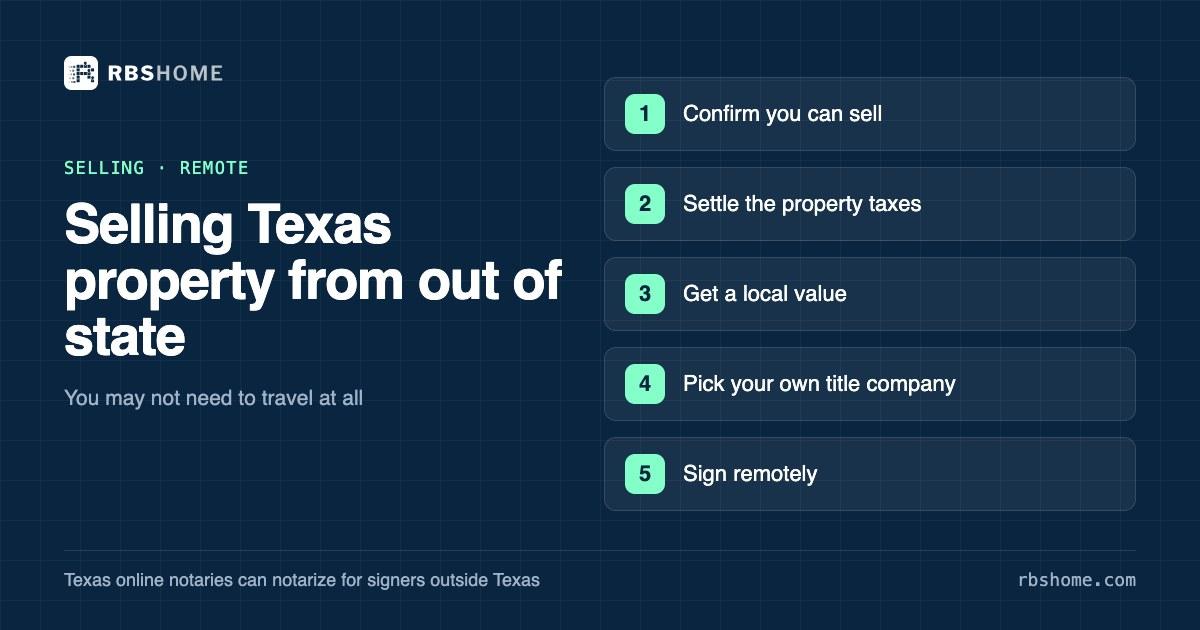
Five steps
- Confirm you can sell. Check that you are the owner of record, or what proof of heirship or authority a title company needs.
- Pay or plan for property taxes. Look up the account with the county tax office and get any delinquent balance under control.
- Get a local opinion of value. Use land comparisons, an agent's MLS search or written offers from local buyers.
- Pick a Texas title company. Choose a title company you found yourself and confirm its contact details independently.
- Sign remotely. Sign with a Texas online notary, a local notary or a mobile notary, as the title company directs.
RBSHome buys houses and land as-is in Dallas County and Collin County, including Dallas, Frisco and McKinney, from owners who live anywhere. We close at a Texas title company you can verify, and you may not need to travel at all.
This article is general information, not legal or tax advice. Talk to a Texas attorney, a CPA or your title company about your sale.
Written offer, usually within 24 hours. Remote closing available through the title company.
Sources
- Texas Government Code chapter 406, subchapter C, Online notary public (sections 406.107, 406.110), effective July 1, 2018: statutes.capitol.texas.gov
- Texas Estates Code section 751.151, Recording for real property transactions: statutes.capitol.texas.gov
- Texas Tax Code section 32.01, Tax liens: statutes.capitol.texas.gov
- Texas Constitution, article VIII, section 24-a: statutes.capitol.texas.gov
- Internal Revenue Service, FIRPTA Withholding: irs.gov