TL;DR
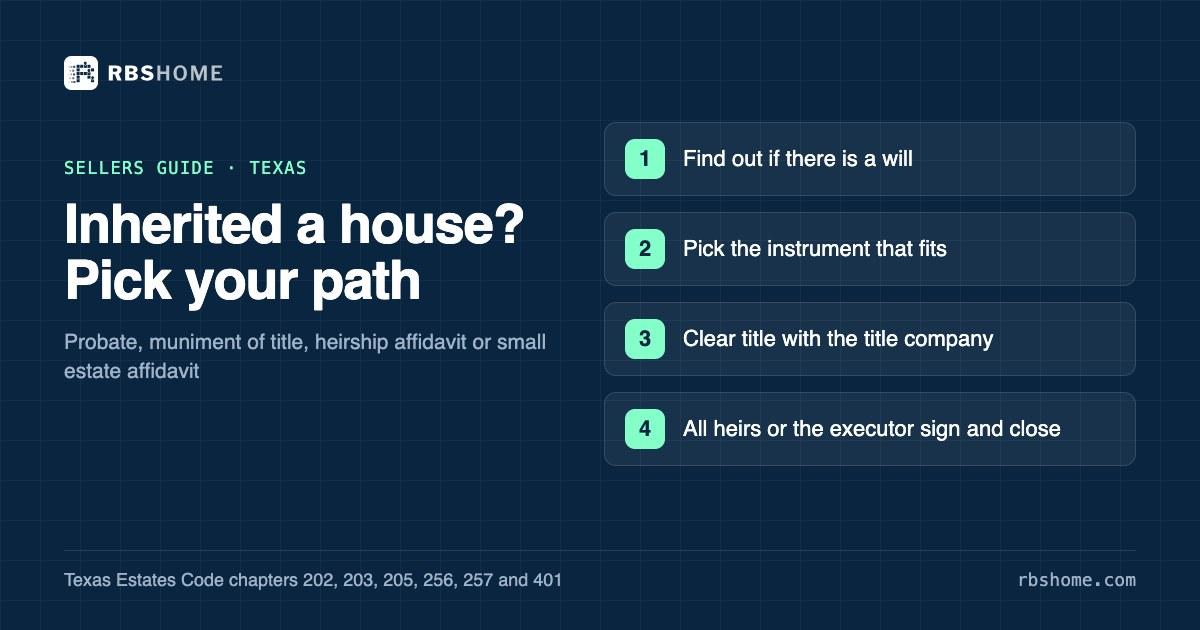
If there is a will, it usually has to be probated: a muniment of title is the fast option when the estate owes no unsecured debts, and full probate with an independent executor is the option when it does. If there is no will, most families sell using a recorded affidavit of heirship, or a court determination of heirship when the family tree is complicated. A small estate affidavit transfers a house only when that house is the homestead and the only real property, and the rest of the estate is $75,000 or less. The title company insuring the sale decides what paperwork it will accept, so call it early.
In this article
- 1. Why heirs need paperwork before they can sell
- 2. Step one: is there a will
- 3. Probate with an independent executor
- 4. Muniment of title: the short path when there is a will
- 5. Affidavit of heirship: the common path when there is no will
- 6. Small estate affidavit: narrow, and rarely about the house
- 7. Court determination of heirship
- 8. Side-by-side comparison
- 9. What the title company will ask for
- 10. Dallas County and Collin County probate courts
- 11. Costs that keep running while you decide
- 12. Four common situations and the usual path
- 13. Selling once you have authority
Why heirs need paperwork before they can sell
Texas law says a person's estate passes the moment they die. Under Estates Code section 101.001, property left by a will vests immediately in the people named in the will, and property of someone who dies without a will vests immediately in their heirs at law. Section 101.051 adds that the estate still passes subject to the person's debts.
So in a legal sense, you may already own the house. The trouble is proving it. The deed in the county records still shows your parent, grandparent or relative as the owner. A buyer who pays you for the house wants a title insurance policy that says they own it free of claims from other relatives, creditors or a will nobody mentioned. The title company will only write that policy if the records, plus whatever documents you give it, show who has the right to sign the deed.
Each of the four instruments in the title of this article is a different way to create that proof. They differ in cost, time, court involvement and how much risk they leave for the buyer. Picking the wrong one usually doesn't ruin anything, but it can cost months.
This guide covers the statewide rules. If you inherited a house in South Dallas or Pleasant Grove specifically, our guide to selling inherited property in 75216 and 75217 covers the neighborhood side: vacancy, code issues and condition.
Step one: is there a will
Everything branches from this question, so settle it before anything else. Look through the person's papers, safe deposit box and email, and ask their attorney, bank and close family. Check whether a will was ever deposited with the county clerk.
If there is a will, Texas law is strict about one point: under Estates Code section 256.001, a will is not effective to prove title to property until it is admitted to probate. You can't record the will by itself in the deed records and sell. It has to go through a court, even if the court process is short.
There is also a clock. Section 256.003 says a will generally can't be admitted to probate after the fourth anniversary of the death, unless the applicant proves they were not in default for failing to present it sooner. Letters testamentary (the court papers that let an executor act) cannot be issued if the will is admitted after four years, unless the application was filed before that anniversary. The same section protects a buyer who, after four years, purchases from the heirs in good faith without knowing a will exists.
If there is no will, the person died "intestate," and Estates Code chapter 201 decides who inherits. The rules depend on whether the person was married, whether the property was community or separate, and whether every child is also a child of the surviving spouse. Two examples from the statute show why this matters for a sale:
- Under section 201.003, if a married person dies without a will and every child is also a child of the surviving spouse, the deceased spouse's half of the community estate passes to the surviving spouse. If there is a child from another relationship, the deceased spouse's half of the community passes to their children instead.
- Under section 201.002, a surviving spouse inherits only a life estate in one-third of the deceased spouse's separate land when there are children, with the rest going to the children.
In plain terms, the people who must sign the deed are not always who the family assumes. Getting the heirship right is the core of every no-will sale.
Probate with an independent executor
Full probate means a court admits the will and appoints an executor, or, with no will, appoints an administrator. The court issues letters, and the executor or administrator signs the deed on behalf of the estate.
Texas strongly favors independent administration, where the executor settles the estate with little court supervision after filing an inventory. Under Estates Code section 401.001, a will can direct that no other action be taken in the probate court beyond probating the will and returning the inventory. If the will names an executor but doesn't say this, section 401.002 lets all the distributees agree to independent administration. With no will, section 401.003 lets all the distributees agree on an independent administrator.
The power to sell is the detail that matters to you. Many wills grant it directly. When the will is silent or there is no will, section 401.006 lets the court include a power of sale in its order if the distributees consent to it in the application. An independent executor with a power of sale can sign a deed without returning to court for each step.
A dependent administration works differently. Under section 356.001, estate property generally may not be sold without a court order authorizing the sale. That adds an application, a hearing and an order before closing, which is slower but gives a court's blessing to the price and terms.
Full probate makes sense when the estate owes debts beyond the mortgage, when there are several properties or accounts to collect, when heirs disagree, or when someone needs legal authority to manage the house before it sells (for insurance, utilities or repairs). It is also the most familiar path to title companies, because the deed comes from a court-appointed person with documented authority.
One practical benefit: Property Code section 5.008(e) exempts a transfer by a fiduciary in the course of administering a decedent's estate from the statutory seller's disclosure notice. An executor selling a house they never lived in often knows little about its condition, so this matters.
Muniment of title: the short path when there is a will
A muniment of title is a Texas procedure where the court admits the will to probate but does not appoint an executor. The court's order, together with the will, becomes the record that title passed to the people named in the will.
Estates Code section 257.001 allows it when the court is satisfied that the estate does not owe an unpaid debt, other than a debt secured by a lien on real estate, or finds for another reason that administration isn't needed. That carve-out is useful: a mortgage on the house does not by itself block a muniment.
Under section 257.054, the applicant must prove, among other things, that the testator is dead, that four years have not passed since the death, and that the estate owes no unpaid debts other than real estate liens. Section 257.102 says the order is sufficient legal authority for anyone who purchases from or deals with the estate, and that a person entitled to property under the will may deal with it as if record title were in their name. Within 180 days after the order, section 257.103 requires the applicant to file a sworn affidavit listing which terms of the will have and haven't been fulfilled, unless the court waives or extends that deadline.
For a sale, this means the devisees named in the will sign the deed themselves, and the title company relies on the certified will and order recorded in the county where the house sits. If a house is left to three children equally, all three sign.
The weak spot is debt. If there are credit cards, medical bills or other unsecured debts, a muniment usually isn't available, and the court may require an administration. Ask the probate attorney about any debt before you file.
You will likely need a lawyer for anything involving a will
The Dallas County Probate Courts' FAQ states that an application to probate a will should be offered by an attorney, and that filing one for others without an attorney is the unauthorized practice of law. The Collin County Clerk's probate page also points to the attorney requirement in Government Code chapter 81 and strongly recommends an attorney even when no executor is needed. Budget for one from the start.
Affidavit of heirship: the common path when there is no will
An affidavit of heirship is a sworn statement of the family history, usually signed by someone who knew the person who died but who does not inherit, and recorded in the deed records of the county where the property sits. Estates Code section 203.002 gives a model form. It asks for the person's marriages, every child (including children from other relationships and children raised in the home), parents and siblings where relevant, whether there was a will, whether there was an administration, any unpaid debts and taxes, and the real property the person owned.
The legal effect is narrower than most families expect. Section 203.001 says that once such an affidavit has been of record for five years or more in the deed records, a court must receive it as prima facie evidence of the facts in it. The affidavit does not transfer title by itself, and section 203.001(d) says it does not affect the rights of an omitted heir or a creditor.
Why do sales close on these affidavits, then? Because title companies are willing to insure on them in many cases. The Texas State Law Library's probate guide says real estate buyers and title companies commonly accept affidavits of heirship as proof of title, while noting that doing so carries some risk for the buyer, and that no law requires third parties to accept them. In practice, every heir named in the affidavit signs the deed to the buyer, and the title company decides whether the affidavit and family facts are clean enough to insure.
This path works best when the family tree is simple and everyone cooperates: for example, a widowed parent with three adult children who all agree to sell. It gets harder when an heir has died and left their own heirs, when someone can't be found, when an heir is a minor, or when there are debts. A title company may then ask for more, or decline to insure on the affidavit.
Small estate affidavit: narrow, and rarely about the house
The small estate affidavit is the most misunderstood of the four. Under Estates Code section 205.001, the heirs of someone who died without a will can collect the estate without a personal representative if:
- 30 days have passed since the death;
- no petition for a personal representative is pending or has been granted;
- the estate assets, not counting the homestead and exempt property, are worth $75,000 or less;
- the affidavit is filed with the court and the judge approves it.
Section 205.002 requires the affidavit to be sworn to by two disinterested witnesses and by each distributee who has legal capacity, and to list known assets, liabilities and the family history.
Now the part that matters for a house. Section 205.008(b) says the chapter does not transfer title to real property, with one exception. Section 205.006 allows title to the homestead to pass by small estate affidavit if the homestead is the only real property in the estate, and the approved affidavit must be recorded in the deed records of the county where the homestead sits. A buyer for value can rely on that recorded affidavit, and takes free of an undisclosed heir's interest unless they had notice of that heir, though the property remains subject to creditor claims.
So the small estate affidavit can work for a family home when the person had no will, lived in the house as their homestead, owned no other real estate, and the rest of the estate is $75,000 or less. It does not transfer a rental house, a vacant lot, a second home or inherited land. It is also unavailable if there is a will, because section 205.001 applies only when the person died intestate.
Court determination of heirship
When the family history is complicated, the cleanest no-will route is a court proceeding to declare heirship under Estates Code chapter 202. A court hears evidence and signs a judgment naming the heirs and their shares. Under section 202.0025, the proceeding can be brought at any time after the death, so it is available decades later, which matters for houses that have passed through several generations without paperwork.
The judgment is a final judgment under section 202.202. Section 202.203 lets an heir who wasn't properly served reopen it by bill of review within four years, or later on proof of actual fraud, but that heir's recovery runs against the named heirs and people claiming under them who are not bona fide purchasers for value. That protection for good-faith buyers is why title companies are comfortable insuring after a heirship judgment.
In Dallas County, expect an attorney ad litem. The same Dallas County Probate Courts FAQ says that although the Estates Code makes the appointment discretionary, the Dallas County probate courts have decided one must be appointed in every heirship case. The ad litem represents unknown heirs, and the estate usually pays that fee.
A heirship judgment can be paired with an administration (when debts must be paid or someone needs authority to sell) or used on its own, with all the heirs signing the deed.
Side-by-side comparison
| Instrument | When it fits | Court involved | Who signs the deed | Main limit |
|---|---|---|---|---|
| Probate with independent executor or administrator | Will or no will; debts, several assets, disagreement, or need for authority | Yes, then little supervision | Executor or administrator with power of sale | Most time and cost up front |
| Muniment of title | There is a will and no unpaid debts other than real estate liens | Yes, one hearing, no executor | Devisees named in the will | Generally within four years of death; debts block it |
| Affidavit of heirship | No will, simple family tree, heirs cooperate | No | All heirs | Title company must agree to insure on it |
| Small estate affidavit | No will, homestead is the only real property, other assets $75,000 or less | Yes, judge approves | Distributees named in recorded affidavit | Transfers only a homestead, never other real estate |
| Determination of heirship | No will, complex or old family history, missing heirs | Yes, with ad litem in Dallas County | All heirs, or an administrator | Slower; ad litem fee |
What the title company will ask for
The title company is the gatekeeper for every path above, because the buyer's policy is what makes the sale close. Contact one before you file anything in court. Tell it the address, the date of death, whether there is a will, and who the family members are. It can tell you what it will need to insure the sale.
Requests commonly include:
- a death certificate;
- the will and the probate order, letters or muniment order, certified and recorded;
- an affidavit of heirship that follows the statutory form, often signed by one or two people who are not heirs;
- signatures from every heir, and sometimes their spouses;
- proof that debts are paid, or a plan to pay them from the sale proceeds;
- payoff letters for any mortgage, and tax certificates showing what is owed;
- identification and, for a heir who can't attend, a power of attorney the title company has approved.
Heirs who live out of state can usually sign with a mobile notary or at a title office where they live, if the title company approves it in advance. Ask about that early rather than the week of closing.
Dallas County and Collin County probate courts
If the house is in Dallas County, probate matters go to the Dallas County Probate Courts. The county has three statutory probate courts, Probate Court No. 1, No. 2 and No. 3, all in the George Allen Courts Building at 600 Commerce Street, 7th Floor, in downtown Dallas. The courts' FAQ says notice in a probate case is returnable the Monday after ten days have passed, so the earliest hearing is the Monday after that ten-day period. The court site links to e-filing information, local rules, forms and a case status search.
If the house is in Collin County, cases go to the Collin County Probate Court in the Russell A. Steindam Courts Building, 2100 Bloomdale Road in McKinney. The court's page says uncontested probate and guardianship cases are often handled by Zoom. The County Clerk's probate office requires original wills to be filed within three days of e-filing the application and won't set a hearing until the original will is received.
Venue normally follows where the person lived when they died, not where the house is. If your father lived in Collin County but owned a rental in Dallas County, the probate case usually belongs in Collin County, and the order or affidavit then gets recorded in Dallas County's deed records too. Your attorney will confirm venue.
If the inherited property is land rather than a house, our guide to selling land in Collin County covers the land side.
Costs that keep running while you decide
The house doesn't wait for the paperwork. Property taxes, insurance, utilities and upkeep continue, and a vacant house is exposed to break-ins and code complaints.
Taxes are the cost most likely to grow quietly. Under Tax Code section 31.02, property taxes are delinquent if not paid before February 1 of the year after they were imposed, and penalties and interest start then. A tax lien attaches every January 1 under section 32.01.
Inherited houses often carry a tax deferral. Older and disabled homeowners can defer property taxes on their homestead under Tax Code section 33.06. The deferral is not forgiveness. The lien stays on the property and interest accrues at 5 percent a year during the deferral. Once the person no longer owns and occupies the home, the protection ends on the 181st day after the tax collector delivers a delinquency notice. Heirs sometimes discover years of deferred taxes only when they order a tax certificate.
This is common. As of November 3, 2026, RBSHome's records show 90,298 Dallas County accounts with a delinquent balance on the latest roll, including 10,605 homesteads and 5,017 accounts with an over-65 exemption. In Collin County, 20,345 accounts were delinquent, including 2,234 homesteads. Our November 2026 tax delinquency report breaks those numbers down.
Delinquent taxes don't stop a sale. They are paid from the proceeds at closing like any other lien. But penalties and interest come out of the heirs' share, and a tax suit adds legal fees to the bill.
Four common situations and the usual path
These are patterns, not legal advice. Your attorney and title company make the call on your facts.
A widowed mother left a will naming her two children, and she had no debts except the mortgage. This is the classic muniment of title. The court admits the will, the two children record the order and sign the deed, and the mortgage is paid off at closing.
A father died without a will, was not married, and left three adult children who all agree to sell. Many families use an affidavit of heirship here, with all three children signing the deed, provided the title company agrees to insure on it. If one child has died, that child's own heirs step into the share, and the affidavit has to cover them.
Grandmother's house has been in the family since she died, no will, and two of her children have also died since. This usually calls for a court determination of heirship, because the shares now run through several estates. If the family can't locate someone, an administration with a power of sale may be the practical way to get a single signature on the deed.
An aunt left a will, but also credit card and medical debt, and the house needs work before anyone would lend on it. A muniment is likely unavailable because of the unsecured debt. An independent administration lets the executor sell the house, pay the valid claims and distribute what's left.
Selling once you have authority
Once the paperwork is in place, an inherited house sells like any other house, with one difference: decisions are made by several people, or by an executor who answers to them. Agree in writing early on who communicates with buyers and how offers will be approved.
You can list the house with an agent, sell it yourself, or sell it as-is to a direct buyer. If the house needs major repairs, is full of belongings, or has heirs spread across several states, a direct sale can reduce the work. If the house is in good condition and the heirs can wait, listing it often brings a higher price. Our Dallas County hub and Collin County hub rank every ZIP by recent activity if you want a feel for your area before talking to anyone.
RBSHome buys houses and land as-is in Dallas and Collin County. You get a written, itemized offer, usually within 24 hours. There are no agent commissions, you pick the closing date, and closing happens at a title company, which reviews the probate or heirship documents as part of its normal work.
This article is general information, not legal or tax advice. For your situation, talk to a Texas attorney, CPA or your title company.
Written, itemized offer, usually within 24 hours. You choose the closing date.