TL;DR
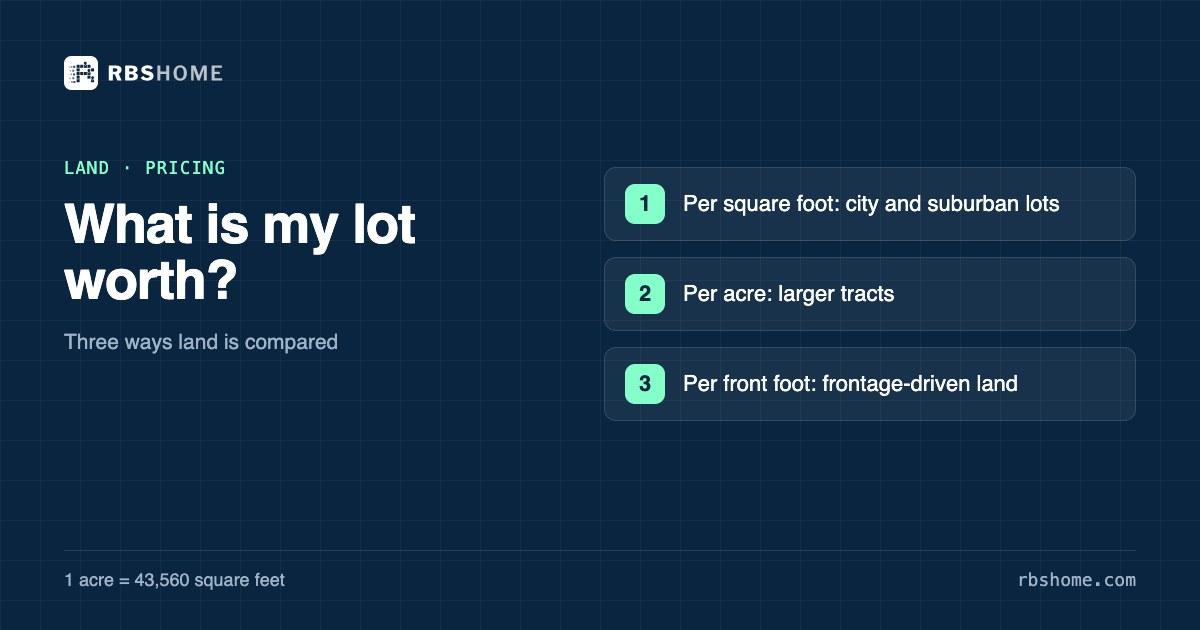
A lot is worth what comparable land sells for, adjusted for its differences. City lots are usually compared per square foot, larger tracts per acre, and frontage-driven land per front foot. The appraisal district value is a starting point, not the answer. Utilities, floodplain, zoning, shape and access can move a lot's value a lot.
Three units, one goal
Land has no bedrooms or bathrooms, so it is compared by a unit of size. The three common units are square feet, acres and front feet. All three try to answer the same question: what are buyers paying for similar land right now?
A useful number to remember: one acre is 43,560 square feet. That lets you convert between the two. A 7,500-square-foot city lot is about 0.17 acres. A half-acre lot is 21,780 square feet.
The right unit is the one buyers in your market use. If every comparable lot near you is priced per square foot, an acreage price will confuse buyers.
Per square foot
Most city and suburban lots in Dallas and Collin County are compared per square foot, or simply per lot when lots in a subdivision are similar in size.
Example of the math: if similar lots near you sold for $40 per square foot, a 7,500-square-foot lot would point to about $300,000. That figure is only an illustration. Real prices vary widely by ZIP code. Our Dallas County land market pages and Collin County hub show land values by ZIP code from appraisal data.
Price per square foot usually falls as lot size grows. A buyer pays more per foot for a standard lot than for an oversized one, because the extra land adds less to what they can build.
Per acre
Larger tracts are compared per acre. In Collin County, tracts of a few acres up to large farm parcels are often priced this way, especially north of the developed cities. Our guide to selling land in Collin County covers what sets those prices.
The same size effect applies. A 2-acre homesite usually brings more per acre than a 50-acre tract, because fewer buyers can afford the large tract and a developer has to spend money on roads and utilities before selling lots.
Per front foot
Front footage is the width of the lot along the street or road. Price per front foot divides the price by that width. It fits when the frontage is what buyers pay for:
- Retail and commercial land along busy roads, where visibility and access depend on frontage.
- Narrow, deep city lots, where the width decides whether a builder can fit the house they want under the setback rules.
Appraisal districts sometimes use front-foot rates in their land schedules too. Our guide to valuing property without sale prices explains how appraisal district land values are built.
What moves a lot's value
Two lots with the same size can be worth very different amounts. The most common adjustments:
- Utilities. Water and sewer at the lot line add value. A long line extension, a septic system or a well can lower it. See water, sewer, MUDs and CCNs.
- Floodplain and drainage. Land in a FEMA flood zone or with drainage problems costs more to build on. See floodplain and drainage checks.
- Zoning and plat. Zoning that allows what buyers want to build, and a recorded plat, raise value. An unplatted tract may need platting first.
- Shape and access. Regular lots with street frontage beat flag lots, landlocked tracts and odd shapes.
- Location. School district, neighborhood and nearby new construction matter as much for land as for houses.
- Title and taxes. Unpaid taxes, liens or missing heirs do not change the land's value, but they reduce what a buyer will pay to take on the problem.
Do not rely on the appraisal district value alone
Appraisal district values come from mass appraisal and can miss a lot's problems or its upside. Read the glossary entry on CAD market value before you use it to set a price.
Where to find comparisons in a non-disclosure state
Texas is a non-disclosure state: sale prices are not in the public record. That makes land comparisons harder. Practical sources:
- An agent's MLS search for closed land sales near you.
- Active and recently expired listings, which show what sellers ask, though not what buyers paid.
- Appraisal district land values for your lot and neighbors, as a rough guide.
- Offers from builders and land buyers, which show real demand.
Write down where each number came from and its date. A land sale from three years ago may not reflect today's market, and an asking price is not a sale price. Three or four solid comparisons beat a dozen weak ones.
Five steps to an estimate
- Measure the lot. Find the lot's square footage, acreage and frontage from the plat, a survey or the appraisal district record.
- Pick the unit buyers use. Use price per square foot for city lots, per acre for larger tracts, and per front foot where frontage drives value.
- Find comparable land. Collect recent land sales and listings nearby, through an agent's MLS search or local land buyers.
- Adjust for differences. Adjust up or down for size, shape, utilities, floodplain, zoning, access and location.
- Check it against a buyer's math. Ask what a builder could build and sell there, and whether your number leaves room for their costs. Our guide to selling a vacant lot to a home builder explains how builders work backward to a land price.
RBSHome buys lots and land in Dallas County and Collin County, including McKinney, Plano and Mesquite. If you want a number to compare with your own estimate, we can give you a written offer.
This article is general information, not an appraisal. For a formal opinion of value, hire a licensed Texas appraiser.
Written offer on your lot, usually within 24 hours.
Sources
- National Institute of Standards and Technology, Handbook 44, Appendix C (General Tables of Units of Measurement: 1 acre = 43,560 square feet): nist.gov
- Federal Emergency Management Agency, Flood Map Service Center: msc.fema.gov
- Dallas Central Appraisal District: dallascad.org
- Collin Central Appraisal District: collincad.org