TL;DR
When someone dies without a will in Texas, the law decides who owns their house. The answer depends on whether there is a surviving spouse, whether there are children (and whether they are also the spouse's children), and whether the house was community or separate property. Heirs own their shares from the date of death, but a buyer will not close until the heirs are proven and every owner signs.
What intestate means for a house
A person who dies without a valid will dies "intestate." Texas has a default set of rules for that case in Estates Code chapter 201. Those rules decide who inherits the house, the land under it, and everything else the person owned.
Section 201.103 says the estate vests in the heirs as if they had bought it themselves. In plain terms, the heirs own the house as soon as the owner dies. What they do not have yet is proof that a title company will accept. That gap is why many families feel stuck. They own the house but cannot sell it.
This guide explains the shares. Our longer guide on probate, affidavits of heirship and small estate affidavits explains the paperwork that turns those shares into a sellable title.
No spouse: children, then parents and siblings
If the person who died was not married, section 201.001 sets the order:
- Children and their descendants take everything. If a child died first and left children, those grandchildren share their parent's portion.
- If there are no children or grandchildren, the estate goes in equal shares to the person's father and mother.
- If only one parent is living, half goes to that parent and half goes to the person's brothers and sisters (and their descendants). If there are no siblings, the living parent takes it all.
- If neither parent is living, everything goes to the brothers and sisters and their descendants.
If none of those relatives survive, the estate splits between the father's side and the mother's side of the family, and goes to grandparents, aunts, uncles and cousins in a set order.
Two details catch families off guard. Half-siblings inherit, but under section 201.057 each half-blood sibling takes half as much as a whole-blood sibling. And under section 201.054, an adopted child inherits from adoptive parents the same as a biological child.
Spouse and community property
Texas is a community property state. A house bought during the marriage is usually community property, even if only one spouse is on the deed.
Section 201.003 handles the deceased spouse's half of the community:
- If there are no children or descendants, the surviving spouse takes it.
- If all of the children are also children of the surviving spouse, the surviving spouse takes it.
- If the deceased spouse has a child from another relationship, the deceased spouse's half of the community passes to their children and descendants. The surviving spouse keeps their own half.
That last rule is where blended families most often end up co-owning a house with a stepparent. It is also where disagreements start.
Spouse and separate property
Property the person owned before the marriage, or received by gift or inheritance, is usually separate property. Section 201.002 treats land differently from personal property:
- With children: the surviving spouse gets a life estate in one-third of the land. The children get the rest, including the remainder of that one-third after the spouse's death.
- With no children: the surviving spouse gets all of the separate personal property and half of the land outright. The other half of the land passes to the person's parents, siblings, or siblings' descendants (nieces and nephews). If none of them survive, section 201.002(d) gives the surviving spouse the entire estate, even if grandparents, aunts, uncles or cousins are alive.
A life estate means the spouse can use that share for life but cannot sell it as full ownership. A buyer will usually need the spouse and the children to sign.
Community or separate is not always obvious
How the house was paid for, refinanced and titled can change the answer. If the classification matters to who signs, ask a Texas probate attorney before you list or sign a contract.
The homestead and the surviving spouse
The Texas Constitution, article XVI, section 52 says a homestead passes like other real property, but it cannot be partitioned among the heirs while the surviving spouse elects to use or occupy it as a homestead. Estates Code section 102.005 says the same. In practice, if the surviving spouse wants to stay, the children usually cannot force a sale, even if they own most of the house.
If heirs who are not a surviving spouse disagree, a co-owner can ask a district court to partition the property under Property Code chapter 23. When the property is "heirs' property" under chapter 23A, the court must order an appraisal, and co-owners who did not ask for a sale get 45 days after notice to elect to buy out those who did. Partition is slow and costly, so most families try to agree first.
From family tree to a sale
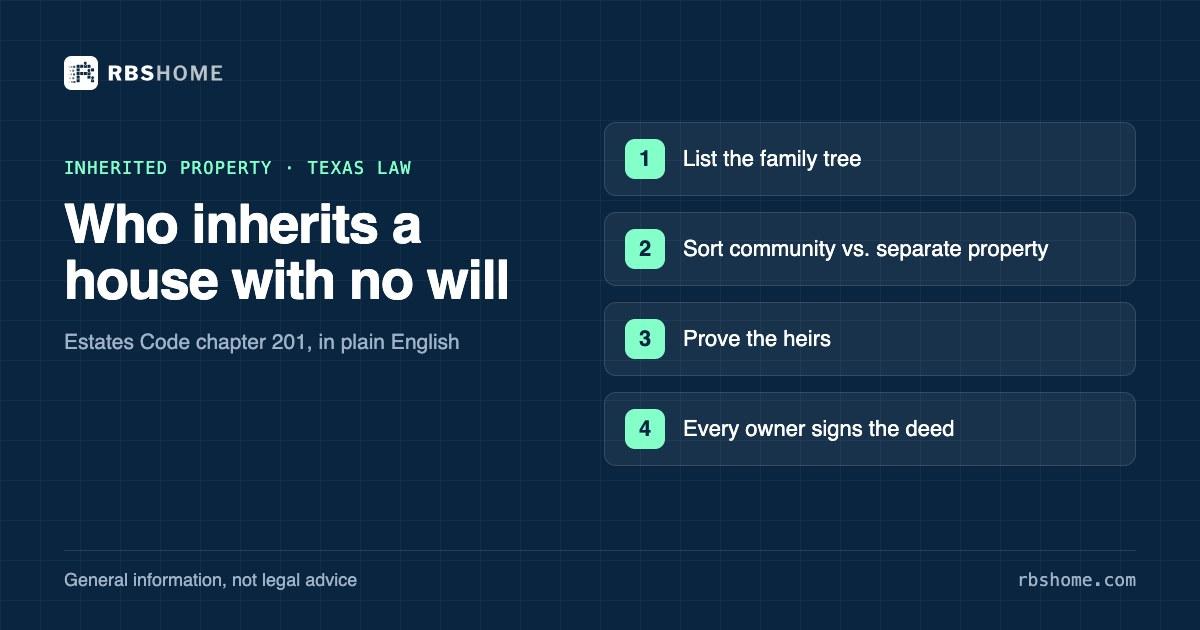
- List the family tree. Write down the spouse, every child (including children who died and left children), and, if there are no children, the parents and siblings.
- Sort the property as community or separate. A house bought during the marriage is usually community. One owned before it, inherited or gifted is usually separate.
- Apply the Texas shares. Use sections 201.001 to 201.003 to work out who owns what fraction. A simple table with each heir's share helps everyone see the same picture.
- Prove the heirs. Ask a title company and a probate attorney which route fits: an affidavit of heirship recorded in the county, a court heirship determination, or a probate administration. An affidavit of heirship form is set out in Estates Code section 203.002.
- Get every owner to sign. Every heir, or a court-appointed representative with power to sell, signs the contract and the deed at closing. Heirs who live out of state can often sign with a remote online notary.
While you work through this, keep paying the property taxes and insurance if you can. Unpaid taxes add penalties and interest each month, and a vacant house can draw code cases. Our guides on selling estate property for executors and on selling a house with code violations in Dallas cover those problems.
RBSHome buys inherited houses as-is in Dallas County and Collin County, including in Dallas, Plano and McKinney. We work with your title company and attorney on heirship. You pick the closing date, and every heir gets their share at closing.
This article is general information, not legal advice. Every family is different. Talk to a Texas probate attorney about your situation.
Written offer, usually within 24 hours. We work with your probate attorney and title company.
Sources
- Texas Estates Code chapter 201, Descent and Distribution (sections 201.001, 201.002, 201.003, 201.054, 201.057, 201.103): statutes.capitol.texas.gov
- Texas Estates Code section 102.005, Prohibitions on Partition of Homestead: statutes.capitol.texas.gov
- Texas Estates Code chapter 203, Affidavit of heirship (sections 203.001, 203.002): statutes.capitol.texas.gov
- Texas Constitution, article XVI, section 52: statutes.capitol.texas.gov
- Texas Property Code chapters 23 and 23A, Partition and Uniform Partition of Heirs' Property Act: chapter 23, chapter 23A