TL;DR
When several heirs inherit a Texas house, each owns a share, and a sale usually needs everyone to sign. If they cannot agree, the options are a buyout, a negotiated sale, or a partition suit in district court. For heirs' property, Texas law requires an appraisal and a buyout chance before any court-ordered sale. A surviving spouse's homestead right can block partition entirely.
Why one heir can stall a sale
When a house passes to several heirs, they usually own it together as co-owners, each with a share. That can happen under a will, under the Texas rules for dying without a will, or through a transfer on death deed that names more than one person.
A buyer's title company will want every owner to sign the deed, or a court order that lets someone sign for them. So if one sibling says no, or simply stops answering, the sale stops. Meanwhile taxes, insurance and upkeep keep coming due.
Option 1: a buyout
The simplest fix is often for the heir who wants the house to buy out the others. That usually takes three things:
- An agreed value. An appraisal from a licensed appraiser, or written offers from buyers, gives everyone the same number.
- Credit for what each person paid. Heirs who paid taxes, insurance or repairs since the death often expect credit. Agree on it in writing.
- Money to pay. The buying heir may need a loan. A lender will want clean title, so the heirship work still has to be done.
Option 2: a negotiated sale
If nobody wants to keep the house, the heirs can agree to sell it and split the proceeds by share. Disputes often shrink when the agreement sets a price floor, a deadline and who handles the sale. The title company then pays each heir their share at closing.
If one heir lives out of state, they can usually sign with a Texas online notary. See our guide for out-of-state owners selling Texas property.
Option 3: a partition suit
Property Code section 23.001 lets a joint owner of real property compel a partition among the joint owners. Under section 23.002, the suit is filed in a district court of a county where any part of the property is located. For a house in Dallas or Collin County, that means a district court in that county. The Texas Rules of Civil Procedure set the rest of the process.
Partition can divide the land itself ("in kind") or order a sale and divide the money. A single-family house usually cannot be divided fairly, so sales are common. A partition suit takes time and legal fees, and the fees reduce what everyone receives.
Partition is a lawsuit
Filing a partition suit means suing your relatives. Talk to a Texas real estate or probate attorney first, and try mediation if the family will agree to it.
What the Heirs' Property Act adds
Texas adopted the Uniform Partition of Heirs' Property Act in 2017 as Property Code chapter 23A. It protects families from forced sales at low prices.
When it applies. Section 23A.003 says the court must decide whether the property is heirs' property. If it is, the case follows chapter 23A unless all co-owners agree otherwise in writing. Section 23A.002 defines heirs' property as property held in tenancy in common where there is no written agreement binding all co-owners about partition, at least one co-owner got title from a relative, and relatives hold at least 20 percent of the interests or make up at least 20 percent of the co-owners, or a co-owner who got title from a relative holds at least 20 percent.
What changes:
- An appraisal first. Section 23A.006 generally requires the court to order an appraisal by a disinterested appraiser to set fair market value, unless the parties agree on value or the cost of an appraisal outweighs its value.
- A buyout right. Under section 23A.007, if any co-owner asked for a sale, the others get notice and have 45 days to elect to buy out the co-owners who asked for the sale. Section 23A.007(c) sets the price for each interest at the appraised value of the whole property times that co-owner's share.
- A preference for an open-market sale. If the court orders a sale, section 23A.010 says it must be an open-market sale unless the court finds sealed bids or an auction would be better for the co-owners as a group.
For most families, chapter 23A means a sibling who wants out gets paid fair value, and the siblings who want to stay get a real chance to keep the house.
The homestead limit
If a surviving spouse lives in the house, partition may not be possible at all. The Texas Constitution, article XVI, section 52 and Estates Code section 102.005 say a homestead cannot be partitioned among the heirs while the surviving spouse elects to use or occupy it as a homestead. Children who own most of the house may still have to wait.
Steps to try first
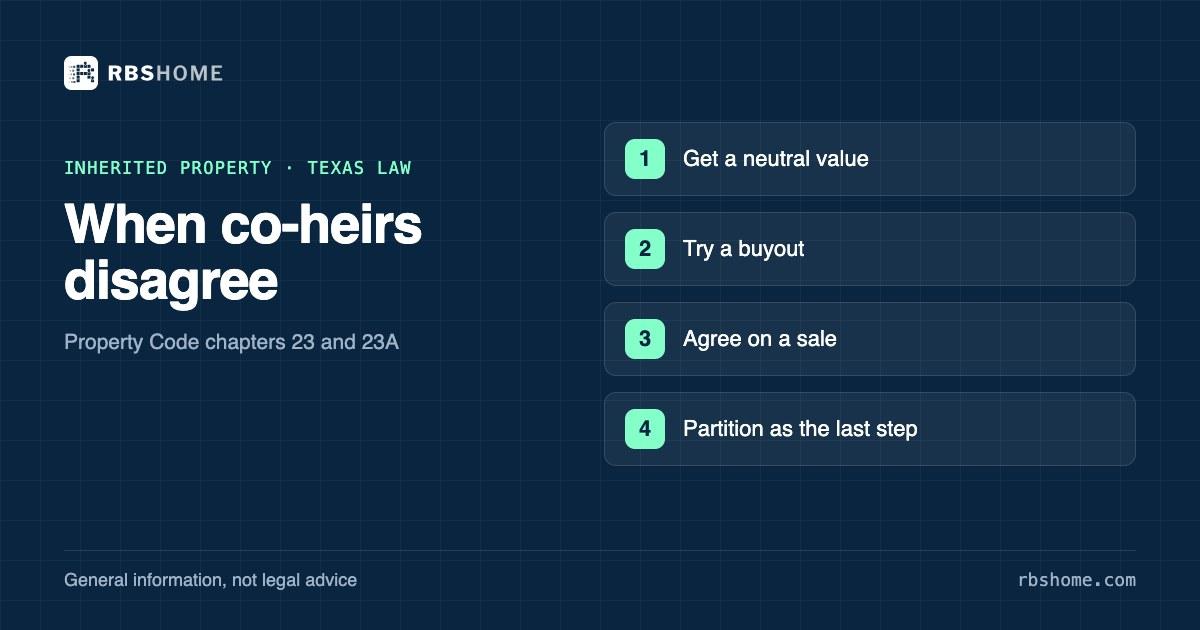
- Confirm who owns what. Work out each heir's share under the will or Texas intestacy rules, and check for a surviving spouse's homestead right.
- Get a neutral value. Order an appraisal or get written offers so everyone argues from the same number.
- Talk through a buyout. See whether the heir who wants to keep the house can buy out the others at that value.
- Consider a negotiated sale. If nobody wants to keep it, agree on a sale with a set price floor and a deadline.
- Use partition as the last step. If talks fail, a co-owner can file a partition suit in district court with an attorney.
Keep the property taxes paid while you work it out. Delinquent taxes add penalties and interest and can lead to a tax suit. See our Dallas and Collin County tax delinquency snapshot. Our glossary explains lis pendens, which is often recorded when a suit involves title.
RBSHome buys inherited houses as-is in Dallas County and Collin County, including Dallas, Garland and Plano. A written offer can give every heir the same number to react to, and the title company pays each heir directly at closing.
This article is general information, not legal advice. Partition cases depend on the facts. Talk to a Texas probate or real estate attorney before you file or respond to a suit.
One written offer every heir can review, usually within 24 hours.
Sources
- Texas Property Code chapter 23, Partition (sections 23.001, 23.002): statutes.capitol.texas.gov
- Texas Property Code chapter 23A, Uniform Partition of Heirs' Property Act (sections 23A.002, 23A.003, 23A.006, 23A.007, 23A.010), added in 2017: statutes.capitol.texas.gov
- Texas Constitution, article XVI, section 52: statutes.capitol.texas.gov
- Texas Estates Code section 102.005: statutes.capitol.texas.gov