TL;DR
A Texas transfer on death deed lets an owner name who gets their real estate at death, without probate for that property. To work, it must be a proper deed, say the transfer happens at death, and be recorded in the county before the owner dies. The beneficiary takes the house with any mortgage and liens, and estate creditors can still reach it if the estate is short. Selling usually starts with recording an affidavit of death.
What a transfer on death deed is
A transfer on death deed is a deed that does nothing until the owner dies. Texas added it to the Estates Code in 2015 as chapter 114.
While the owner is alive, section 114.101 says the deed does not affect the owner's rights. The owner can still sell or mortgage the property, keeps homestead rights, and keeps tax exemptions. The beneficiary gets nothing during the owner's life. Section 114.052 says the deed is always revocable, even if it says otherwise.
At death, section 114.103 says the property passes to the named beneficiary if the beneficiary survives the owner by 120 hours. If a beneficiary dies first or within that window, that share lapses and passes as the statute directs.
For families, the appeal is simple. It also avoids the cost of probate for that one property, though other assets may still need it. One deed, recorded in the county, can move a house to a child without probate for that house. Compare that with the routes in our guide to probate and heirship affidavits.
The three tests for a valid deed
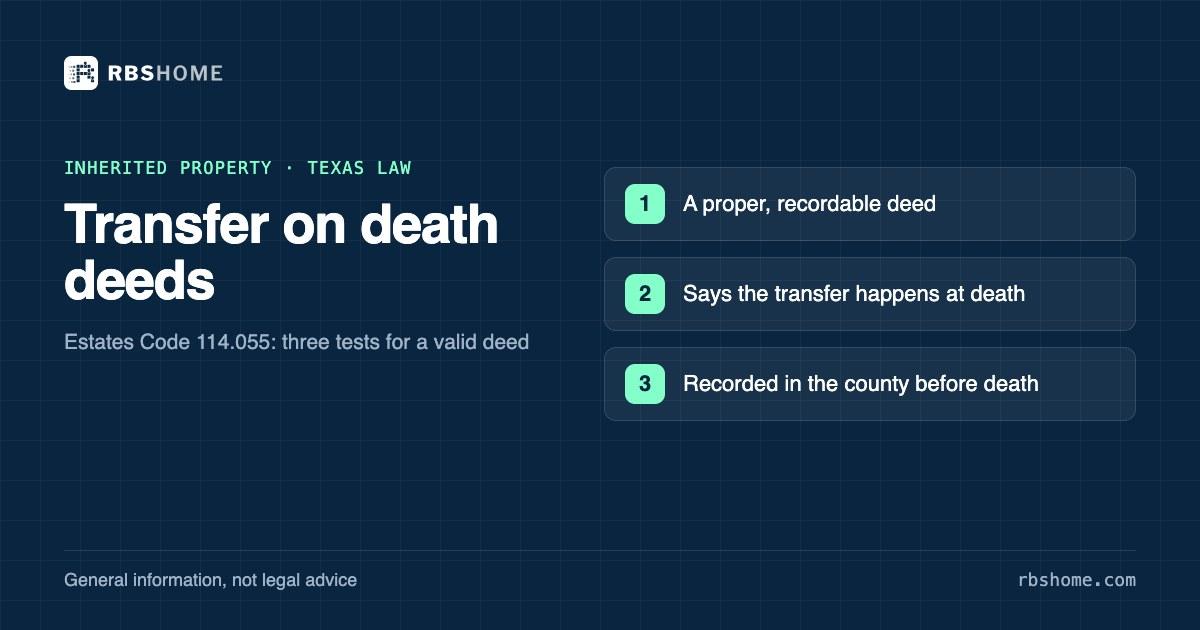
Section 114.055 says a transfer on death deed is effective only if it:
- Contains the essential elements and formalities of a recordable deed. That means a proper legal description, the owner's signature and an acknowledgment before a notary.
- States that the transfer to the beneficiary happens at the owner's death.
- Was recorded before the owner's death in the deed records of the county clerk where the property is located.
The third test is the one that fails most often. A deed that was signed and notarized but never recorded is not a transfer on death deed. In Dallas County that means the Dallas County Clerk's real property records, and in Collin County the Collin County Clerk's. Check them before assuming the deed counts.
Section 114.056 adds that the owner does not need to notify the beneficiary, deliver the deed, or receive anything in return.
What a will can and cannot change
Section 114.057(b) is short: a will may not revoke or supersede a transfer on death deed. So if a parent's will leaves the house to all three children but a recorded transfer on death deed names one child, the deed controls the house.
The owner can revoke or change a transfer on death deed during life by recording a later transfer on death deed or an instrument of revocation, under the rules in section 114.057. The statute also addresses the effect of a divorce on a deed that names a former spouse. If the family history includes a divorce, ask an attorney to read the deed and the decree together.
If more than one deed is on record
Pull every recorded instrument for the property, in date order. A later transfer on death deed or a recorded revocation can change who the beneficiary is.
What the beneficiary inherits with the house
The deed moves the house, but not free and clear.
- Mortgages and liens stay. Section 114.104 says the beneficiary takes the property subject to all conveyances, encumbrances, mortgages, liens and other interests on it at the owner's death. A mortgage, a home equity loan, a reverse mortgage or unpaid property taxes all come with it.
- Estate debts can reach it. Section 114.106(a) says that if the estate cannot pay its claims, administration expenses, any estate tax, or family allowances, the personal representative can enforce that liability against the property as if it were part of the probate estate.
- It is still not probate property. Section 114.106(b) says the property is not considered part of the probate estate for any purpose.
If the house has a reverse mortgage, see our guide on what heirs can do with a reverse mortgage. Property taxes are a lien on the property, and the over-65 deferral ends after the owner's death unless a qualifying surviving spouse keeps living there.
Selling as the beneficiary
- Find the recorded deed. Search the county clerk's deed records for the transfer on death deed and any later revocation.
- Record proof of death. Ask a title company what it needs. Commonly that is a death certificate and an affidavit of death recorded in the county.
- Check what the property is subject to. Order a title search for mortgages, liens, unpaid taxes, and any claims against the estate. The title commitment lists what must be cleared before closing.
- Line up every beneficiary. If the deed names more than one beneficiary, each one signs the contract and the deed.
- Close at a title company. The title company pays off liens and taxes from the proceeds and records the new deed.
Title companies vary on timing. Some want to wait until creditors have had a chance to come forward, especially if the estate owes money. Ask early so the closing date is realistic. Out-of-state beneficiaries can usually sign with a Texas online notary; see our guide for out-of-state owners selling Texas property.
If the property you inherited is a lot rather than a house, our guide to what a lot is worth explains how land is priced.
RBSHome buys houses and land as-is in Dallas County and Collin County, including Dallas, Mesquite and Frisco. We work with your title company on the affidavit of death and lien payoffs, and you choose the closing date.
This article is general information, not legal advice. Transfer on death deeds can interact with wills, divorces and debts in ways that need a lawyer. Talk to a Texas probate or real estate attorney about your situation.
Written offer, usually within 24 hours. Liens and taxes are paid at the title company.
Sources
- Texas Estates Code chapter 114, Transfer on Death Deed (sections 114.052, 114.055, 114.056, 114.057, 114.101, 114.103, 114.104, 114.106), added in 2015: statutes.capitol.texas.gov