TL;DR
Home builders buy lots that are easy to build on. Before you talk price, check zoning, utilities, floodplain, the plat and title, because the builder will. Price the lot from land comparisons, reach builders already active near you, and expect a due diligence period. In Texas, a bare lot usually needs different notices than a house.
Why builders buy lots in our area
Dallas and Collin County both draw home builders, but in different ways. In Collin County, much of the building is on new subdivision land in the north. In Dallas County, small builders often buy single infill lots or teardowns in established neighborhoods.
Our own data shows where builders have been buying. See where home builders are buying land in Dallas and Collin County and where small builders buy infill lots in Dallas County. If builders are already active near your lot, you have a better chance of a sale at a fair price.
The five checks a builder runs
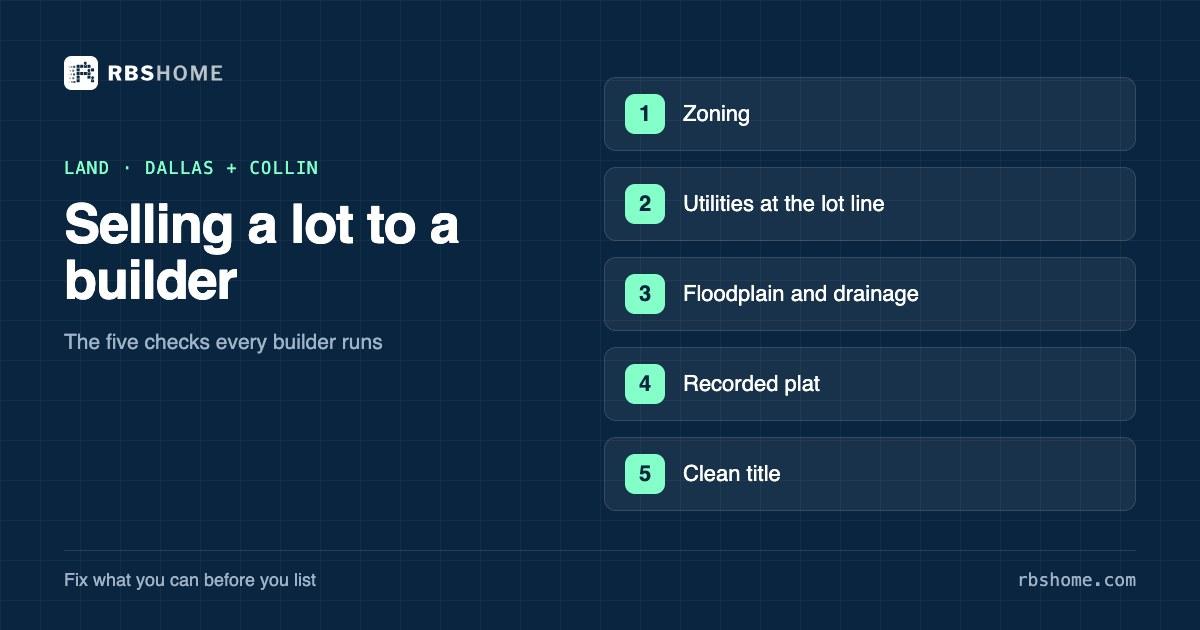
A builder will not buy a lot until they know they can build the house they plan and sell it at a profit. Expect them to check:
- Zoning. Does the zoning allow a single-family house of the size they want? What are the setbacks, height limits and lot coverage rules? See our Dallas infill zoning and setbacks guide.
- Utilities. Are water and sewer at the lot line? If a line has to be extended, who pays? See water, sewer, MUDs and CCNs.
- Floodplain and drainage. Is any part of the lot in a FEMA flood zone, or does water cross it? See floodplain and drainage checks.
- Plat status. Is the lot part of a recorded plat with a lot and block? An unplatted tract may need platting before a permit. See platting and replatting a lot.
- Title. Who owns it, and are there liens, unpaid taxes, missing heirs or easements?
Each problem does not kill a sale. It lowers the price, because the builder has to pay to fix it and wait while it is fixed.
Documents to gather
Having these ready makes you look like a serious seller and shortens due diligence:
- Your deed and any earlier deeds, so title is easy to trace.
- The plat, or the recording information for it.
- A survey, if you have one, even an old one.
- The latest tax statement from the county tax office, and proof that taxes are paid.
- HOA documents or deed restrictions, if any.
- Any utility letters, permits or reports from earlier plans for the lot.
If you inherited the lot, a buyer will also need proof of who the heirs are. See who inherits when there is no will.
How builders price a lot
Builders usually work backward. They estimate what the finished house will sell for, subtract build costs, financing, selling costs and their margin, and what is left is what they can pay for the land. That is why two builders can offer very different prices for the same lot.
As a seller, compare your lot with similar lots. Our guide to what a lot is worth explains pricing per square foot, per front foot and per acre, and why the appraisal district's land value is only a starting point.
A clean lot is worth more than a cheap fix
If a small problem can be solved cheaply, such as clearing brush or finding an old survey, solving it before you list can raise offers more than it costs.
Contracts, due diligence and notices
The contract. When Texas real estate license holders handle a sale of unimproved land for one-to-four family homes, they use the TREC Unimproved Property Contract. As of November 2026 that is TREC No. 9-18, effective July 1, 2026. TREC describes it as for property with no buildings, generally platted land with a recorded lot and block. Builders and private sellers sometimes use their own forms, so read every page.
Due diligence. Builders commonly ask for a period to inspect and back out. Ask for earnest money, a fixed end date, and copies of any surveys or reports they order. Our glossary explains the option period and earnest money.
Texas notices for land. The Property Code section 5.008 seller's disclosure covers residential property with a dwelling, so it usually does not apply to a bare lot. Other notices in chapter 5 can apply:
- Section 5.010 requires a bold notice in a contract for vacant land about possible additional taxes if the land is appraised under a special method, such as agricultural use.
- Section 5.011 requires a notice about possible annexation when the property may be outside city limits.
- Section 5.013 requires a seller of unimproved land to be used for homes to disclose the location of transportation pipelines, to the best of the seller's knowledge.
See our full guide to Texas seller's disclosure rules for the exemptions and deadlines.
Steps to sell
- Gather the lot's documents. Find the deed, the plat, any survey, the tax statement and any HOA or deed restrictions.
- Check the five things builders check. Look up zoning, utilities, floodplain, plat status and title before you talk price.
- Set a realistic price range. Use land comparisons per square foot, per front foot or per acre, not the appraisal district value alone.
- Reach the right builders. Contact builders who are already building in your ZIP code, or a land buyer who works with them.
- Negotiate the contract terms. Agree on price, earnest money, the due diligence period, who pays for the survey and title policy, and the closing date.
RBSHome buys lots and land in Dallas County and Collin County, including Frisco, Allen and Dallas, and works with local builders. If you would rather skip the builder search and due diligence, we can make a written offer and close at a title company on your date.
This article is general information, not legal advice. Talk to a Texas real estate attorney before you sign a land contract.
Written offer on your lot, usually within 24 hours.
Sources
- Texas Real Estate Commission, Unimproved Property Contract (TREC No. 9-18, effective July 1, 2026): trec.texas.gov
- Texas Property Code chapter 5 (sections 5.008, 5.010, 5.011, 5.013): statutes.capitol.texas.gov