TL;DR
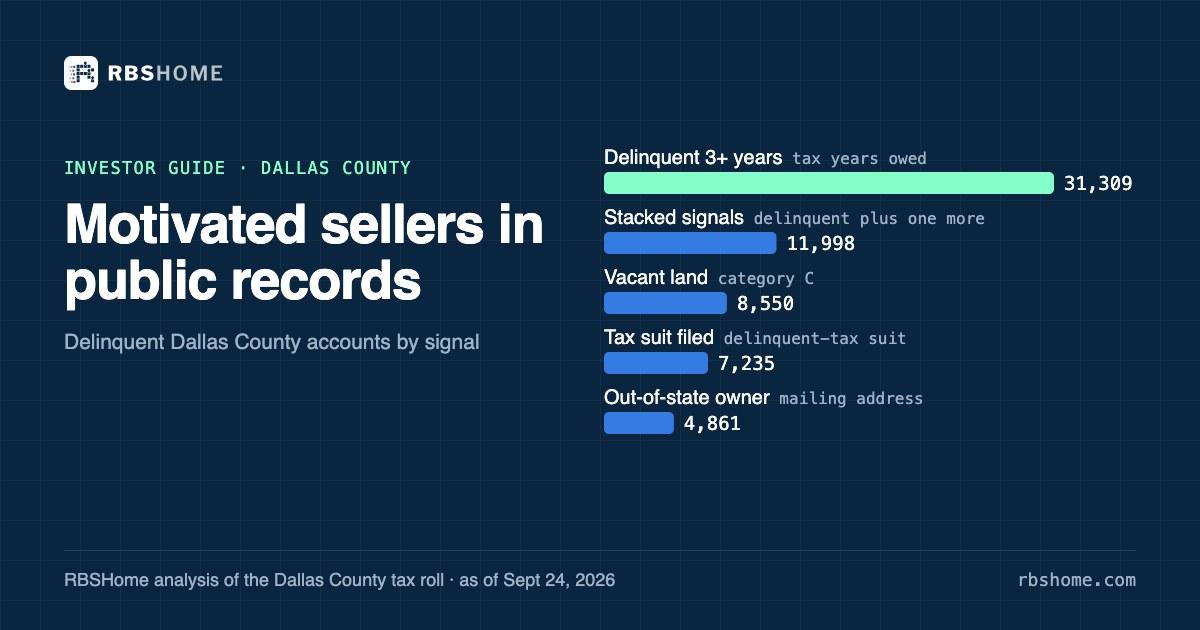
Motivated sellers leave traces in public records: years of unpaid property taxes, tax lawsuits, notices of trustee sale, probate filings, open code cases, out-of-state mailing addresses and vacant land. In Dallas County, the tax office's free TRW file is the backbone, and as of September 24, 2026 it showed 31,309 accounts delinquent 3 or more years. Leads that stack two or more signals are the most useful. How you contact owners matters as much as how you find them: follow federal calling and texting rules and treat people in hardship with respect.
In this article
- 1. What public records can and can't tell you
- 2. County tax rolls and the Dallas TRW file
- 3. Notices of trustee sale
- 4. Probate and inherited property
- 5. Code enforcement cases
- 6. Out-of-state and absentee owners
- 7. Vacant land
- 8. Stacking signals
- 9. The law on calls and texts
- 10. Respectful outreach to owners in hardship
- 11. A weekly workflow
What public records can and can't tell you
A motivated seller is someone whose circumstances make a quick, certain sale worth more to them than the last dollar of price. Public records can't tell you what someone wants. They can tell you when an owner's situation has the shape that often goes with motivation: a tax bill they haven't paid for years, a lender preparing to foreclose, a death in the family, a city citing the property, or a house owned from three states away.
Two limits are worth keeping in mind from the start. First, every signal has innocent explanations. An out-of-state owner may be a happy landlord. A delinquent account may be a billing dispute. Second, a record is a snapshot. Taxes get paid, foreclosures get cured, and code cases close. The value of public records comes from combining them and keeping them current, not from any single list.
This guide walks through the main sources for Dallas County and Collin County, shows what our data says about each as of the dates noted, then covers the part many guides skip: the rules on contacting owners, and how to do it decently.
County tax rolls and the Dallas TRW file
Property-tax delinquency is the most reliable distress signal in Texas because it's public, it's specific and it's updated often. Taxes become delinquent on February 1 if unpaid, and penalties and interest build from there.
Dallas County. The Dallas County Tax Office publishes its tax roll as the TRW file. According to the office's TRW FAQ, the file covers the entities the office collects for, including current-year accounts, unpaid prior-year balances and appraisal changes, and it's available "for no additional charge." A delinquent account is identified by a due date in the past. The FAQ also lists the limits: the file is too large for Excel, the office provides no technical support, there's no flag for accounts going to auction, and there's no legal description. You join it to the Dallas Central Appraisal District data files by account number to get property details.
Here's what the Dallas lead pool looked like in our snapshot of September 24, 2026:
| Dallas County roll, Sept 24, 2026 | Accounts |
|---|---|
| All roll accounts | 960,281 |
| Delinquent | 94,216 |
| Delinquent 3 or more tax years | 31,309 |
| Delinquent with a delinquent-tax suit | 7,235 |
| Delinquent vacant lots and land (category C) | 8,550 |
| Delinquent with an out-of-state mailing address | 4,861 |
| Delinquent with an open City of Dallas 311 code case | 346 |
| Delinquent with at least one more signal | 11,998 |
How to read it: roughly one account in ten was delinquent, but most of those are a single missed year that will be paid. The 31,309 accounts delinquent three or more years are where real trouble sits, and the 7,235 with a tax suit are the ones closest to a forced sale. For a more recent count, as of November 3, 2026 Dallas County had 90,298 delinquent accounts, 7,040 of them with a suit, 10,605 homesteads and 5,017 with an over-65 exemption.
That last number deserves care. Owners 65 and older, disabled owners and qualifying disabled veterans can defer taxes on a homestead under Tax Code §33.06. A delinquent account on a senior's homestead may be a deferral, not distress, and it's a household where pressure is especially inappropriate.
Collin County. As of November 3, 2026, Collin County had 20,345 delinquent accounts, 1,026 with a suit and 2,234 homesteads. Collin's delinquency is far lower relative to its size than Dallas's, so Collin investors usually need to combine tax data with other signals to build a useful list. Our tax delinquency report breaks both counties down by ZIP.
Notices of trustee sale
Most Texas home loans are secured by a deed of trust that allows non-judicial foreclosure. Under Property Code §51.002, those sales happen on the first Tuesday of the month, after at least 21 days' notice. The notice of trustee sale is filed with the county clerk and is public.
In Dallas County, the clerk's foreclosure notices page explains that sales take place on the north side of the George Allen Courts Building, and that notices filed on or after February 24, 2026 can be searched on the clerk's public search site by choosing "Foreclosure."
The notices we captured for Dallas County sales were:
| Dallas County trustee sale date | Notices captured |
|---|---|
| September 1, 2026 | At least 795 |
| October 6, 2026 | At least 490 |
| November 3, 2026 | At least 282 |
| December 1, 2026 | At least 248, as of Nov 7 |
These are minimums because the source caps results per search. Across the September to December sales, the ZIPs with the most notices were 75115 DeSoto with 75, 75104 Cedar Hill with 46, and 75216 South Oak Cliff with 41. We cover the monthly picture in our post on Dallas County foreclosure postings.
A few things to know about foreclosure leads. Many notices are filed and then withdrawn because the owner catches up, modifies the loan or sells. The window between notice and sale is short, at least 21 days, so owners are under real time pressure and often hearing from many people at once. And the most helpful thing you can tell an owner may be that they have options other than selling to you, which we explain in our guide to avoiding foreclosure in Dallas County.
RBSHome doesn't capture Collin County foreclosure postings yet, so we don't give Collin counts here.
Probate and inherited property
When an owner dies, the property often passes to heirs who don't want it, live elsewhere, or can't agree. That's one of the most common reasons good houses sell as-is.
Probate cases are filed in each county's probate courts and are public court records. Dallas County has dedicated probate courts, and Collin County handles probate through its own courts. A probate filing tells you who died, which property may be involved and who the executor or administrator is.
Not every inherited property goes through probate. Families also use affidavits of heirship and other procedures, and some houses sit in a deceased owner's name for years. Clues in the appraisal and tax records include an owner name with "estate of," a mailing address that changed to a relative's, a homestead exemption that dropped off, and taxes that went unpaid after years of on-time payment.
Approach estates gently. The person you reach may be grieving, may not have legal authority to sell yet, and may be one of several heirs. Our post on selling inherited property in South Dallas explains what heirs face before they can sell, and it's worth understanding before you contact one.
Code enforcement cases
Cities cite properties for things like high weeds, junk, unsafe structures and open vacancy. A property with repeated or serious code cases often has an owner who is overwhelmed, absent or out of money.
In our Dallas data, 346 delinquent accounts also had an open City of Dallas 311 code case as of September 24, 2026. That's a small number, but these properties often show the most distress. A code case combined with delinquent taxes can also mean city liens for mowing, cleanup or demolition, which affect what an owner can net from a sale.
Code data is city by city. Dallas, Plano, McKinney, Frisco, Garland and the other cities in both counties each run their own code programs and publish data differently, if at all. Check the city where the property sits.
Out-of-state and absentee owners
The appraisal district records the owner's mailing address. When it differs from the property address, the owner is absent. When it's in another state, the owner is a long way from the property's problems.
In our Dallas snapshot, 4,861 delinquent accounts had an out-of-state mailing address. Common stories behind these: an inherited house, a former home kept as a rental that stopped working, or land bought decades ago and forgotten. Distance makes repairs, tenant problems and code citations harder to deal with, which is why absentee ownership combines well with other signals.
On its own, absentee ownership is a weak signal. Plenty of investors own rentals from out of state with no intention of selling. Use it as a multiplier, not a list.
Vacant land
Vacant lots and acreage are a distinct category. Owners often hold land for decades, pay little attention to it, and fall behind on taxes without much consequence until a suit arrives.
In our Dallas snapshot, 8,550 delinquent accounts were vacant lots or land (appraisal category C). The demand side is strong in some areas: Collin County recorded 12,002 builder purchases in the year to November 7, 2026, and in parts of South Dallas, where 75216 recorded 77 builder purchases from 48 different builders. A delinquent lot in a ZIP where builders are active is a much better lead than one in a ZIP where nobody is building.
When you evaluate a vacant lot, check road frontage, flood zones, utilities and whether the lot is buildable under current zoning, before you ever contact the owner.
Stacking signals
A single signal produces long lists with low response. Two or three signals together produce short lists of owners who are more likely to need a solution.
In our September 24, 2026 snapshot, 11,998 delinquent Dallas accounts had at least one more signal beyond delinquency: a tax suit, an out-of-state owner, an open code case or a foreclosure notice. That's about one in eight delinquent accounts.
Common stacks that work:
- Delinquent 3+ years and a tax suit. The owner is behind and the taxing units have started the path to a sale.
- Delinquent and out of state. An absent owner who has stopped paying.
- Delinquent and a code case. The property itself is in trouble, not just the bill.
- Vacant land, delinquent, in a ZIP with active builders. A forgotten asset with a real buyer market.
- Foreclosure notice plus delinquent taxes. A lender and the taxing units are both owed.
Stacking also helps you prioritize ethically. An owner with several signals is more likely to benefit from a fast, certain sale. An owner with one weak signal is more likely to find your outreach unwelcome.
Our Dallas County distressed property leads apply this kind of stacking, and ZIP-level counts are on every ZIP page. In the November 7, 2026 data, the Dallas ZIPs with the most distressed properties tracked were 75216 with 2,106, 75217 with 1,578 and 75241 with 1,123.
The law on calls and texts
Finding an owner is legal. How you contact them is regulated, and the penalties for getting it wrong can be large. This section is a summary of federal rules, not legal advice. Have an attorney review any calling or texting program before you start.
Texts count as calls. The FCC's telemarketing rules at 47 CFR §64.1200 apply their Do Not Call and calling-hour protections to telephone solicitations and telemarketing texts to wireless numbers.
Consent for automated marketing. Under §64.1200(a)(2), a telemarketing call made with an automatic telephone dialing system or an artificial or prerecorded voice to a cell phone requires the called party's prior express written consent, with narrow exceptions. Prerecorded telemarketing calls to residential lines also need prior express written consent. A number you found through skip tracing doesn't come with consent.
Calling hours. No telephone solicitation to a residential subscriber before 8 a.m. or after 9 p.m., local time where the person is.
The National Do Not Call Registry. You can't make telephone solicitations to residential numbers on the registry unless an exception applies. The FTC's guide to the Telemarketing Sales Rule says sellers and telemarketers must sync their lists with the registry every 31 days and pay for access by area code, with the first five area codes free.
Your own do-not-call list. Anyone making telemarketing calls must keep a written do-not-call policy, train staff on it, and keep a list of people who asked not to be called. Under the FCC rule, a do-not-call request must be honored for 5 years.
Opt-outs by text. FCC rules say a reply such as "stop," "quit," "end," "revoke," "opt out," "cancel" or "unsubscribe" revokes consent, and other wording must be treated as a revocation if a reasonable person would understand it that way.
Caller ID. The Telemarketing Sales Rule requires transmitting caller ID information.
Texas has its own telemarketing and solicitation laws on top of the federal rules. Ask your attorney how they apply to your program.
Mail is the low-risk channel
Direct mail to the owner's mailing address of record isn't subject to the telephone rules above. For owners you haven't spoken with before, a clear, honest letter is often both the safest and the most respectful first contact.
Respectful outreach to owners in hardship
The people behind these records are often having one of the worst years of their lives. How you treat them is a matter of decency, and over time it's also what a reputation is built on.
Say who you are and what you want. Name your company, say you buy property, and say why you're writing. Don't disguise a solicitation as an official notice, a government letter or a personal note from a neighbor.
Never use fear. Don't exaggerate foreclosure or tax-sale timelines, imply legal consequences you can't know, or suggest you're their only option.
Tell them about their options. An owner facing a tax sale may be able to pay, ask the tax office or the taxing units' attorneys what payment options exist, or, if 65 or older or disabled, defer taxes on a homestead. An owner facing foreclosure may be able to reinstate or modify the loan, or list with an agent if there's time and equity. A cash sale is the right answer for some people, not all.
Honor "no" the first time. Put them on your do-not-contact list and keep them there.
Be careful with seniors and estates. Over-65 homesteads and grieving families deserve extra patience. Speak with the person who has legal authority, and encourage them to involve family, an attorney or a trusted adviser.
Put offers in writing. A written, itemized offer gives the owner something they can show others and compare. A closing at a title company protects both sides.
A weekly workflow
- Refresh the data. The Dallas TRW file is rebuilt weekly. Foreclosure notices are filed throughout the month for the next first-Tuesday sale.
- Rebuild your stacks. Re-run your filters so paid accounts and cured foreclosures drop off.
- Screen the property. Check flood zones, frontage, condition from the street and recent builder or investor activity in the ZIP.
- Screen the contact plan. Mail first. For calls or texts, check consent and Do Not Call status, and keep records.
- Track outcomes. Note who responded, who asked not to be contacted, and who sold to someone else.
Doing all of this by hand takes a lot of time. Our plans include Dallas and Collin delinquency data with these signals already joined, and our AI connector can filter leads and pull owner portfolios in plain language. Neither returns phone numbers or email addresses, and neither contacts anyone for you.
This article is general information, not legal or tax advice. For your situation, talk to a Texas attorney, CPA or your title company.
Stacked Dallas and Collin County leads