TL;DR
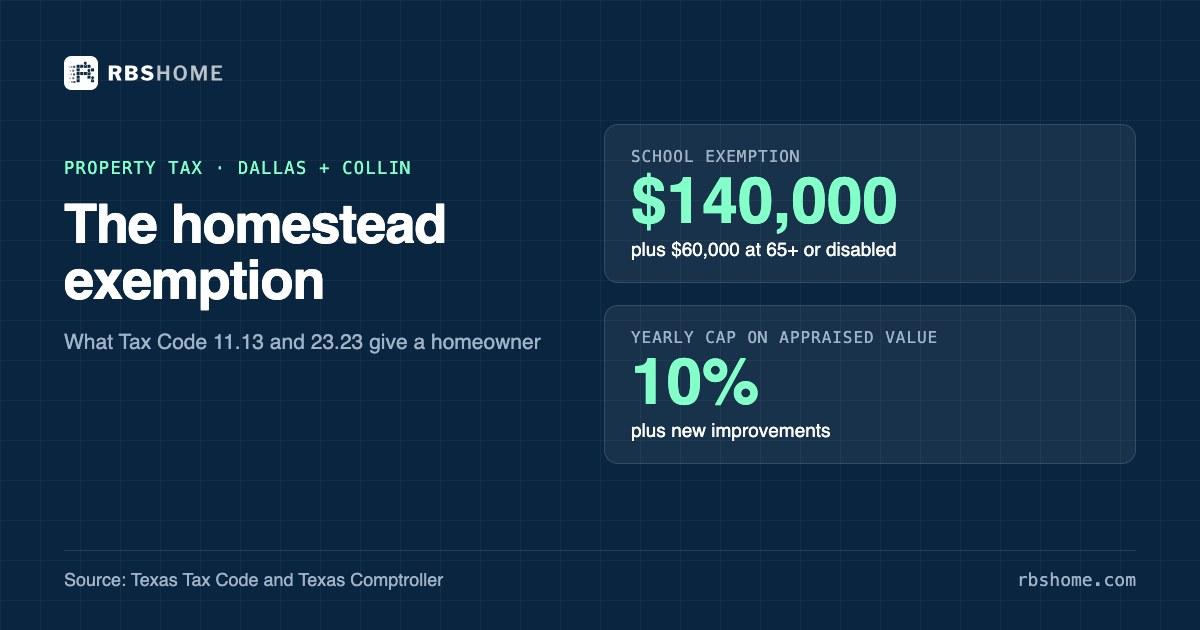
If you own and live in your home in Dallas or Collin County, the Texas residence homestead exemption cuts your school taxes by taking $140,000 off the appraised value, plus $60,000 more if you are 65 or older or disabled. It also caps how fast your taxable value can rise. Apply once with your appraisal district, ideally before May 1. A missed year can usually be filed late.
What the exemption is worth
A residence homestead exemption removes part of your home's appraised value before taxes are figured. The main pieces come from Tax Code section 11.13, and the Texas Comptroller's exemptions page lists the same figures:
- School districts: $140,000 of appraised value is exempt from school taxes (section 11.13(b)).
- Local option: a city, county or other taxing unit may adopt an exemption of up to 20 percent of appraised value (section 11.13(n)). The Comptroller notes the minimum is $5,000 where it is offered.
School taxes are often the largest line on a Dallas or Collin County tax bill, so the school exemption matters most. Your appraisal notice and tax bill show each taxing unit and the exemptions it applied.
Extra help at 65 or disabled
If you are 65 or older or disabled, you get more:
- An extra $60,000 school exemption under section 11.13(c), on top of the $140,000.
- Local-option exemptions that a taxing unit may adopt under section 11.13(d).
- A school tax ceiling under section 11.26. A school district may not increase the total school tax on the home of a person who is 65 or older or disabled above the ceiling. Our glossary entry on the over-65 tax ceiling has the short version.
If you are 65 or older or disabled and behind on taxes, read our guide to the Texas tax deferral and payment plans.
The 10 percent cap
Tax Code section 23.23 limits how much the appraised value of a homestead can rise each year. The appraised value can go up by no more than 10 percent of last year's appraised value, plus the value of new improvements, even if the market value rose faster.
The cap starts on January 1 of the tax year after the first year you qualify for the exemption. It ends when neither you nor your spouse or surviving spouse qualifies. That is why a new buyer's taxes can jump in the first years after a purchase: the cap resets.
Who qualifies
You qualify if you own the home and live in it as your principal residence. The application under section 11.43 asks you to list each owner and their share, and to state that you do not claim a homestead exemption on another home in Texas or a residence homestead exemption outside Texas.
The application asks for your driver's license or state ID number. Section 11.43 generally requires the address on your license to match the home, with limited waivers, for example for active-duty military. Update your license first.
If you own only part of the home, section 11.41 multiplies the exemption by your ownership share.
Deadlines and late filing
- General deadline: before May 1 for exemptions based on your status on January 1 (section 11.43(d)).
- Buying during the year: section 11.42(f) lets a buyer who acquires the home after January 1 get the general homestead exemption for the rest of that year, if the prior owner did not get the same exemption for that year. The 65-or-older and disabled exemptions follow their own rules.
- Late filing: under section 11.431, the appraisal district must accept and decide a late homestead application filed up to two years after the delinquency date for those taxes. If the appraisal records were already approved, the chief appraiser notifies the tax collector so the bill can be corrected.
You usually apply once. The exemption continues until you no longer qualify, though the appraisal district can ask you to confirm. Section 11.43(g) says that when you stop qualifying, for example because you moved out and rented the house, you must notify the appraisal office in writing before May 1. Keeping an exemption you no longer qualify for can lead to back taxes later.
How to apply
- Check that you qualify. You must own the home and live in it as your principal residence, and not claim a homestead anywhere else.
- Update your driver's license address. Make sure your Texas driver's license or state ID shows the home's address.
- Fill out Form 50-114. Complete the Texas Comptroller's Application for Residence Homestead Exemption, or the appraisal district's online version.
- File with your appraisal district. File with the Dallas Central Appraisal District or the Collin Central Appraisal District before May 1.
- Check your notice of appraised value. Confirm the exemption shows on your next notice and tax bill, and follow up if it does not.
You can file directly with the appraisal district. You do not need a paid service to apply.
When you sell or inherit
When you sell, the buyer applies for their own exemption. Taxes for the year are usually split between seller and buyer at closing based on the days each owned the home.
When a homeowner dies, the exemption does not automatically pass to the heirs. An heir who lives in the house may be able to qualify. Our guides on who inherits when there is no will and Texas transfer on death deeds explain how ownership passes. If you think your value is too high, see our guide to protesting your appraisal.
RBSHome buys homes and land as-is in Dallas County and Collin County, including Allen, Carrollton and Irving. Our homestead exemption glossary entry has a short definition you can share.
This article is general information, not legal or tax advice. Exemption amounts and rules change with new laws. Confirm your situation with your appraisal district.
Written offer, usually within 24 hours. Taxes are prorated at closing.
Sources
- Texas Tax Code chapter 11 (sections 11.13, 11.26, 11.41, 11.42, 11.43, 11.431): statutes.capitol.texas.gov
- Texas Tax Code section 23.23, Limitation on appraised value of residence homestead: statutes.capitol.texas.gov
- Texas Comptroller of Public Accounts, Property Tax Exemptions (Form 50-114 and exemption amounts): comptroller.texas.gov
- Dallas Central Appraisal District: dallascad.org
- Collin Central Appraisal District: collincad.org