TL;DR
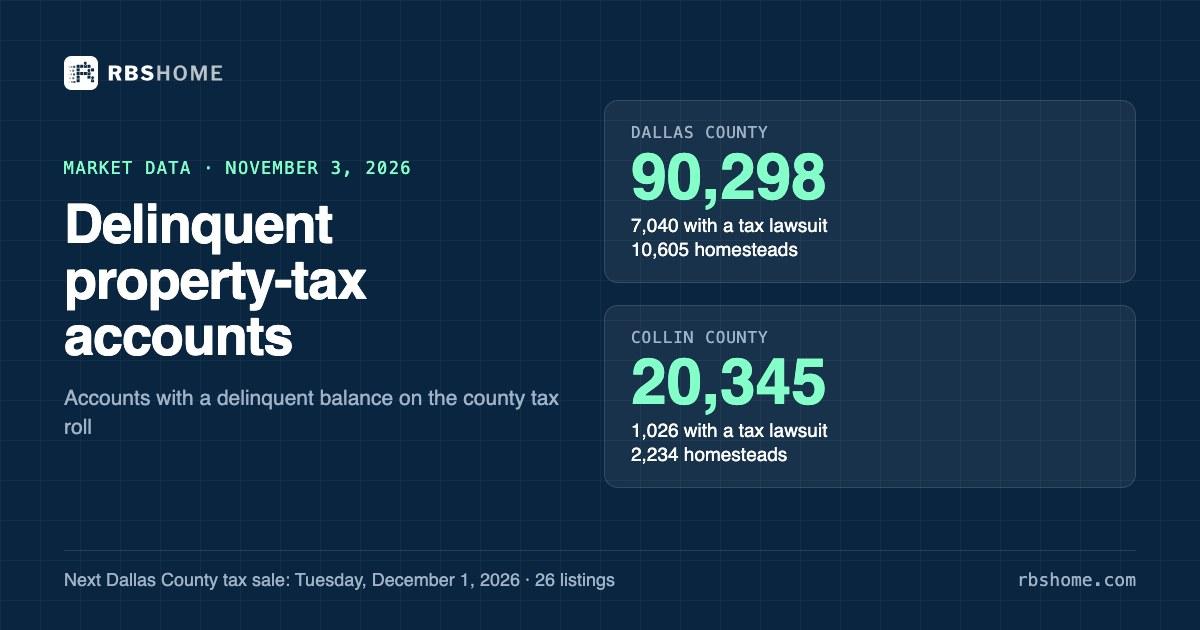
As of November 3, 2026, 90,298 Dallas County and 20,345 Collin County property-tax accounts carry a delinquent balance. Lawsuits have been filed on 7,040 of the Dallas accounts and 1,026 in Collin. Thousands of delinquent accounts are owner-occupied homesteads: 10,605 in Dallas County and 2,234 in Collin. Most delinquent owners have options well before a tax sale.
We load the full Dallas County and Collin County tax rolls every week and flag every account with a delinquent balance. This is the snapshot as of November 3, 2026.
The numbers
| Dallas County | Collin County | |
|---|---|---|
| Accounts with a delinquent balance | 90,298 | 20,345 |
| …with a delinquent-tax lawsuit on file | 7,040 | 1,026 |
| …that are residence homesteads | 10,605 | 2,234 |
| …with an over-65 exemption | 5,017 | not in roll data |
| Tax-sale listings scheduled for Dec 1, 2026 | 26 | 6 pending constable sales |
An "account" is one line on the county tax roll. That is usually one parcel, though business personal property and mineral interests have accounts too. A delinquent balance can be a few dollars or tens of thousands. In September we counted 94,216 delinquent Dallas County accounts, so today's count is about 3,900 lower.
Who is behind
- Most delinquent accounts are not homes people live in. In Dallas County, about 12% of delinquent accounts are residence homesteads. The rest include rentals, vacant lots, commercial property and business personal property.
- But thousands of families are behind on their own homes. 10,605 Dallas County and 2,234 Collin County homestead accounts are delinquent. 5,017 of the Dallas accounts have an over-65 exemption, which means they may qualify for a deferral (see below).
- Lawsuits are the step that matters. Fewer than 8% of delinquent Dallas accounts have a suit on file. A suit leads to a judgment, and a judgment leads to a tax sale.
The ZIP-by-ZIP picture of distressed properties, which combines tax delinquency with foreclosure and code signals, is on our Dallas County and Collin County market pages.
What happens next, in order
- February 1: unpaid taxes become delinquent. Penalty and interest start, and both grow every month.
- July 1: the taxing units can add an attorney collection fee of up to 20%, and a law firm starts collection.
- Lawsuit: the county, city and school district sue jointly to foreclose their tax lien.
- Judgment: the court sets the amount owed and orders the property sold.
- Tax sale: the constable or sheriff auctions it on the first Tuesday of a month. The next Dallas County sale is December 1, 2026.
- Redemption: after the sale, the former owner can buy it back. The window is 2 years for a homestead or agricultural land and 180 days for other property, and it costs the purchase price plus a premium.
If you're behind on property taxes
You have more options before a lawsuit than after one, and more before a judgment than after.
- Ask for a payment agreement. Texas tax offices can set up installment agreements on delinquent taxes. Ask before the July 1 collection fee is added.
- If you're 65+, disabled, or a qualifying disabled veteran, ask about a deferral on your homestead (Tax Code §33.06). A deferral stops a tax sale while it's in place. Interest keeps accruing, so it's not free, but you keep the house.
- Check your exemptions. Homestead and over-65 exemptions lower the bill going forward and sometimes can be applied to past years.
- If the numbers don't work, sell before the sale. A sale pays the delinquent taxes at closing from the proceeds, and you keep the remaining equity. At a tax sale the house can sell for the minimum bid, and getting the excess proceeds back takes a separate claim. That is why we wrote this guide to selling a tax-delinquent house.
Where the numbers come from
Dallas County and Collin County tax-roll files loaded into RBSHome's database, as of November 3, 2026. Counts are distinct accounts with a delinquent balance that are still on the latest roll. Tax-sale counts are from the counties' published sale listings. This post is general information, not legal or tax advice. For your account, call your county tax office or a Texas attorney.
We buy houses and land in Dallas and Collin counties with back taxes owed. The taxes are paid from the sale at closing.
Dallas and Collin County. Back taxes paid at closing.