TL;DR
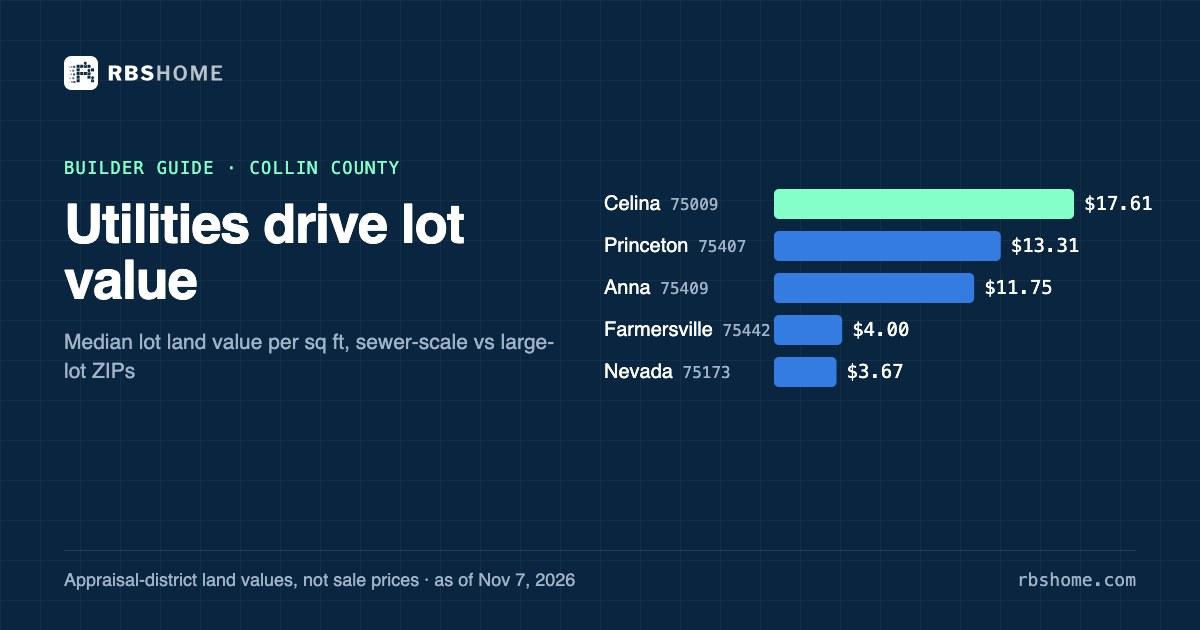
Before you price a lot in Dallas or Collin County, confirm who will provide water and sewer, at what cost, and on what timeline: retail providers generally need a CCN from the Public Utility Commission, which you can look up in the PUC's CCN Viewer. MUDs pay for infrastructure with district taxes, and septic lots in new single-family subdivisions need at least half an acre with public water or one acre with a private well. As of November 7, 2026, sewer-scale lots in Celina carried a median land value of $17.61 per square foot, against $4.00 in large-lot Farmersville.
In this article
- 1. The four utility questions for any lot
- 2. Water and sewer CCNs: who has the right to serve
- 3. How to look up a CCN, and what to do if your lot isn't in one
- 4. Getting land out of a CCN
- 5. MUDs: how districts pay for infrastructure
- 6. Septic systems and TCEQ lot-size rules
- 7. City, ETJ or county: why jurisdiction changes the utility answer
- 8. Why utilities show up in Collin County lot values
- 9. A utility due-diligence checklist
In most of Dallas County, infill lots are inside cities with established water and sewer systems, and the utility question is mostly about tap fees and line capacity. In Collin County's growth corridor, it's often the question that decides whether a lot is worth buying. The same acre can be worth very different amounts depending on whether it can get sewer service, from whom, and how soon.
This guide covers the four layers of utility due diligence for North Texas lots: CCNs, municipal utility districts, septic rules and city jurisdiction. It cites the statutes and the state agencies that run each one. Then it shows how the utility picture lines up with lot values in our Collin County data.
The four utility questions for any lot
Before anything else, answer these four questions. Every section below helps with one of them.
- Who has the right to serve the lot with water, and with sewer? It may be a city, a private utility, a water supply corporation or a district. Water and sewer may come from different providers.
- Is there capacity and a line close enough to reach? A service area on a map isn't a pipe in the ground.
- What will it cost? Tap fees, impact fees, line extensions, and any district taxes or assessments the future homeowner will carry.
- If there's no sewer, can the lot support a septic system? Lot size, soil and the local permitting authority decide that.
Water and sewer CCNs: who has the right to serve
A certificate of convenience and necessity, or CCN, is the state's grant of a retail water or sewer service area. Water Code §13.242 says that, unless otherwise specified, a utility, an affected county's utility, or a water supply or sewer service corporation can't provide retail water or sewer service to the public without first getting a certificate from the Public Utility Commission. The PUC can let some providers operate without one, such as cities that have given the required notice or small systems with fewer than 15 potential connections outside anyone else's service area.
Two other rules in Chapter 13 matter to builders:
- The holder must serve. Under §13.250, a retail utility that holds or must hold a CCN has to serve every consumer within its certificated area and provide continuous and adequate service.
- You can't build your own system inside someone else's area. Under §13.242(b), a person who isn't a retail public utility can't build facilities to serve more than one connection off their own property inside another utility's certificated area without that utility's written consent.
So the CCN map tells you who you'll be negotiating with. If your lot sits in a water supply corporation's area, you'll deal with that corporation's service rules, extension policies and fees, even if a city line runs across the street.
How to look up a CCN, and what to do if your lot isn't in one
The PUC runs a Water and Sewer CCN Viewer. Its Find Your Water or Wastewater Utility page explains how to use it. Enter the address in the search bar, click the number that appears near the address on the map, and the tool shows the utility's name.
The same page says that if an address returns no result, it isn't in a CCN. That can mean a city-owned utility or another political subdivision serves it, or that there's no retail water or wastewater service at all. In that case, the PUC points users to the Texas Water Development Board's Water Service Boundary Viewer.
A few practical notes:
- Look up water and sewer separately. The viewer has both layers. If a parcel shows a water CCN but no sewer CCN, ask whether a city or district provides sewer. If no one does, the lot will need a septic system.
- Map lines are approximate at the parcel level. If your lot sits near a boundary, ask the utility directly whether it considers the lot inside its area, and get the answer in writing.
- A CCN doesn't guarantee capacity. Ask the provider for a written statement that it can serve the number of connections you plan, and what extension you'll have to pay for.
Getting land out of a CCN
Sometimes the certificate holder can't serve a project at the needed scale, or a city or another provider can serve it more cheaply. Chapter 13 has two landowner tools for moving land out of a CCN.
Expedited release under §13.254(a-1). The owner of a tract of at least 50 acres that isn't in a platted subdivision actually receiving service can petition the PUC for expedited release. First, the owner must send the certificate holder a written request for service describing the area, timing, level of service, flow and pressure needs, and other details. The holder must then get at least 90 days to respond.
Streamlined expedited release under §13.2541. The owner of a tract of at least 25 acres that isn't receiving water or sewer service can petition for release if the land is in a qualifying county. The list includes counties with at least 1.2 million people and counties adjacent to one. The PUC must grant the petition within 60 days. It may require the landowner to compensate the certificate holder, with the amount set by an independent appraiser.
These are tools for developers with acreage, not for single lots. They also take time and money. If you're buying a tract to subdivide, ask a utility attorney early whether release is realistic.
MUDs: how districts pay for infrastructure
A municipal utility district is a political subdivision that can build water, sewer and drainage systems and repay the cost with bonds backed by district taxes. MUDs are created under Water Code Chapter 54 and Article XVI, Section 59 of the Texas Constitution, and they're overseen by the Texas Commission on Environmental Quality.
What builders should know:
- City consent comes first. Under §54.016, land inside a city or its ETJ can't be included in a district without the city's written consent. For land in the ETJ only, there's a fallback: if the city refuses or doesn't act within 90 days of a written request, the landowners or voters can petition the city to provide the water or sewer service instead, and if no contract is signed within 120 days of that petition, the failure counts as authorization to include the land in a district. Land inside city limits has no such fallback.
- TCEQ weighs the alternatives. When the TCEQ decides whether to create a district under §54.021, it considers whether comparable service is available from other systems, whether projected construction costs, tax rates and water and sewer rates are reasonable, and the project's effect on things like groundwater and drainage.
- Buyers get a notice. Water Code §49.452 requires a person selling property in a covered district to give the purchaser a written notice. Exceptions include foreclosure transfers, transfers by will or probate, and transfers to a government entity. If you build and sell homes in a MUD, that obligation is yours.
To check whether a lot is in a district, use the TCEQ's Water Districts resources. The Water District Database lists districts with their contact information, office addresses and counties, and the Water Districts Map helps you find a district and its board. If the map leaves you unsure, the title commitment and the seller's tax statements will usually show a district levy.
A MUD isn't good or bad for a builder. It's how a lot of North Texas infrastructure gets built ahead of homes. But the district tax is part of a homeowner's monthly payment, and buyers compare it. Find out the current rate and any planned bond issues before you price the house.
Septic systems and TCEQ lot-size rules
Where there's no sewer, the lot needs an on-site sewage facility (OSSF), usually a septic system. The TCEQ sets the rules in 30 Texas Administrative Code Chapter 285, and local governments act as authorized agents that issue permits. The TCEQ's On-Site Sewage Facilities page has a county map for finding the authorized agent. In Collin County, the county's Development Services FAQ says owners outside city limits apply for OSSF permits through the county's online portal.
The lot-size rule is in 30 TAC §285.4:
| Situation | Minimum lot size for individual septic systems |
|---|---|
| Single-family subdivision served by a public water supply | At least 1/2 acre (21,780 sq ft) |
| Single-family subdivision not served by a public water supply (private wells) | At least 1 acre (43,560 sq ft) |
| Existing small lots subdivided before January 1, 1988 | May use septic, but the system must meet Chapter 285 |
The minimums apply to single-family subdivisions platted or created after the rule took effect. The rule also requires planning materials, prepared by a professional engineer or professional sanitarian, for certain developments before anyone files a permit application. The permitting authority has 45 days to approve or deny them in writing.
Two practical points. First, the minimum isn't a guarantee. Soil, slope, floodplain and setbacks from wells and property lines can rule out a system on a lot that meets the size rule. A site evaluation comes before the offer, not after. Second, the size rule shapes the whole subdivision. A septic subdivision can't go below half an acre per lot, while a sewered one can go as small as zoning allows. That difference shows up directly in land value, as the data below shows.
Collin County reviews septic plats
Collin County's Development Services FAQ says it reviews plats only where the lots will rely on septic systems rather than collective sewer. If your lots will use septic in unincorporated Collin County or the ETJ, expect that review on top of the city's or county's plat process.
City, ETJ or county: why jurisdiction changes the utility answer
Who regulates the land often decides who serves it.
Inside city limits, the city usually provides or controls water and sewer, and its plat rules require proper provision for utilities before approval. The City of Dallas platting guidelines, for example, say land must not be platted until proper provision has been made for water, wastewater and other public facilities.
In the ETJ, the city controls plats (or shares control with the county under a Chapter 242 agreement), but it may not provide service. The lot might be in a private utility's CCN or a MUD. Under Local Government Code §42.021, the ETJ reaches from half a mile to five miles beyond city limits depending on population.
ETJ release. Senate Bill 2038, effective September 1, 2023, added Subchapter D to Chapter 42. Under §42.102 and §42.104, the owners of a majority in value of an area, or more than 50 percent of its registered voters, can petition the city for release from the ETJ. The signatures must be gathered within 180 days. If the petition has enough signatures, the city must release the area. If it doesn't act by the later of 45 days or its next meeting after day 30, the area is released by operation of law (§42.105). Released land can't be put back into the ETJ or city limits unless the owners ask. Section 42.101 excludes some areas, such as land near military bases and areas under strategic partnership or certain development agreements.
For utilities, release cuts both ways. It can free land from city development rules, but it can also take the city off the table as a water or sewer provider, leaving the CCN holder, a district or septic. Ask an attorney before you rely on a release, or before you buy land on the assumption that one will happen.
Why utilities show up in Collin County lot values
Our ZIP data shows how closely lot values track utility-scale development. Here are five Collin County ZIPs, as of November 7, 2026.
Look at the lot sizes. In Celina, Princeton and Anna, the median lot is 6,000 to 7,200 square feet. In a new subdivision, lots that size need sewer under the TCEQ rule. In Farmersville and Nevada, the median lot is 22,128 and 23,873 square feet, just over half an acre, which is the TCEQ minimum for a septic lot in a subdivision with public water. Further out, in Blue Ridge (75424), the median lot is 51,140 square feet at $1.72 per square foot, a little over the one-acre private-well minimum. Our data doesn't record which lots have sewer, so we can't prove the link lot by lot. But the pattern is what you'd expect where lot sizes follow utility rules.
The per-square-foot gap is large. Celina's median is more than four times Farmersville's. The gap per lot is much smaller. As an illustration only, multiplying each ZIP's median rate by its median lot size gives about $127,000 in Celina, $81,000 in Princeton, $85,000 in Anna, $89,000 in Farmersville and $88,000 in Nevada. (That's a rough product of two medians, not a median lot value.) In other words, a half-acre septic lot carries about the same land value as a 6,000 square foot sewered lot, but it holds one house instead of three or four. Sewer service is what lets land be divided densely, and density is what drives land value per square foot.
Builder demand follows the same line. In the 12 months to November 7, 2026, builders recorded 2,932 purchases in Celina, 1,989 in Princeton and 868 in Anna, against 666 in Farmersville and 267 in Nevada. Princeton and Anna also led in new-construction permits since October 1. For a land seller or a developer, the practical point is simple. The value of an acre in eastern Collin depends heavily on whether it can be served by sewer, and on who controls that service. Our Collin County market page ranks all 31 ZIPs, and where builders are buying land covers the busiest ones.
A utility due-diligence checklist
Run this before you sign, or during your feasibility period.
- Look up water and sewer CCNs in the PUC viewer. Write down the provider for each. If there's no result, find out whether a city or district serves the area.
- Check for a district in the TCEQ Water Districts Map Viewer. If the lot is in a MUD, get the current tax rate, outstanding bonds and any planned issues.
- Request a will-serve letter from each provider for the number of connections you plan, with the location of the nearest adequate main.
- Price the connection. Get tap fees, impact fees and the cost of any line extension in writing. In some cases a developer's share of city infrastructure costs is capped by rough-proportionality rules. Ask the city.
- Confirm jurisdiction. Is the lot inside city limits, in an ETJ, or unincorporated? Has it been released from an ETJ, or is a release pending? This tells you who approves the plat and who's likely to serve it.
- If septic, check size and soil. Confirm the lot meets 30 TAC §285.4 for its water source, and get a site evaluation before you commit. Identify the authorized agent through the TCEQ map.
- Check drainage and floodplain at the same time. Floodplain can limit where a septic system or a house can go.
- Plan the buyer disclosures. If the finished home will be in a district, budget for the §49.452 notice at resale.
Utilities rarely make a lot great by themselves, but they often make a lot unworkable. A lot that passes all eight checks is a lot you can price with confidence. If you're tracking where builders are buying in Dallas and Collin County, RBSHome's builder tools show builder counts, land values and permits by ZIP. You can also query our data through the AI connector.
This article is general information, not legal or tax advice. For your situation, talk to a Texas attorney, CPA or your title company.
ZIP-level builder demand and land values, Dallas and Collin County.