TL;DR
For custom and spec builders operating in Highland Park (75205), Bluffview (75209), and Preston Hollow (75220), acquiring off-market land requires strict adherence to Dallas infill zoning regulations. This guide breaks down maximum lot coverage limits, R-7.5 vs. R-10 setback constraints, and the 12-point RBS Teardown Screening Checklist we use to source viable dirt.
For luxury infill builders operating within the most coveted ZIP codes of the Dallas-Fort Worth metroplex—specifically Highland Park (75205), Bluffview/Devonshire (75209), and Preston Hollow (75220)—the greatest barrier to scaling production is not capital or buyer demand. It is the acquisition of viable, zoning-compliant dirt.
As the broader North Texas market continues to expand outward into master-planned communities in Collin and Denton counties, the urban core remains heavily supply-constrained. Dallas posted the second-highest permit volume statewide recently, surpassing Houston in total residential construction value with over $639 million generated in a single month. With an average permit value resting at a premium $389,500, it is clear that Dallas infill development is heavily concentrated in the mid-to-upper luxury tiers.
However, acquiring a teardown lot is only the first step. Navigating the complex web of municipal zoning codes, tree ordinances, and setback restrictions dictates whether a project will yield a $3.5M finished exit or result in a stalled permit application. Here is a definitive builder's guide to Dallas infill zoning and off-market lot acquisition in 2026.
The Scarcity of the Dallas Infill Lot in 2026
To understand the intense competition for teardown lots in 75205 and 75220, we must look at regional construction behavior. Nationally, 6.9% of all new single-family homes built last year were teardowns, while an additional 20.1% were built on infill lots inside established neighborhoods.
However, in the West South Central region (which includes Texas), the infill share drops to an exceptionally low 9.7%. Because developers have the geographical freedom to build massive subdivisions in exurbs like Celina and Forney, genuine urban infill within the Dallas city limits is exceptionally scarce.
For high-net-worth buyers who refuse to commute from the exurbs and demand the prestige of Highland Park ISD or the sprawling private estates of Preston Hollow, builders must actively source mid-century ranch homes and bulldoze them.
Decoding Dallas Zoning: Maximum Lot Coverage and Height Restrictions
When underwriting a teardown acquisition, the physical condition of the existing house is entirely irrelevant. The true value lies in the dimensions of the lot and its assigned municipal zoning code, which dictates the maximum allowable footprint for your new build.
The two most common single-family residential zoning codes encountered in premier Dallas infill neighborhoods are R-7.5(A) and R-10(A).
Understanding R-7.5(A) Zoning
Typically found in denser infill pockets and transitional corridors, an R-7.5 designation means the lot must be a minimum of 7,500 square feet.
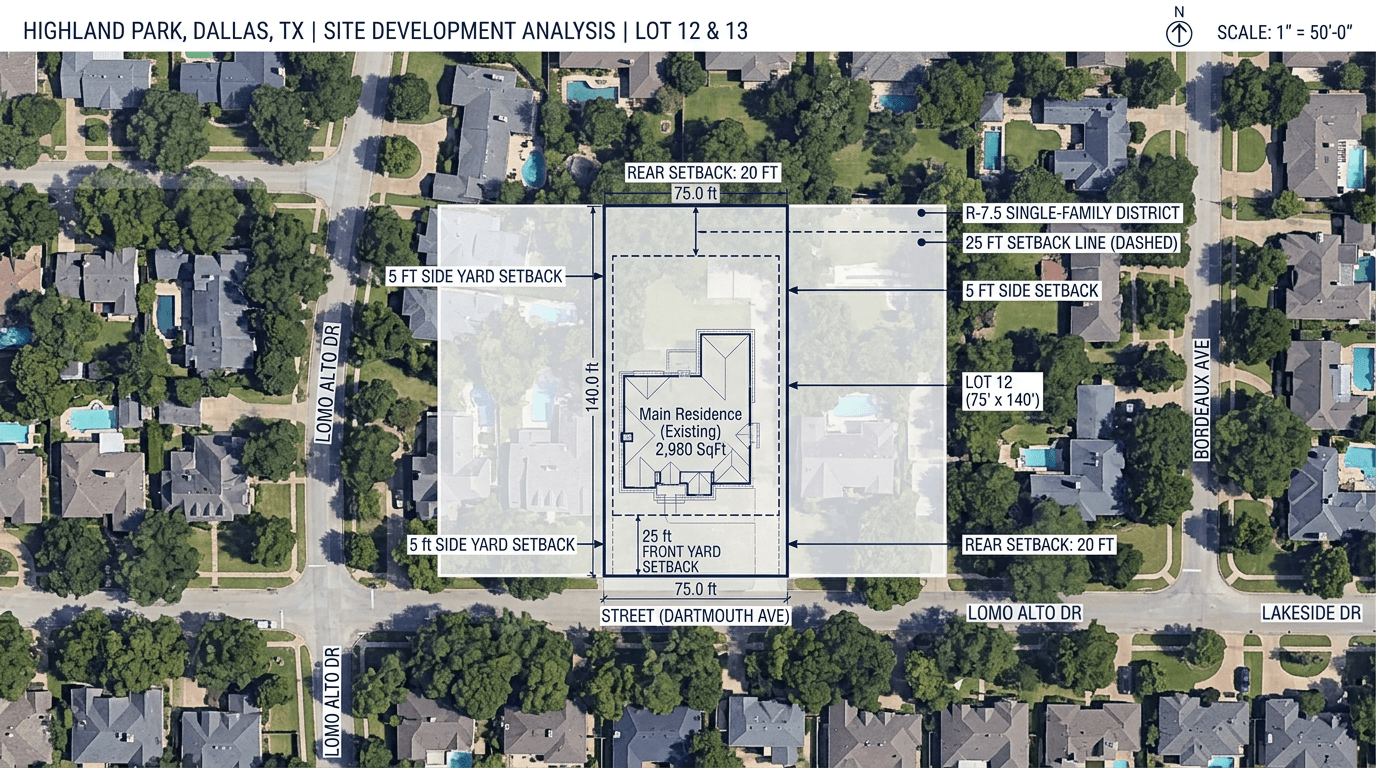
- Front Setbacks: Generally require a 25-foot minimum front yard setback.
- Side/Rear Setbacks: Side yards typically require a 5-foot setback, while rear yards demand a 5-foot to 15-foot setback depending on alleyway access and lot orientation.
- Lot Coverage: Dallas city code typically restricts maximum lot coverage to 45% for residential structures. This means on a standard 7,500 sq ft lot, the foundation footprint cannot exceed 3,375 square feet (including attached garages). To achieve the 4,500+ sq ft floor plans expected by retail buyers, builders must design vertical, two-story homes.
- Height Restrictions: The maximum structure height is generally capped at 30 feet.
Understanding R-10(A) Zoning
More common in the sprawling, estate-heavy corridors of Preston Hollow (75220), R-10 zoning mandates a minimum lot size of 10,000 square feet.
- Setback Variances: While front setbacks may still hover around 25 to 30 feet, the larger lot size provides significantly more architectural flexibility, allowing for sprawling single-story moderns or wide-set transitional designs.
- Lot Coverage Economics: A 45% lot coverage allowance on a 10,000 sq ft lot permits a massive 4,500 sq ft foundation footprint. This is highly desirable for builders targeting the empty-nester demographic who strongly prefer primary bedroom suites on the first floor.
Highland Park (75205) Town Ordinances
It is critical to note that Highland Park is its own independent municipality. Dallas City zoning codes do not apply here. The Town of Highland Park enforces strict, unique ordinances regarding maximum floor-area ratios, restrictive height envelopes, and heavily enforced permeable surface requirements. Underwriting a lot in 75205 requires consultation directly with HP town planners, not Dallas City Hall.
The Defensible Path to CO: Utility Taps and Tree Mitigation
A lot may look perfect on paper, but subsurface infrastructure and legacy landscaping can completely kill a developer's margin. A "defensible path to a Certificate of Occupancy (CO)" means ensuring no hidden municipal hurdles will stall the project.
Dallas Article X Tree Ordinance
One of the most expensive oversight errors an infill builder can make is ignoring the City of Dallas Article X Landscape and Tree Preservation regulations. Dallas aggressively protects its urban canopy, particularly in established neighborhoods like Bluffview and Lakewood.
- If a legacy Oak or Pecan tree sits squarely in the middle of your R-7.5 buildable footprint, you cannot simply cut it down.
- Removing protected, historic, or significant trees requires applying for a removal permit, which is rarely granted for simple convenience. If removal is approved, the builder is forced into extreme tree mitigation requirements—either planting multiple replacement trees on the lot (which consumes buildable space) or paying massive fees into the city's Reforestation Fund, which can cost tens of thousands of dollars.
Utility Taps and Topography
Older teardowns in 75209 and 75220 often utilize outdated, narrow utility lines. Builders must underwrite the cost of pulling new, upgraded water and sewer taps to the street. Furthermore, extreme topography changes or lots sitting in the 100-year floodplain can force a builder to import thousands of dollars of dirt fill and construct expensive retaining walls just to make the lot buildable.
Applying the RBS Teardown Screening Checklist
At RBS Home Buyers, we source off-market teardowns specifically for local builders. To ensure we only deliver highly profitable, green-light lots, our acquisitions team utilizes a strict 12-point filtering system before we ever present an assignment contract to our builder network.
We underwrite based on the finished exit band of the neighborhood—knowing that custom specs in these zip codes exit between $1.6M and $3.75M. Therefore, the land basis must support this premium without inherent flaws.
The Hard NOs: Disqualifying Adjacencies
Retail buyers paying upwards of $3 Million for a new custom home demand perfection. As a result, we aggressively blacklist lots with the following adjacency issues:
- Properties that back up to or corner on an arterial street, highway, or off-ramp.
- Lots situated directly across from heavy commercial buildings, high-traffic churches, or schools.
- Specific blacklisted Dallas arterials: We immediately pass on lots located directly on Walnut Hill, Royal Ln, Forest Ln, Midway, Inwood, Hillcrest, Marsh Ln, NW Highway, and Webb Chapel Rd. A $3.5M buyer will not tolerate the noise profile of a 4-lane arterial.
How to Source Off-Market Builder Lots with RBS
Relying on the MLS to find teardowns in 75205, 75209, or 75220 means paying retail prices for distressed assets and competing in bidding wars against inexperienced flippers.
The most successful luxury builders in DFW source their land off-market. By partnering with a professional acquisitions firm like RBS Home Buyers, you gain access to our direct-to-seller marketing pipelines. We handle the negotiations with legacy homeowners, inherited estates, and tired landlords, securing the purchase contracts at wholesale land value. We then assign or double-close the lot directly to you, fully screened for zoning and adjacency flaws.
Learn more about our builder partnership process here →
We source off-market infill dirt. Join our preferred builder list today.