TL;DR
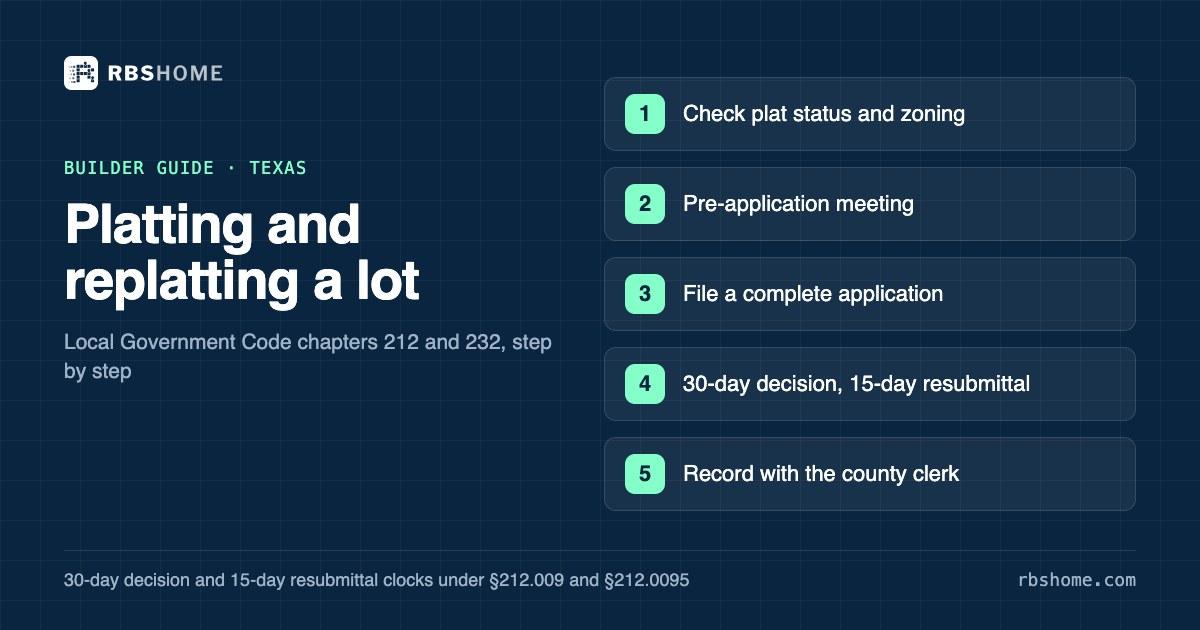
In Texas, dividing land into building lots generally requires a plat approved by the city, under Local Government Code Chapter 212 for land inside city limits or the ETJ, or by the county under Chapter 232 for unincorporated land. Since the 2019 shot-clock law, a city must act on a complete plat within 30 days, put any conditions or reasons for denial in writing with citations, and decide on your response within 15 days. If it misses a deadline, the plat is approved. Most real delays happen before filing or after approval: easements, right-of-way, utility releases and infrastructure acceptance.
In this article
- 1. When Texas law requires a plat
- 2. Who approves your plat: city, county or both
- 3. The 30-day shot clock and what changed in 2019
- 4. Replat, amending plat or minor plat
- 5. The City of Dallas process
- 6. A Collin County city: how McKinney does it
- 7. Unincorporated Collin County and Chapter 232
- 8. Pitfalls that cost builders months
- 9. Putting the clocks together
A plat turns a piece of land into lots the city will issue building permits on. For a builder buying infill lots or a small tract, the plat question decides whether you can start in weeks or in a year. It also decides whether a "lot" you're under contract on is really a lot.
This guide covers the Texas statutes that govern platting, the 2019 changes that put cities on a clock, the City of Dallas and City of McKinney processes, and the pitfalls we see most often. It isn't legal advice. Platting rules are local, they change, and the details of your site matter. Use this to ask better questions of your surveyor, engineer and the city's planning staff.
When Texas law requires a plat
Inside a city or its extraterritorial jurisdiction (ETJ), Local Government Code §212.004 requires an owner who divides a tract into two or more parts to lay out a subdivision, lots, or streets and other areas dedicated to public use to have a plat prepared. Two details trip people up.
- The method of division doesn't matter. A division counts whether it's made by a metes-and-bounds deed, a contract for deed, an executory contract or any other method. You can't avoid platting by selling a piece "by description."
- The five-acre exception is narrow. A division into parts larger than five acres, where each part has access and no public improvement is being dedicated, isn't a division under that subsection.
Cities can also define which divisions need a plat (§212.0045), and many require one simply to create a building site. The City of Dallas platting guidelines (December 2024) list when platting is required, including to create a building site, to subdivide, to combine lots, and when property will be developed in a way that doesn't match an existing plat. They add that a parcel conveyed by metes and bounds may not be recognized as a building site.
The guidelines also say a plat isn't the same as a "tax plat" created by a deed. A lot can still count as a building site if it has kept the same shape since September 11, 1929, or since before annexation. So can a parcel where building permits were issued before August 1, 1984. If you're buying an older Dallas lot that has never been platted, those exceptions are worth checking before you assume you need a replat.
Once approved, a plat must be acknowledged like a deed and filed with the county clerk (§212.004(c)–(d)).
Who approves your plat: city, county or both
Inside city limits, the plat authority is the city's planning commission, or the city council if there's no commission (§212.006). The council can require its own approval too. Cities can also delegate approval to staff (§212.0065), and if staff disapproves, you can appeal to the commission or council.
In the ETJ, the city's plat rules generally apply, but the county may also have a role. Chapter 242 requires a city and county to sign a written agreement saying which of them regulates plats and related permits in the city's ETJ. Under §242.001(b), a plat in the ETJ can't be filed with the county clerk without approval from the entity the agreement authorizes. In fast-growing Collin County, where much of the new building happens at the edges of cities, that agreement tells you where to file. Collin County's Development Services FAQ says that for property in a city's ETJ, the city is the platting authority, and for property outside any ETJ, the county engineering department is.
Outside cities and ETJs, Chapter 232 applies, and the commissioners court approves plats. More on that below.
One more change matters for ETJ land. Senate Bill 2038 (2023) added Subchapter D to Chapter 42, which lets landowners petition to release land from a city's ETJ (§42.102). If you're buying land that has been released, or that the seller plans to release, your platting authority may shift from the city to the county. Confirm the current status with the city and the county before you design anything.
The 30-day shot clock and what changed in 2019
House Bill 3167, effective September 1, 2019, rewrote the plat approval process for cities and counties. It was amended again in 2023. The current rules for cities:
- A complete application starts the clock. Each city must publish a complete written list of what a plat application needs (§212.0081). An application with everything on the list is complete, and a plat is considered filed when you submit it with the completed application and fees (§212.004(f)).
- 30 days to act. The plat authority must approve, approve with conditions, or disapprove within 30 days after filing. If it doesn't disapprove within that period, the plat is approved (§212.009). If the city council must also approve, it gets another 30 days after the commission acts.
- Extensions only at your request. The 30 days can be extended in 30-day increments only if you ask in writing and the city agrees, or if a takings impact assessment is required (§212.009(b-2)). A city can't request or require you to waive a deadline (§212.0097).
- Written reasons with citations. A conditional approval or disapproval must come with a written statement of each condition or reason. Each one must relate to the platting requirements, cite the statute or ordinance it rests on, and not be arbitrary (§212.0091).
- You respond on your schedule. The city can't set a deadline for your response (§212.0093). Once you respond, it has 15 days to decide, and it can deny only for a reason it already gave you. If your response addresses every item and the city doesn't act in time, the plat is approved (§212.0095).
- The burden is on the city in court. If you sue over a disapproval, the city must prove by clear and convincing evidence that the disapproval was lawful, and the court can't defer to the city (§212.0099).
- No extra studies. A city can't require an analysis, study or document as part of a plat application that state law doesn't explicitly allow (§212.004(g)).
The shot clock covers the decision, not the design
The 30 days start when the city receives a complete application. The weeks your surveyor and engineer spend preparing the plat, civil plans and utility coordination happen before that. Most cities also expect you to resolve staff comments before filing so the plat can be approved the first time.
Replat, amending plat or minor plat
Picking the right plat type is the single biggest factor in how long your project takes. Here's how the state categories line up with local practice.
Replat
A replat changes a recorded plat. Under §212.014, a replat can be recorded and controls over the earlier plat without vacating it, if it's signed by only the owners of the property being replatted, approved by the plat authority, and doesn't try to amend or remove covenants or restrictions.
Residential replats carry extra steps under §212.015. They apply where, during the preceding five years, the area was zoned for no more than two residential units per lot, or any lot in the original plat was deed restricted to two units or fewer. That covers most single-family infill.
- If the replat needs a variance or exception, the city must hold a public hearing. Notice goes out at least 15 days before, in the newspaper and by mail to owners of lots in the original subdivision within 200 feet. If owners of at least 20 percent of the adjoining area within 200 feet file a written protest, approval takes a three-fourths vote of members present.
- If no variance is needed, there's no hearing. Within 15 days after approval, the city must mail notice of the approval to owners in the original subdivision within 200 feet.
Splitting one lot into two, the most common infill replat, often fits the no-variance path if both new lots meet the zoning minimums. If either lot falls short on width, depth or area, plan for a hearing.
Amending plat
An amending plat under §212.016 is signed by the applicants only and needs no notice, hearing or approval from other lot owners. But it's limited to listed purposes. Those include correcting errors in courses, distances or descriptions, fixing clerical mistakes, moving a lot line to cure an encroachment, and relocating lot lines between adjacent lots when all those owners join and the number of lots doesn't increase. It also covers replatting lots fronting an existing street when all owners join, no lots are added, and no new street or extension of city facilities is needed. An amending plat can't remove recorded covenants or restrictions.
If you're combining two lots or shifting a line to make a better building pad, an amending plat is usually the fastest tool. If you're adding a lot, it usually isn't.
Minor plat
"Minor plat" is mostly a local category. Cities define it by lot count, acreage and whether new public infrastructure is needed, and often let staff approve it. Dallas and McKinney define it differently, as the next two sections show.
The City of Dallas process
Dallas runs platting through the Planning and Development Department's Subdivision Section. The December 2024 guidelines describe these plat types:
| Dallas plat type | What it covers | Approval |
|---|---|---|
| Minor plat | 5 acres or less in residential districts (R, D, TH), or 3 acres or less in other districts, with no new public infrastructure | City Plan Commission; preliminary plat fee only, no separate final plat fee |
| Major plat | Anything that isn't a minor or correction plat | Preliminary and final plat, often with engineering plans, bonds and contracts |
| Minor amending plat | Changes under state law that can't create or eliminate a lot | Processed like a final plat; some corrections approved by the Subdivision Administrator |
| Major amending plat | Changes under state law that may create or eliminate a lot | City Plan Commission |
| Replat | Changes part of a recorded plat; residential replat if zoned or deed restricted to two units or fewer | City Plan Commission |
The steps, as the guidelines describe them:
- Pre-application meeting. Strongly recommended. A subdivision planner reviews the regulations that apply to your property.
- Preliminary plat application. Filed with the Subdivision Section on Wednesdays and Thursdays. Incomplete submittals aren't processed. Required items include the recorded deed, a title policy or recent tax certificate, the proposed plat, a zoning map, a tree survey, and any zoning ordinance, Board of Adjustment decision or planned development ordinance for the site. For replats, you need certified copies of the original subdivision plat and all later replats. If you're platting part of a lot with a structure on the remainder, you need a memo from zoning staff confirming the remainder is a legal building site.
- Routing and staff review. The plat goes to City departments and utility companies the day it's accepted. Staff meets about two weeks before the hearing to set its recommendation.
- City Plan Commission. The guidelines say the Commission acts on all subdivision plats except administrative plats, and its action is final. It must approve, approve with conditions or deny within 30 days of accepting the complete application, or the plat is approved automatically. Because the Commission acts as a quasi-judicial body on plats, applicants may not contact commissioners before the hearing.
- Final plat. Not accepted until every department that must release the plat has done so in writing. The guidelines warn that a deed that doesn't match the plat delays release.
- Recording. You pick up the signed plat, get tax certificates and file it with the county clerk. The guidelines say you must then return an original and a scanned PDF to the City. If you don't, the City may hold or revoke building permits and certificates of occupancy.
The guidelines also set expiration rules. An approved minor plat, minor amending plat or administrative plat expires two years after approval if no progress is made. Progress includes filing a final plat or a permit application, incurring development costs, posting fiscal security, or paying utility or impact fees. Because the City of Dallas extends into several counties, the guidelines list recording requirements for Dallas, Collin, Denton and Kaufman counties.
A Collin County city: how McKinney does it
McKinney's Development Guide (revised August 2025) shows how a fast-growing Collin County city handles the same state framework. Its Development Guide describes these plat types:
- Conveyance plat. Subdivides land so it can be sold, without approving development. The guide says it doesn't authorize construction or vest rights, and a development plat must follow.
- Minor plat. For four or fewer lots when no street dedication or utility extension is needed. Once approved, it's filed with the county.
- Replat. Further subdivides platted property and can extend streets or utilities. Residential replats may require property owner notices and hearings. If infrastructure is needed, it must be built and accepted before the replat is filed.
- Amending plat. Corrects errors and updates information. No new lots, right-of-way or utilities.
- Preliminary and final plat. Required when a project creates more than four lots, has lots without frontage on an existing street, or needs a new street or extension of city facilities. Final plats are filed after the city accepts the public improvements.
The guide says most plats are approved by staff, with variance requests going to the City Council. It lists maximum staff review times of 30 days for the first submittal and 15 days for each resubmittal, in line with the state clock. Submittals go through the city's online portal, generally on Mondays. For residential replats requesting a variance, the guide calls for 15-day property owner and legal notices. To file a plat, you deliver signed copies, certified original tax certificates for every property, the approval letter, final acceptance paperwork where applicable, and HOA documents if required. City staff then file the plat with Collin County. The guide lists submittal fees of $325 plus $10 per lot inside city limits and $650 plus $10 per lot in the ETJ for most plat types.
Unincorporated Collin County and Chapter 232
Land outside any city and its ETJ falls under Chapter 232. Section 232.001 requires a plat when an owner divides a tract into two or more parts to lay out a subdivision, lots, or areas dedicated to public use, and again, the method of division doesn't matter.
Chapter 232 has more exceptions than Chapter 212. Under §232.0015, a county may not require a plat in several cases. They include divisions where every lot is more than 10 acres and nothing is dedicated to public use, land used primarily for agriculture, and divisions into four or fewer parts transferred to relatives within the third degree. If the land stops being used for agriculture, platting applies.
The county clock is similar to the city clock. Under §232.0025, the county must publish its required-documents list. It has 10 business days to tell you what's missing from an incomplete application, and it must act within 30 days after receiving a complete one. If it fails to act, the application is granted by operation of law and part of the fee is refunded.
Plat revisions in unincorporated areas follow §232.009. You apply to the commissioners court, which publishes notice and holds a meeting. If the revision doesn't affect a public interest, the notice goes by mail to owners within 200 feet and is posted on the county website instead. The court approves the revision if it won't interfere with other owners' established rights, or if affected owners agree.
Collin County's Development Services FAQ says unincorporated and ETJ properties are always within the county's permitting jurisdiction for development permits and septic (OSSF) permits. It also says Development Services reviews plats only where the lots will rely on septic systems rather than a sewer system. Check the county's Development Services FAQ and ask the county engineering department which office handles your plat.
Pitfalls that cost builders months
None of these show up on the statute's 30-day clock. All of them can add months.
Easements on the old plat. Every existing easement has to be shown on your plat, with its grantee and recording reference. A utility easement down the middle of the lot you want to split can kill the split. Releasing it needs the utility's cooperation, and a replat under §212.014 can't remove covenants or restrictions.
Deed restrictions. If the original subdivision restricts lots to single-family use or a minimum size, your replat triggers §212.015 notice rules, and the restriction may bind you even if zoning allows more. Pull the restrictions with the title commitment, not after.
Right-of-way dedication. If your lot fronts a street the city plans to widen, expect a request to dedicate right-of-way on the plat. That shrinks your buildable area. State law limits this. Under §212.010(c), a city can't require land for a future street you don't intend unless the street is included, funded and approved in the city's adopted capital improvement plan or a similar county or state plan. Under §212.904, your share of infrastructure costs can't exceed what's roughly proportionate to your project, and you can appeal. Check the city's thoroughfare plan before you buy.
Utility service and releases. In Dallas, plats are routed to City engineering groups, including water and wastewater, and the final plat waits on their written releases. In Collin's growth areas, your lots may sit in a private water utility's certificated area or a municipal utility district, and the city may want proof of service before it approves. If the subdivision will rely on groundwater under the land, §212.0101 can require a groundwater availability certification, and the 30-day clock then starts when you submit it (§212.009(b-1)). Get a will-serve letter early.
Infrastructure before recording. In McKinney, replats and final plats needing public improvements aren't filed until the improvements are built and accepted. Dallas major plats often need engineering plans, bonds and contracts. Budget for the time it takes to build and inspect a sewer extension, not just the plat review.
Survey errors. The Dallas guidelines say plats with incorrect metes and bounds descriptions will be recommended for denial. Use a surveyor who knows the city's checklist.
Taxes at recording. Both Dallas and McKinney require tax certificates when the plat is recorded. If the seller has delinquent taxes, they must be paid before the plat can be filed.
Plat expiration. An approved plat can expire if you don't make progress. Track the dates.
Don't close on a lot you can't permit
If your deal depends on a replat, write the contract so you can terminate if the plat isn't approved, or close only after recording. Platting fails more often on easements, restrictions and utilities than on the city's review.
Putting the clocks together
Here are the clocks that state law and the two cities' published materials set. The time your consultants need to prepare the plat and civil plans comes on top.
| Step | Who sets the clock | Published or statutory time |
|---|---|---|
| Decision on a complete city plat | Local Gov't Code §212.009 | 30 days, or approved by inaction |
| City council approval, if required | §212.009(b) | 30 more days after commission action |
| Decision on your response to conditions | §212.0095 | 15 days |
| Notice of incomplete county application | §232.0025(b) | 10 business days |
| Decision on a complete county plat | §232.0025(d) | 30 days, or granted by operation of law |
| Residential replat hearing notice | §212.015(b) | At least 15 days before the hearing |
| McKinney staff review | Development Guide (Aug 2025) | 30 days first submittal, 15 days resubmittal |
For builders, the lesson is to front-load the work. Pull the plat, the restrictions and the title commitment before you sign. Talk to the city's subdivision staff about which plat type fits. Get utility letters while your surveyor is drawing. The statutory review is the fast part.
If you're looking for lots that are already platted and ready to build, RBSHome's builder tools show which Dallas and Collin County ZIPs builders are buying in and at what land values. In the 12 months to November 7, 2026, builders recorded 12,002 purchases in Collin County and 1,793 in Dallas County, and in Collin nearly all of them were lot purchases. Our Collin County and Dallas County pages rank every ZIP, and where builders are buying land breaks down the busiest ones. For lot-level zoning and setback detail in north Dallas, see our infill zoning and setbacks guide.
This article is general information, not legal or tax advice. For your situation, talk to a Texas attorney, CPA or your title company.
Builder demand by ZIP for Dallas and Collin County.