TL;DR
Texas does not make sale prices public, so investors value property by combining evidence. Start with the appraisal district's land and improvement values, check them against closed MLS sales pulled by a licensed agent, then add clues from recorded deeds and deeds of trust, rent comps for income property, and ZIP-level land values per square foot. Each source has known blind spots, so the answer is a range you can defend, not a single number.
In this article
- 1. What non-disclosure means for an investor
- 2. Appraisal-district values and how they are set
- 3. Why CAD values lag the market
- 4. Land value per square foot by ZIP
- 5. Closed sales from the MLS, through an agent
- 6. Deeds, deeds of trust and other recorded clues
- 7. Rent comps for income property
- 8. A valuation workflow that holds up
- 9. Mistakes that cost investors money
What non-disclosure means for an investor
In most of the country you can look up the price of almost any home sale in a public database. In Texas you can't. Texas does not require the price paid for real estate to be disclosed to the public. A Texas deed usually recites "ten dollars and other good and valuable consideration," and the county clerk records it without any price attached.
That changes how you value a property. You can't pull a list of nearby sales from the county and average them. The numbers that are public are the appraisal district's estimates, the loan amounts on some recorded mortgages, and whatever owners and agents choose to share. The real closed prices sit mostly inside the Multiple Listing Service, which only licensed members can reach.
None of this makes valuation impossible. It means you need to combine several imperfect sources and know where each one goes wrong. The rest of this guide covers those sources in the order we use them for Dallas County and Collin County property: appraisal district records, ZIP-level land values, MLS sales through an agent, recorded documents and rent data.
Appraisal-district values and how they are set
Every Texas county has an appraisal district that values property for tax purposes. In our two counties, that's the Dallas Central Appraisal District and the Collin Central Appraisal District. DCAD says it appraises property for 61 local governing bodies in Dallas County. Both sites let you search any parcel by owner, account number or address, free and without an account.
The Texas Tax Code sets the rules. Under Tax Code §23.01, taxable property is appraised at its market value as of January 1, using generally accepted appraisal methods. When a district uses mass appraisal, its standards must comply with the Uniform Standards of Professional Appraisal Practice. Under §25.18, each district's reappraisal plan has to cover every property at least once every three years. Both districts publish their reappraisal plans and mass-appraisal reports on their websites, and those documents are worth skimming if you invest in one area often.
Mass appraisal is the key phrase. A district values hundreds of thousands of parcels at once. It groups them into market areas, builds a model of how size, age, location and other features affect value, and applies that model across the group. It does not walk through each house. That's why a CAD value can be close on a typical tract home and far off on an unusual property.
Market value, appraised value and taxable value
A CAD record shows several numbers, and they mean different things.
- Market value is the district's estimate of what the property would sell for on January 1.
- Appraised value can be lower than market value. For a residence homestead, Tax Code §23.23 caps the yearly increase in appraised value at 10 percent plus the value of new improvements. A long-held homestead in a rising neighborhood can carry an appraised value far under its market value. Section 23.231 adds a separate "circuit breaker" limit for some lower-value non-homestead real property.
- Taxable value is what's left after exemptions, and it differs by taxing unit.
For valuation, read the market value line, not the taxable value. A seller's tax bill tells you very little about price.
Land and improvement splits
Each CAD market value is split into land value and improvement value. The district sets land values from its own land schedules, often a rate per square foot, per front foot or per acre that varies by neighborhood. Improvement value is roughly what is left.
Those splits are a district judgment, not a market fact, and they vary between districts and between neighborhoods. Two things follow:
- On teardowns and infill lots, land value matters most. If a builder will knock the house down, the improvement value tells you nothing. The land line is the more useful CAD number, and even it can trail what builders pay in hot pockets.
- On farm and ranch land, look past the taxable figure. Land with an agricultural (open-space) appraisal is valued for tax purposes on its productivity under Tax Code §23.52, and that productivity value can't exceed market value. The productivity figure can be a small fraction of what the land would sell for. The record usually shows the market value too. Use that one.
Why CAD values lag the market
CAD values are useful because they're public, consistent and available for every parcel. They're risky because they trail the market in several predictable ways.
The valuation date is January 1. By the time you read a value in October, it describes a market that is more than nine months old. In a fast-rising or falling area, that gap matters.
Models smooth over individual features. A district can't see a new kitchen, a cracked foundation or a flooded basement unless it inspects or the owner protests with evidence. Condition is the biggest blind spot. A distressed house and a renovated house on the same street can carry similar values.
Protests move values for some owners and not others. Owners can protest their appraised value before the appraisal review board under Tax Code §41.41. Owners who protest every year, often with professional help, may have values pushed down. Owners who never protest, which includes many distressed and absentee owners, may not.
Unusual property has few comparables. Large acreage, commercial-zoned lots, odd shapes and properties with flood or access problems are hard to model. The CAD value on those can be off in either direction.
The practical rule: use the CAD value to find the right neighborhood of value and to compare parcels with each other, then confirm with sales evidence.
Land value per square foot by ZIP
For lots and teardowns, the most useful single CAD statistic is land value per square foot. Divide a parcel's CAD land value by its lot size and you get a number you can compare across parcels of different sizes.
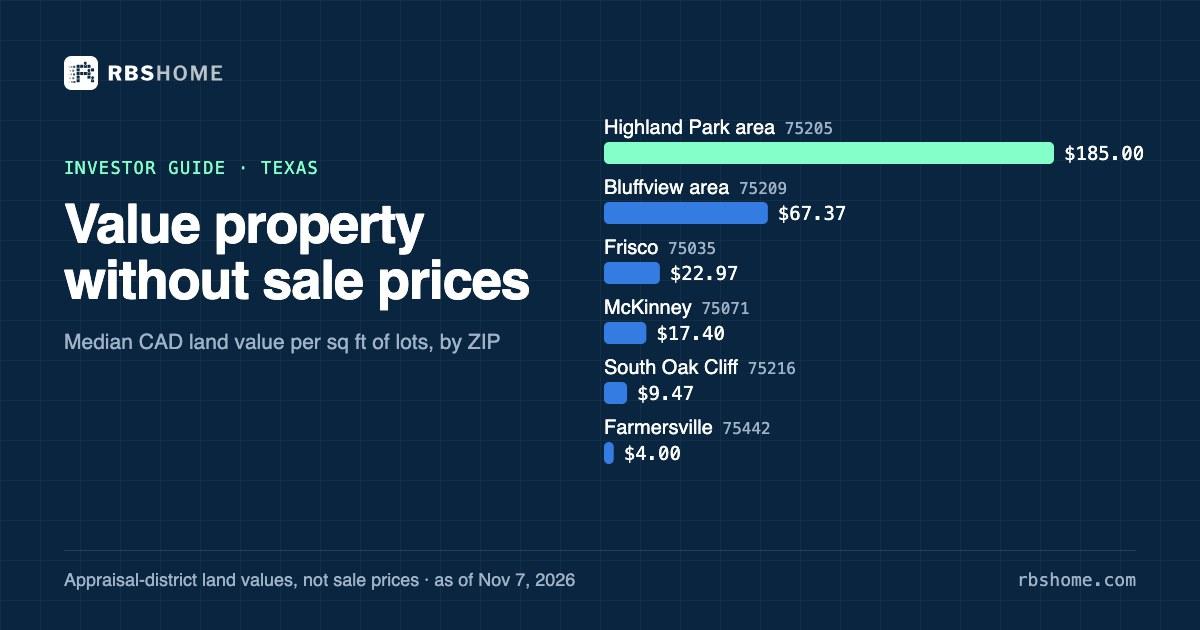
Our ZIP market pages do this at scale. For each ZIP in Dallas and Collin County, we take the appraisal districts' land values for lots and report the median land value per square foot and the median lot size. Here is a sample, computed on November 7, 2026. Every figure is the appraisal district's land value, not a sale price.
| ZIP | Area | County | Median CAD land $/sq ft | Median lot (sq ft) |
|---|---|---|---|---|
| 75205 | Highland Park area | Dallas | $185.00 | 8,550 |
| 75225 | Preston Hollow area | Dallas | $157.50 | 9,954 |
| 75209 | Bluffview area | Dallas | $67.37 | 8,215 |
| 75214 | Lakewood | Dallas | $58.50 | 8,760 |
| 75229 | Northwest Dallas | Dallas | $35.68 | 14,710 |
| 75034 | Frisco | Collin | $25.81 | 9,712 |
| 75035 | Frisco | Collin | $22.97 | 7,823 |
| 75009 | Celina | Collin | $17.61 | 7,187 |
| 75071 | McKinney | Collin | $17.40 | 7,110 |
| 75216 | South Oak Cliff | Dallas | $9.47 | 7,898 |
| 75217 | Pleasant Grove | Dallas | $6.55 | 8,114 |
| 75442 | Farmersville | Collin | $4.00 | 22,128 |
Three things stand out. First, the range is enormous: the median lot in 75205 carries a CAD land value per square foot more than 40 times that of the median lot in 75442. Second, lot size and land value per square foot move in opposite directions at the edges. Farmersville's median lot is about three times the size of a McKinney lot, at less than a quarter of the rate. Bigger lots usually carry a lower value per square foot, so compare a parcel against lots of similar size. Third, the fast-growing Collin ZIPs, such as Celina 75009 and McKinney 75071, sit in a middle band. That's also where builder buying in Collin is heaviest, which we cover in where builders are buying land.
How to use the ZIP figure
Take a 7,000-square-foot lot in 75071. At the ZIP median of $17.40 per square foot, the CAD-based land value comes to about $121,800. That's the appraisal district's view of comparable land, not a price anyone paid. Use it in three ways:
- As a sanity check. If a seller wants three times that figure, ask why. There may be a good reason, such as a corner lot or new utilities, or the asking price may be wishful.
- As a relative measure. If one lot's own CAD land value per square foot is far below its ZIP median, find out why. It may have a flood zone, an easement, poor access or an odd shape.
- As the first step before sales evidence. The ZIP median tells you roughly where the land market is. Closed sales, covered next, tell you where it actually traded.
Every ZIP in the two counties is ranked on our county hubs for Dallas County and Collin County. Each ZIP page also shows how many lot records the median is based on, so you can see when a figure rests on thin data.
A CAD-based range is not an appraisal
Any value built from appraisal-district land rates, including ours, is a screening number. It tells you whether a deal is worth a closer look. Before you commit money, get sales evidence from a licensed agent or a valuation from a licensed appraiser.
Closed sales from the MLS, through an agent
The best evidence of value in Texas is still the closed sale. Most of those prices are recorded in the MLS, which in North Texas is run for its broker members. If you are not a licensed agent, you get MLS sales by working with one.
There are two common ways to do that.
A comparative market analysis or broker price opinion. Under Occupations Code §1101.002, providing a written analysis or opinion of the estimated price of real property in the ordinary course of business, when it isn't called an appraisal, is brokerage activity. That means a licensed agent can prepare one for you. Many agents will do this for investors they work with regularly. Ask for the raw sale list, not just the conclusion: addresses, close dates, prices, square footage, lot size, days on market and the listing remarks about condition.
A licensed appraisal. When you need a formal opinion of value, for a lender, a partner or a dispute, hire a licensed appraiser. It costs more and takes longer, but it's the only document that is an appraisal.
When you read MLS comps, watch for the same things a lender would:
- Condition. A renovated sale is not a comp for a house that needs a roof and foundation work. Listing photos and remarks are your best guide.
- Time. Sales older than six months can mislead in a moving market. Weight recent ones more heavily.
- Distance and boundaries. Highways, rail lines, school attendance zones and creeks can split values sharply. A sale half a mile away across a boundary can be worth less than a sale two miles away on the same side.
- Lot size on land deals. For lots, compare price per square foot or per acre, and compare lots of similar size, for the reason shown in the ZIP table above.
One more limit: not every sale goes through the MLS. Off-market deals between investors, sales to builders and many land trades never appear there. That's why the remaining sources still matter even after you have MLS data.
Deeds, deeds of trust and other recorded clues
The county clerk's real property records don't show prices, but they show a lot that bears on value. In Dallas County, recorded documents are searchable through the clerk's public search site. In Collin County, start from the clerk's land recordings page. Note that Collin's clerk says its online database isn't the official repository, so confirm anything important against the official record.
What to look for:
- The deed itself. It tells you who sold to whom and when. A deed from an individual to a builder entity, followed months later by a new-construction permit, tells you a builder paid something for that lot. Patterns of builder deeds in a subdivision are a strong signal of land demand, even without prices.
- The deed of trust. When a buyer finances a purchase, the lender records a deed of trust, often the same day as the deed. It frequently states the original loan amount. Lenders rarely lend the full price, so a recorded loan suggests a minimum price. It's a clue, not proof: loan-to-value ratios vary, and some buyers pay cash.
- Releases and refinances. A string of refinances with rising loan amounts suggests the owner has borrowed against rising value. A release of lien tells you a loan was paid off, which matters when you estimate an owner's equity.
- Liens and judgments. Mechanic's liens, city liens for mowing or demolition, IRS liens and abstracts of judgment don't change market value, but they change what an owner can accept and what it costs to clear title.
- Plats and replats. A recorded replat can turn one lot into two, which can change value more than any comp.
Some investors also ask sellers directly what they paid, or ask title companies and lenders they work with what they are seeing. That information is informal and you should treat it as such, but it often fills gaps.
Rent comps for income property
For rental houses and small multifamily, value depends on income as much as on sales. Rent data is easier to get than sale data in Texas, because rents are advertised publicly.
A simple approach:
- Collect current asking rents for similar units nearby from listing sites, local property managers and the MLS rental section through your agent. Match bedrooms, bathrooms, size and condition.
- Discount asking rents toward what actually leases. Asking rents on units that have sat for weeks are not market rents.
- Estimate real expenses. In Texas, property taxes are a large share of operating cost, so pull the actual tax bill and the current appraised value. Remember that a homestead cap ends when the property sells to an investor who doesn't qualify for the homestead exemption, so the taxable value can reset toward market value. Add insurance, repairs, vacancy and management.
- Apply a yield you would accept. Divide net operating income by your target return to get the price you can pay. Compare that against the sales evidence.
When the income value and the sales value disagree, find out why. A house in a neighborhood where owner-occupants pay more than investors can justify will show a sales value well above its income value. That's fine if you plan to resell to an owner-occupant, and a trap if you plan to hold it as a rental.
A valuation workflow that holds up
Here is the order we recommend for a Dallas or Collin County property you are considering.
- Pull the CAD record from DCAD or Collin CAD. Note the market value, the land and improvement split, the lot size, the year built and any exemptions. Check whether the homestead cap or an agricultural valuation is hiding the market value.
- Compare the land value per square foot with the median on the ZIP page. A big gap is a question to answer, not a bargain to celebrate.
- Check the recorded documents. Who owns it, how long they've owned it, what loans are recorded, and whether there are liens.
- Get closed sales from a licensed agent. Insist on condition notes and recent dates.
- For rentals, build the income view from current rents and real tax bills.
- Set a range, not a point. Write down a low, middle and high value and the evidence behind each. Then decide what you would pay, after repairs, holding costs, closing costs and your margin.
If you research a lot of parcels, an AI assistant can speed up steps one to three. Our AI connector can pull a parcel's appraisal-district values and a CAD-based land-value range from comparable lots in its ZIP, and it labels the result as CAD-based and not an appraisal. It doesn't return sale prices, because there aren't any public ones to return.
Mistakes that cost investors money
Treating the CAD value as a price. It's an estimate as of January 1 that ignores condition and can trail the market. On some properties it's high, on others low.
Reading the taxable value instead of market value. On a long-held homestead, the capped figure can be far below market. On ag land, the productivity value can be a fraction of market.
Comparing lots of very different sizes. Land value per square foot falls as lot size rises. A rate from a quarter-acre lot doesn't apply to a three-acre tract.
Ignoring condition in comps. A common error in deal analysis is using renovated sales to value a distressed house without a full repair estimate.
Trusting a single source. Every source on this list has a blind spot. A value that agrees across CAD data, closed sales and income is one you can rely on. A value that rests on one source is a guess.
Skipping the professional step. For any purchase that matters to you, have a licensed agent or appraiser review your number. The cost is small next to the cost of overpaying.
This article is general information, not legal or tax advice. For your situation, talk to a Texas attorney, CPA or your title company.
ZIP land values, builder demand and parcel records for Dallas and Collin County