TL;DR
You can sell a Dallas house with an open code case, a city lien or even a demolition order, but each one has to be dealt with. Recorded city liens for mowing, cleanup, securing, demolition or civil penalties are paid from your sale proceeds at closing, and the city then releases them. Open cases that are not yet liens transfer with the property, so the buyer prices in the fix. A demolition order has strict deadlines and appeal windows, so act fast and get legal advice.
In this article
- 1. How a Dallas code case starts
- 2. What the city can do when a violation isn't fixed
- 3. City liens you may find on a title report
- 4. Substandard structures and demolition orders
- 5. Selling with an open case or a lien
- 6. How city liens get paid at closing
- 7. Open cases that are not liens yet
- 8. Your options, from fix-first to sell as-is
- 9. What our data shows
- 10. A checklist before you list or accept an offer
How a Dallas code case starts
Most City of Dallas code cases start with a 311 service request or a code officer's inspection. According to the city's Dallas 311 page, residents can call 3-1-1 inside city limits or (214) 670-3111 from anywhere, submit a request online, or use the Dallas 311 mobile app. The call center operates 24 hours a day. The same page notes that 311 does not work service requests and cannot close them; it routes them to the department responsible.
For property conditions, that department is Dallas Code Compliance. It has three divisions. Neighborhood Code addresses nuisance and property-standard violations through seven community code districts. Nuisance Abatement takes action on violations that owners don't resolve. Consumer Health covers food establishments and similar businesses, which aren't relevant here.
Typical residential cases involve high weeds and grass, litter and junk, open storage, junked vehicles, a vacant house left open, and structural problems such as a failing roof, broken windows or rotted siding. A complaint can come from a neighbor, a passing officer, or a sweep of a neighborhood.
For an owner, a code case usually becomes visible as a notice: mailed to the address on the appraisal district record, handed to someone at the house, or posted on the property. If you own a house you don't live in, especially an inherited or vacant one, the notice may go to an old address and never reach you. Many owners learn about a case only when they try to sell.
What the city can do when a violation isn't fixed
State law gives Texas cities the power to fix certain problems themselves and bill the owner.
For weeds, rubbish and similar unsanitary conditions, Health and Safety Code section 342.006 lets a city do the work and charge the owner if the owner doesn't comply within seven days of notice. Notice can be given in person, by letter to the owner's address on the appraisal district records, or, if personal service can't be made, by publication or by posting on the property. A notice returned as refused or unclaimed still counts. The same section lets a city warn that a repeat violation within a year can be corrected without further notice.
The city's Nuisance Abatement division says most mow-and-clean cases come from a code officer's inspection and referral. If the owner doesn't resolve the problem within the time allowed, the property is referred for abatement, and the city's crews or contractors do the work. The division states that failure to pay the billed charges results in a lien against the property.
For unoccupied buildings that violate minimum standards and are open to entry, Local Government Code section 214.0011 lets a city secure the building and then notify the owner within ten days. Securing typically means boarding windows and doors. The cost is billed to the owner and can become a lien.
City liens you may find on a title report
The city's Special Collections office lists the lien types it handles: paving, demolition, heavy clean, litter clean, secure closure, vegetation removal, weed, mow and clean, site clearance, and civil penalties.
How these liens work depends on the law behind them.
Cleanup and weed liens. Under Health and Safety Code section 342.007, the city files a statement of expenses with the county clerk, and the lien attaches when it is filed. The lien secures the city's costs plus interest at 10 percent from the date the city paid for the work. It is inferior only to tax liens and liens for street improvements, and the city can sue to foreclose it.
Demolition, repair and civil penalty liens. Under Local Government Code section 214.001, if a city has to vacate, secure, remove or demolish a building itself after an owner fails to act, it can assess the expenses against the property and holds a lien, unless the property is a homestead protected by the Texas Constitution. The lien attaches when its notice is recorded with the county clerk. When the city gave the required notice and opportunity to mortgagees and lienholders, the lien is a privileged lien subordinate only to tax liens. Section 214.0015 gives a similar lien for city repair costs or civil penalties for failure to repair or demolish, again excluding protected homesteads.
The practical point is that a recorded city lien sits ahead of most other claims, and it doesn't go away when the owner changes. A buyer's title company will find it and require it to be paid or otherwise handled before it insures the sale.
Substandard structures and demolition orders
A demolition order is the most serious kind of code action, and it follows a legal process.
Under Local Government Code section 214.001, a city ordinance can require a building to be vacated, secured, repaired, removed or demolished if it is dilapidated, substandard or unfit for human habitation and a hazard to public health, safety and welfare, or if it is unoccupied and open to entry. The ordinance must set minimum standards, require notice to the owner, and provide a public hearing. The hearing can be held by a civil municipal court.
Key rules from the statute:
- The owner carries the burden at the hearing to show the scope of work needed and how long it will reasonably take.
- 30 days is the default. The hearing must require the owner, lienholder or mortgagee to secure the building or to repair, remove or demolish it within 30 days, unless they show the work can't reasonably be done in that time.
- More than 90 days requires a plan. The city may not allow more than 90 days unless the owner submits a detailed plan and schedule at the hearing and shows the work can't reasonably be finished in 90 days. Longer schedules come with progress reports.
- Notice can bind later buyers. A city may record notice of the hearing in the county's real property records, and that recorded notice binds anyone who later acquires an interest in the property.
- Appeals are short. Under section 214.0012, an owner, lienholder or mortgagee can challenge the order in district court by filing a verified petition within 30 calendar days after the final decision is delivered. After that, the decision becomes final.
Cities can also go to court. Local Government Code chapter 54 lets a municipality bring a civil action to enforce certain ordinances. Section 54.018 allows an action to compel repair or demolition of a structure, combined with civil penalties of up to $1,000 a day under section 54.017. Under section 54.018(c), the city may file a notice of lis pendens, and a later buyer takes the property subject to the case and the court's orders.
In Dallas, these lawsuits come from the City Attorney's Office. Its Community Prosecution section says it has authority to bring civil actions to enforce state nuisance laws and city ordinances, that it addresses code and fire code violations among other issues, and that its prosecutors start cases in state district court and municipal court. It also says it tries to resolve problems before going to court.
If you receive a hearing notice or a lawsuit, don't wait
The statutory deadlines are short: 30 days to act under a typical order, and 30 calendar days to appeal an order to district court. Selling the house does not erase a recorded order or lis pendens; the buyer takes the property subject to it. Talk to a Texas real estate attorney as soon as a hearing notice or petition arrives, and tell any buyer about it in writing.
Selling with an open case or a lien
You can sell a house in Dallas with an open code case, a recorded lien, or a pending demolition case. None of these makes the property unsellable. They affect who will buy it, what they will pay, and what has to happen at closing.
Disclosure. For most single-dwelling home sales, Property Code section 5.008 requires a seller's disclosure notice, and the statutory form asks whether the seller is aware of any notices of violations of deed restrictions or governmental ordinances affecting the condition or use of the property. Some transfers are exempt, such as sales by an executor during estate administration. If you know about a code case, disclose it. Hiding it invites a dispute later, and recorded items will surface in the title search anyway.
Financing. A buyer using a mortgage may struggle with a house under a repair or demolition order. Lenders and appraisers look at condition, and a lender may not lend on a structure the city has found substandard. That narrows the buyer pool to cash buyers, renovation lenders and investors.
Title. The title company searches the county records. Recorded city liens, recorded hearing notices and lis pendens show up in the title commitment, and the title company will require them to be paid, released or accepted by the buyer as exceptions.
How city liens get paid at closing
Paying a city lien at closing works like paying off a mortgage.
- The title company finds the lien in the title search, or you tell it about one you know of.
- Someone requests a payoff. The Special Collections page asks that lien payoff and release requests be sent to the email address it lists (DWULiens@dallas.gov). The title company often handles this. The payoff includes interest where the law allows it.
- The lien is paid from your proceeds at closing, the same way your mortgage payoff is.
- The city releases the lien. According to Special Collections, a release is sent immediately when payment is made by cash or cashier's check, and a 10-day hold applies when payment is by check or credit card. The title company records the release.
If you think a lien is wrong, for example because the work was never done or the notice went to the wrong owner, the Special Collections page directs disputes to Code Compliance at (214) 671-9391 or to revenue-collections@dallas.gov. Start that conversation well before closing. Lien inquiries can also go to Special Collections at Dallas City Hall, 1500 Marilla Street, (214) 670-3438, which the Nuisance Abatement page lists.
Paying a city lien does not by itself close an open code case. If the condition still exists, the case can continue against whoever owns the house next.
Open cases that are not liens yet
Many code problems never become liens. An open case with a notice of violation, or a pending citation in municipal court, is not recorded against the property the way a lien is, so the title search may not show it.
These cases still matter:
- The condition stays with the house. If the grass is high or the roof is open, the next owner inherits the problem and the enforcement.
- Citations are a separate matter. If you received a municipal court citation, ask the court or an attorney how selling the house affects it before you close.
- Abatement can still happen. If the case is unresolved, the city may still abate and bill. Who pays depends on timing and on the contract.
Before you sell, call the Neighborhood Code office for your district and ask what open cases exist on the address, what is required to close them, and whether any abatement or court date is scheduled. The Neighborhood Code page lists the district offices and phone numbers. It also describes an Intensive Case Resolution Team for cases where compliance efforts have stalled.
In the contract, say plainly who is responsible for open cases and any bills that arrive after closing. A short paragraph saves arguments later.
Your options, from fix-first to sell as-is
There are four realistic paths, and the right one depends on the size of the problem and your resources.
1. Fix the violations, close the case, then sell. For minor issues such as weeds, junk or a broken fence, fixing them first is usually cheap and widens your buyer pool. Ask the code officer to re-inspect and confirm the case is closed. Pay any existing liens so the title is clean.
2. List with the violations disclosed and price them in. If the fix is moderate, some retail buyers will take it on for a lower price. Expect inspection negotiations and lender questions.
3. Sell as-is to a cash buyer or investor. For major structural problems, a repair order or a demolition case, the buyer pool is mostly cash buyers and renovators. They price in the repairs, the city's deadlines and the risk. Paid liens come out of your proceeds at closing either way.
4. Demolish, then sell the lot. If the structure isn't worth saving, some owners demolish it themselves with a permit and sell the lot. In some neighborhoods, builders pay for buildable lots. Before you do this, check whether the lot is buildable under current zoning and setbacks; our guide to Dallas infill zoning and setbacks explains the basics, and our report on where builders are buying land shows where demand is. In historic or conservation districts, demolition may need extra approval.
If the house is your homestead, the homestead exclusion in the chapter 214 lien rules may matter. If it is inherited, the title work is often the bigger job; see our guide to selling inherited property in 75216 and 75217.
What our data shows
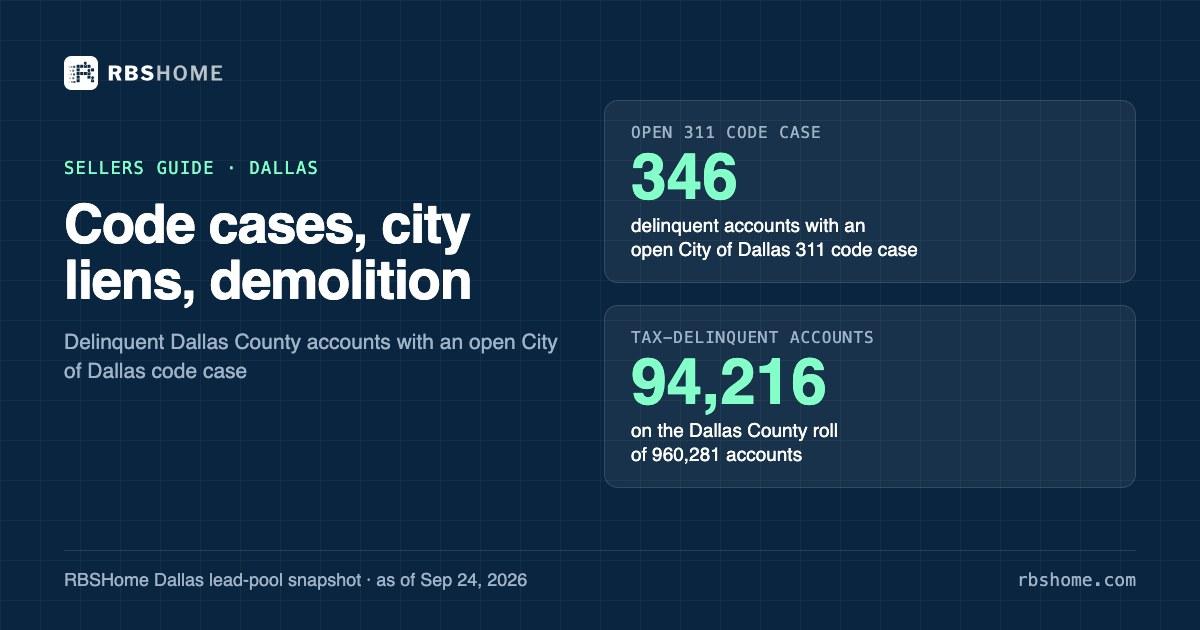
RBSHome tracks Dallas County tax roll accounts and matches them against other public signals. In our Dallas lead-pool snapshot as of September 24, 2026:
| Measure (as of Sep 24, 2026) | Accounts |
|---|---|
| Dallas County roll accounts | 960,281 |
| Delinquent on property taxes | 94,216 |
| Delinquent 3 or more tax years | 31,309 |
| Delinquent with a tax suit | 7,235 |
| Delinquent with an open City of Dallas 311 code case | 346 |
| Delinquent with at least one more signal (suit, out-of-state owner, open code case or foreclosure notice) | 11,998 |
Code cases and tax trouble often come together. A house with an absentee owner can fall behind on taxes and on upkeep at the same time, and each problem makes the other harder to fix. If you are in that position, the taxes and the code case can usually be settled at one closing, from the same proceeds.
Our distressed-property counts as of November 7, 2026 are highest in the southern part of the county: 2,106 tracked properties in 75216, 1,578 in 75217, 1,123 in 75241 and 998 in 75215. The Dallas County distressed property page has the full ranking.
A checklist before you list or accept an offer
- Get your code history. Call the Neighborhood Code district office for open cases, and check whether any 311 requests mention your address.
- Order a title report or ask a title company to run a search. It will show recorded city liens, hearing notices and lis pendens.
- Request written lien payoffs from Special Collections for anything recorded.
- Gather the paperwork. Notices, citations, hearing orders and correspondence with the city.
- Decide fix-first or as-is based on contractor bids and the city's deadlines.
- Disclose everything in writing to buyers.
- Write responsibility into the contract for open cases and any invoices that arrive after closing.
- If there is a hearing, order or lawsuit, talk to a Texas real estate attorney before you sign a contract, so the sale doesn't collide with a court deadline.
RBSHome buys houses and land as-is in Dallas and Collin County. You get a written, itemized offer, usually within 24 hours. There are no agent commissions, you pick the closing date, and closing happens at a title company, which pays recorded liens from the proceeds and records the releases.
This article is general information, not legal or tax advice. For your situation, talk to a Texas attorney, CPA or your title company.
Itemized offer, usually within 24 hours. Liens are paid at the title company.