TL;DR
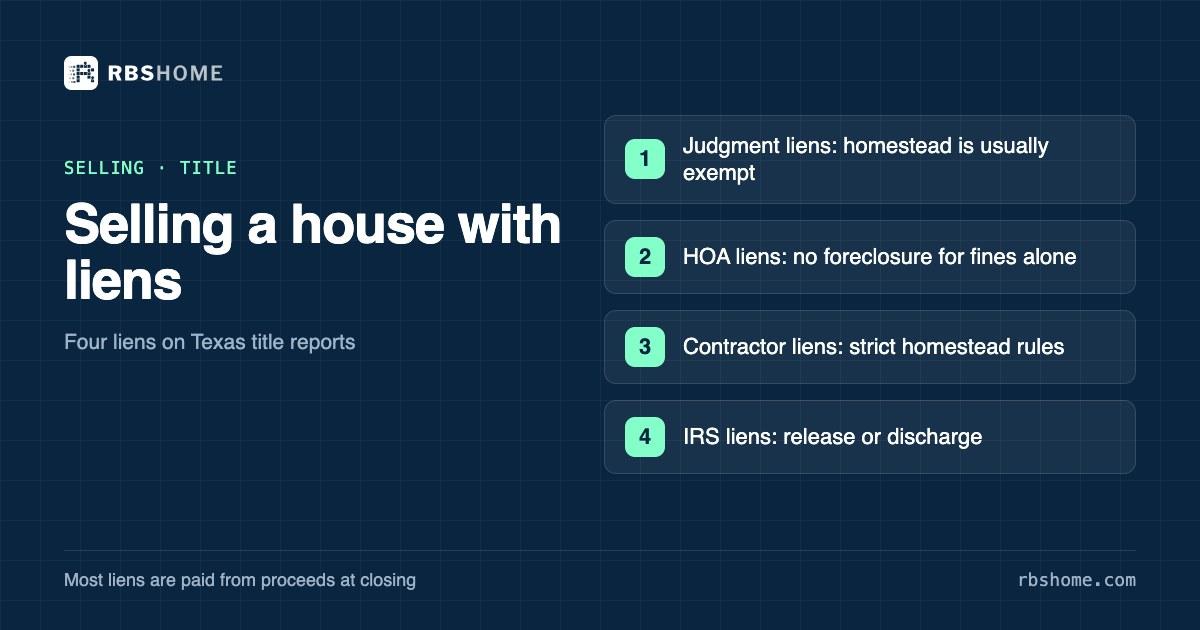
Most liens do not stop a Texas home sale. The title company finds them, gets payoff amounts, pays them from your proceeds at closing and records releases. The Texas homestead protection keeps many judgment liens off the home you live in. HOA liens, contractor liens and IRS liens each follow their own rules, so get payoffs early.
How liens show up and get paid
A lien is a legal claim against property for a debt. When you sell, the buyer's title company searches the county records and lists every lien it finds in the title commitment. To issue a clean title policy, it needs each lien paid, released or otherwise handled.
In most sales the process is simple. The title company asks each lienholder for a written payoff, pays those amounts from your proceeds at closing, and records the releases. You get what is left. The questions are which liens are valid against your house, and whether the proceeds cover them.
Judgment liens and the homestead
When someone wins a money judgment against you, they can record an abstract of judgment in the county records. Property Code section 52.001 says a recorded abstract creates a lien on the debtor's real property in that county, other than real property exempt from seizure or forced sale. A Texas homestead is generally exempt.
That means a judgment lien usually does not attach to the home you live in. But title companies still see the abstract, and it can slow a sale. Section 52.0012 gives homeowners a tool: you can record a homestead affidavit in the county real property records, with a certificate of mailing to the judgment creditor. If the creditor does not file a contradicting affidavit, the affidavit can serve as a release of record, and buyers and lenders can rely on it.
How long a judgment lien lasts: under section 52.006, generally 10 years from recording, ending sooner if the judgment becomes dormant. Judgments for the state or a state agency do not become dormant.
Rental houses, vacant lots and land you do not live in are not homestead, so a judgment lien can attach to them. That is why investors and heirs who inherit a second property often find judgment liens on the title report.
Homestead status is a question of fact
Whether a property is your homestead depends on facts like where you live and what you claim. If a creditor disputes it, talk to a Texas attorney before closing.
HOA liens
Most Texas HOAs have a lien for unpaid assessments under their recorded declaration. Property Code chapter 209 sets rules for many residential associations. One protection matters most: section 209.009 says an association may not foreclose its assessment lien if the debt consists only of fines, attorney's fees tied only to those fines, or certain other amounts.
When you sell, the title company asks the HOA for a payoff and a resale certificate. Unpaid dues, late fees and fines are usually paid from your proceeds. If you dispute some charges, raise it with the HOA early so it does not hold up closing.
Contractor and mechanic's liens
Contractors and suppliers who are not paid can file liens under Property Code chapter 53. For a homestead, the bar is higher. Section 53.254 says that to fix a lien on a homestead:
- the contractor and the owner must sign a written contract setting out the terms,
- the contract must be signed before the work or materials are provided,
- if the owner is married, both spouses must sign, and
- the contract must be filed with the county clerk.
If a contractor's lien appears on your title report, ask the title company whether it meets these rules. Some liens can be removed. Others must be paid or bonded.
Federal tax liens
According to the IRS, a federal tax lien is the government's legal claim against your property when you neglect or fail to pay a tax debt, and it covers real estate. The IRS releases the lien within 30 days after the debt is paid.
If the sale will not pay the full tax debt, a discharge removes the lien from a specific property, which can help when that property is being sold. IRS Publication 783 explains how to apply for a certificate of discharge. Apply well before your closing date.
Property tax liens
Property taxes are their own lien. Under Tax Code section 32.01, a tax lien attaches to property on January 1 each year to secure that year's taxes, penalties and interest. Delinquent taxes are paid first at closing. If you are behind, see our tax deferral and payment plan guide and our glossary entry on tax liens.
City liens for mowing, cleanup or demolition are covered in our guide to selling a house with code violations or city liens in Dallas.
What to do before you sign a contract
- Order a title search or ask a title company to run one, so there are no surprises.
- List every lien with the creditor, amount and recording date.
- Ask for written payoffs from each lienholder.
- Check homestead protection for judgment and contractor liens, and record a homestead affidavit if it fits.
- Start any IRS discharge application early.
- Compare total liens with expected proceeds. If the liens are larger than the sale price, talk to a Texas attorney before you sign. Our closing costs guide shows the other costs that come out of proceeds.
RBSHome buys houses as-is in Dallas County and Collin County, including Dallas, Mesquite and Allen. We close at a title company that pays valid liens from the proceeds and records the releases, and you see every payoff on the settlement statement.
This article is general information, not legal or tax advice. Lien rules have exceptions. Talk to a Texas attorney, CPA or your title company about your situation.
Written offer, usually within 24 hours. Liens are paid at the title company.
Sources
- Texas Property Code chapter 52, Judgment liens (sections 52.001, 52.0012, 52.006): statutes.capitol.texas.gov
- Texas Property Code chapter 53, Mechanic's, contractor's or materialman's liens (section 53.254): statutes.capitol.texas.gov
- Texas Property Code chapter 209, Texas Residential Property Owners Protection Act (section 209.009): statutes.capitol.texas.gov
- Texas Tax Code section 32.01, Tax liens: statutes.capitol.texas.gov
- Internal Revenue Service, "Understanding a federal tax lien": irs.gov
- Internal Revenue Service, Publication 783, Instructions on How to Apply for Certificate of Discharge From Federal Tax Lien: irs.gov