TL;DR
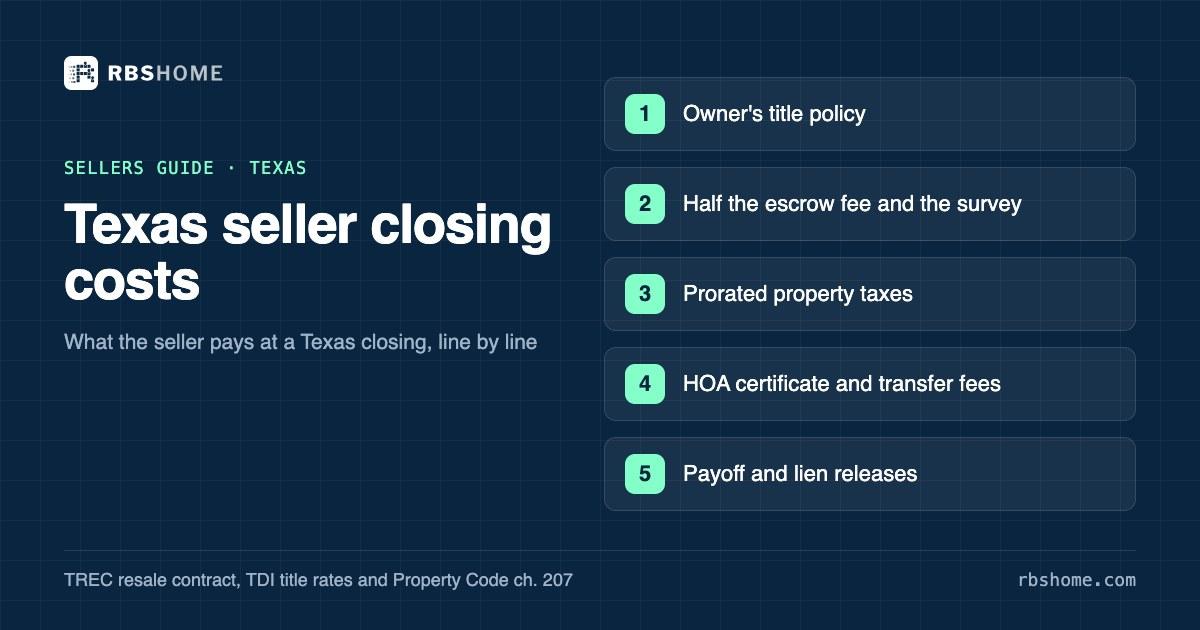
A Texas home seller typically pays the seller's half of the escrow fee, deed preparation, tax certificates, the release and payoff of any mortgage, the seller's share of this year's property taxes (because Texas taxes are paid in arrears), and whatever the contract assigns to the seller: often the owner's title policy, sometimes a survey and HOA resale certificate. Broker compensation is a separate, negotiable cost. The title premium is set by the state, so it is the same at every title company; escrow fees are not.
In this article
- 1. The short list
- 2. Where the split comes from
- 3. Owner's title policy
- 4. Escrow fee
- 5. Survey
- 6. Property taxes: paid in arrears, prorated at closing
- 7. Mortgage payoff and lien releases
- 8. HOA resale certificate and transfer fees
- 9. Recording fees and document preparation
- 10. Broker compensation
- 11. What the buyer normally pays
- 12. Situational costs that surprise sellers
- 13. A sample seller net sheet
- 14. Ways to lower what you pay
The short list
Here are the costs a Texas home seller should expect to see on a closing statement. Some are fixed by contract custom, some by the deal you negotiate, and a few by law.
| Cost | Seller usually pays? | What sets the amount |
|---|---|---|
| Owner's title policy | Negotiated; contract box | State-promulgated premium |
| Escrow fee | Half, under the TREC contract | Each title company |
| Survey | Depends on contract choice | Surveyor |
| Current-year property taxes | Seller's share, as a credit to buyer | Tax rate, value and days owned |
| Mortgage payoff and release | Yes | Lender's payoff statement, county recording fees |
| Tax certificates and deed preparation | Yes, under the TREC contract | Tax collectors and title company |
| HOA resale certificate | Depends on addendum choice | Association, capped by statute |
| HOA transfer fees | Buyer up to a cap, seller pays excess | Association and addendum |
| Broker compensation | Negotiated | Separate written agreements |
The rest of this article goes line by line, with the official source for each rule.
Where the split comes from
Most Texas home sales use contracts promulgated by the Texas Real Estate Commission. The main one for existing houses is the TREC One to Four Family Residential Contract (Resale), form 20-19. Paragraph 12 lists who pays what.
Under paragraph 12A(1)(a), the seller pays: releases of existing liens, including prepayment penalties and recording fees; release of the seller's loan liability; tax statements or certificates; preparation of the deed; one-half of the escrow fee; and other expenses the contract assigns to the seller.
Paragraph 12A(2) gives the buyer a much longer list, mostly tied to the buyer's loan. That list is covered further down.
Other paragraphs assign the owner's title policy (paragraph 6A), the survey (6C), prorations (13) and HOA items (a separate addendum). Several of these are check-the-box choices, so the actual split depends on what you and the buyer agree to. A direct sale to an investor may use a different contract, but the same items have to be assigned somewhere.
Owner's title policy
The owner's title policy protects the buyer against covered title problems, such as a forged deed in the chain or an unknown heir. In Texas, the premium is not a market price. The Texas Department of Insurance title FAQ says the premium rate is set by TDI and that all title companies charge the same premium for a policy. It also says the buyer and seller may negotiate who pays it.
Under paragraph 6A of the TREC contract, the seller furnishes the buyer an owner's policy at either the seller's or the buyer's expense, depending on which box is checked. Check that box before you sign.
The TDI title rate chart effective March 1, 2026 lists these basic premiums:
| Policy amount | Basic premium |
|---|---|
| $100,000 | $780 |
| $200,000 | $1,274 |
| $250,000 | $1,521 |
| $300,000 | $1,768 |
| $350,000 | $2,015 |
| $400,000 | $2,262 |
| $500,000 | $2,756 |
Between $100,001 and $1,000,000, the chart's formula is: subtract $100,000 from the policy amount, multiply by 0.00494, round to the nearest dollar and add $780. A $325,000 sale, for example, works out to $1,892.
Two add-ons can show up next to the premium. First, TDI's title page says a guaranty fee of $3.00 per policy applies to closings after September 30, 2026. Second, paragraph 6A(8) of the contract lets the parties choose whether the standard survey exception is amended to read only "shortages in area," and at whose expense. That amendment costs extra, so look at which box is checked.
Escrow fee
The escrow fee, sometimes called the closing or settlement fee, pays the title company for running the closing: holding earnest money, collecting documents, preparing the closing statement and disbursing funds. Under the TREC contract, the seller and buyer each pay one-half.
Unlike the title premium, escrow fees are not set by the state. TDI's FAQ notes that escrow fees and closing costs differ between agents and that you can shop around. If you are choosing the title company, ask for the escrow fee and any other charges (courier, wire, e-recording, document storage) in writing before you open the file.
Survey
The buyer's title company and lender usually want a survey showing the boundaries, improvements and easements. Paragraph 6C of the TREC contract gives three choices:
- The seller provides an existing survey plus a Residential Real Property Affidavit (form T-47) or Declaration (T-47.1) promulgated by TDI, stating that nothing has changed. If the seller misses the deadline, the buyer gets a new survey at the seller's expense. If the title company or lender won't accept the existing survey, a new survey is ordered at whichever party's expense the contract says.
- The buyer obtains a new survey at the buyer's expense.
- The seller furnishes a new survey at the seller's expense.
If you have your survey from when you bought the house and you haven't added a fence, pool, addition or shed since, option 1 often saves the cost of a new survey. Find that survey in your closing papers before you list.
Property taxes: paid in arrears, prorated at closing
Texas property taxes are paid after the year they cover. Under Tax Code section 31.02, taxes are due when the bill arrives and are delinquent if not paid before February 1 of the following year. Bills usually go out in the fall. So at most closings, the current year's taxes haven't been paid yet, and often haven't even been billed.
Paragraph 13 of the TREC contract prorates current-year taxes through the closing date. In practice, the seller gives the buyer a credit for the part of the year the seller owned the house, and the buyer pays the full bill when it comes. The contract says that if taxes are not paid at or before closing, the buyer pays the current year's taxes, and that the parties adjust the proration later if the actual bill differs from the estimate.
A hypothetical example: if the year's taxes are estimated at $6,000 and closing is June 30, the seller owned the house for 181 days of a 365-day year, so the seller's share is about $2,975. That amount appears as a seller debit and a buyer credit. The numbers are made up; your title company calculates the real figure from the tax office's records.
Three wrinkles:
- Exemptions change. The contract allows the proration to take into account any change in exemptions that will affect the current year's taxes. If you have a homestead or over-65 exemption, the buyer's bill may differ, and the title company may use a different estimate.
- Late-year closings. If you close after the bill has been issued, the title company may pay the full bill from your proceeds, and the buyer then credits you for their share of the year.
- Past-due taxes. Any prior-year delinquency, with penalties and interest, is paid from the seller's proceeds. The TREC contract requires the seller to furnish tax statements or certificates showing no delinquent taxes. Under Tax Code section 31.08, a tax collector may charge up to $10 for each tax certificate.
Delinquent taxes are more common than most people think. As of November 3, 2026, RBSHome's records show 90,298 Dallas County accounts and 20,345 Collin County accounts with a delinquent balance on the latest roll. Our tax delinquency report has the breakdown. Delinquency doesn't block a sale; it just comes out of the proceeds.
Mortgage payoff and lien releases
Your mortgage balance is the largest number on most seller closing statements, though it isn't a "cost" so much as your loan coming due. The title company orders a payoff statement from your lender. That statement shows the principal, interest through a specific date, and any fees. Interest keeps accruing daily until the lender receives the funds, so a closing that slips a few days increases the payoff.
The TREC contract puts these on the seller: releases of existing liens, including any prepayment penalties and recording fees, and release of the seller's loan liability. If you have a second mortgage, a home equity line, a solar lien, a contractor's lien or a judgment, each one needs a payoff and a recorded release.
Recording a release is a county clerk fee. The Dallas County Clerk's recording fee page lists $25.00 for the first page of a standard document and $4.00 for each additional page. Collin County publishes its own land recording fee schedule on the Collin County Clerk's land recordings page. The title company handles the recording and shows the charge on your statement.
City liens and HOA balances are paid the same way, from the seller's proceeds, with a release recorded afterward.
HOA resale certificate and transfer fees
If the house is in a subdivision with a mandatory property owners' association, two kinds of HOA charges come up.
The resale certificate. Property Code section 207.003 requires the association to deliver the subdivision information (the restrictions, the bylaws and rules, and a resale certificate) within 10 business days after a written request. The certificate must show regular assessments, special assessments, amounts owed on the property, known violations, any right of first refusal, and every fee tied to the transfer, including any administrative transfer fee. The association may charge a reasonable and necessary fee of no more than $375 for the package and no more than $75 for an update, which it must deliver within seven business days of the request. It can't charge the fee if it doesn't deliver the certificate on time.
Who pays depends on the TREC Addendum for Property Subject to Mandatory Membership in a Property Owners Association. Its paragraph A offers four choices: the seller obtains and pays for the subdivision information; the buyer obtains it at the buyer's expense; the buyer already has it, with any update at the buyer's expense; or the buyer doesn't require it.
Transfer fees. Paragraph C of the same addendum says the buyer pays association fees, deposits, reserves and other transfer charges up to a dollar amount written in the blank, and the seller pays any excess. Regular dues are prorated separately under paragraph 13 of the contract. If the blank is small and the association's transfer charges are large, the difference comes out of your proceeds. Read the resale certificate's fee list before you agree to the number.
Paragraph D adds one more item: if the buyer doesn't require the subdivision information but the title company still needs information from the association, such as dues status or a right-of-first-refusal waiver, the addendum says whether the buyer or seller pays for it.
Recording fees and document preparation
Under the TREC contract, the seller pays for preparing the deed. The deed is usually a general warranty deed, which paragraph 9B(1) requires the seller to sign and deliver at closing. The title company or an attorney it works with prepares it and charges a document fee.
Recording fees for the deed and the buyer's deed of trust appear on the buyer's list in paragraph 12A(2). The seller's recording costs are mainly the lien releases covered above.
Paragraph 9B(5) also says private transfer fees, as defined in Property Code chapter 5, subchapter G, are the seller's obligation unless the contract says otherwise. These are uncommon, but if the title commitment shows one, ask about it early.
Broker compensation
For many sellers, broker compensation is the largest cost after the mortgage. It is set entirely by agreement. Paragraph 12B of the TREC contract states that brokerage compensation is not set by law and is fully negotiable, and that each party pays its own broker under separate written agreements. It includes optional boxes for the seller to contribute toward the buyer's broker, or the buyer toward the seller's broker.
When you interview listing agents, ask what they charge, what that includes (photography, staging, marketing), and how they suggest handling any contribution to a buyer's broker. If you sell directly to a buyer with no agents, this line is zero.
What the buyer normally pays
Paragraph 12A(2) of the TREC contract puts the buyer's loan costs on the buyer: appraisal, loan application and origination charges, credit reports, loan documents, interest, recording fees, copies of easements and restrictions, the lender's title policy and endorsements, loan-related inspections, the buyer's half of the escrow fee, prepaid items such as insurance and tax reserves, and mortgage insurance or loan funding fees.
The seller pays none of those unless the seller agrees to a concession. Paragraph 12A(1)(b) has a blank where the seller agrees to pay up to a set amount toward the buyer's expenses, excluding brokerage compensation. Concessions are common when buyers are short on cash for closing, and they come straight out of the seller's net.
Situational costs that surprise sellers
These don't apply to every sale, but when they do, they can be large.
- Repairs or credits after inspection. A buyer who paid an option fee can terminate for any reason during the option period, so inspection results often lead to a repair request or a price cut.
- Lender-required repairs. Under paragraph 7E, neither party has to pay for these unless they agree. If no one agrees, the contract ends.
- A home warranty. Paragraph 7H lets the seller agree to reimburse the buyer for a residential service contract up to a stated amount.
- Rollback taxes on land. If land taxed under an open-space or agricultural appraisal changes use, Tax Code section 23.55 imposes an additional tax equal to the difference between the taxes paid and the market-value taxes for each of the three prior years the land had the special appraisal. Who bears that cost should be written into the contract. Our guide to selling land in Collin County covers land sales in more detail.
- City liens. Liens for mowing, cleanup, securing or demolition of a property are paid from the proceeds like other liens.
- Past-due HOA amounts. The resale certificate shows them, and they are paid at closing.
- Small fees. Courier, wire, e-recording, mobile notary and overnight shipping fees add up, especially when sellers sign from out of town.
Ask for an estimated closing statement early
Once you have a contract, ask the title company for an estimated settlement statement. It lists every charge and credit, with the payoff, tax proration and HOA amounts the title company has gathered. Problems are easier to fix when you see them two weeks before closing than at the closing table.
A sample seller net sheet
This example is hypothetical. The sale price, rates, payoff and fees are made up to show how a net sheet is built. They are not quotes or typical Dallas or Collin County figures. The title premium is the actual TDI basic premium for the example price.
| Line (hypothetical) | Amount |
|---|---|
| Sale price | $400,000 |
| Listing broker (example 3%) | −$12,000 |
| Contribution to buyer's broker (example 2%) | −$8,000 |
| Owner's title policy (TDI basic premium at $400,000) | −$2,262 |
| Seller's half of escrow fee (example) | −$550 |
| Tax certificates and deed preparation (example) | −$230 |
| Recording a 3-page lien release in Dallas County | −$33 |
| HOA resale certificate (statutory maximum) | −$375 |
| Seller's share of current-year taxes (example) | −$2,975 |
| Seller concession toward buyer's costs (example) | −$4,000 |
| Mortgage payoff (example) | −$210,000 |
| Estimated proceeds to seller | $159,575 |
In this made-up example, the costs other than the mortgage payoff total $30,425. About two-thirds of that is broker compensation, which is also the most negotiable line. The title premium, escrow fee, certificates and recording are comparatively small and mostly fixed.
Ways to lower what you pay
You can't change the state-set title premium, but you can affect most of the rest.
- Negotiate broker compensation for your listing, and decide deliberately whether to contribute to the buyer's broker and how much.
- Find your existing survey and use the T-47 affidavit if nothing has changed.
- Compare escrow fees if you are the one choosing the title company.
- Read the HOA addendum blanks, especially the transfer-fee cap in paragraph C.
- Pay off small liens and clear past-due taxes early if you have the cash, so penalties and interest stop growing.
- Get contractor bids for known defects before listing, so repair requests after inspection don't surprise you.
- Close on the date you planned. Every day of delay adds mortgage interest to the payoff and holding costs to your side.
If you'd rather skip most of these lines, a direct sale removes broker compensation and repair negotiations, though it comes at a lower price. Whether it nets more depends on the house; compare both options with real numbers.
RBSHome buys houses and land as-is in Dallas and Collin County. You get a written, itemized offer, usually within 24 hours, so you can see each closing cost before you decide. There are no agent commissions, you pick the closing date, and closing happens at a title company. For a sense of local activity, our Dallas County and Collin County hubs rank every ZIP.
This article is general information, not legal or tax advice. For your situation, talk to a Texas attorney, CPA or your title company.
Written, itemized offer, usually within 24 hours. No agent commissions.