TL;DR
MCP is an open standard that lets AI assistants call outside tools. RBSHome runs a remote MCP server at https://rbshome.com/api/mcp, listed in the official MCP Registry as com.rbshome/rbshome, that lets Claude, ChatGPT and other MCP apps search Dallas and Collin County property, tax-delinquency, tax-sale and appraisal-district land records in plain language. It is read-only apart from saving a filter, returns no sale prices or contact details, and every answer is a starting point to verify before you buy.
In this article
What MCP is, in plain terms
AI assistants are good at reasoning and writing, and unreliable on specific facts they weren't given. Ask a general assistant who owns a parcel in Garland or how much tax is owed on it, and it will either decline or make something up.
The Model Context Protocol is an open standard that fixes part of this. Its own documentation describes MCP as "an open-source standard for connecting AI applications to external systems," and compares it to a USB-C port for AI applications. A service publishes an MCP server that offers a set of tools, each with a name, a description and the inputs it accepts. When you connect that server to your assistant, the assistant can decide to call a tool, read the result and use it in its answer.
For property research, that changes the workflow. Instead of copying an address into five county websites and pasting the results into a chat, you ask the question once and the assistant calls the tools it needs. The answer is grounded in the records it fetched, with sources and links you can check.
MCP servers come in two kinds: local ones that run on your computer and remote ones you reach over the internet. RBSHome's is remote. It runs at https://rbshome.com/api/mcp and is listed in the official MCP Registry under the name com.rbshome/rbshome, so MCP apps and directories can find it.
What the RBSHome connector covers
The connector reads the same data as the RBSHome map, for Dallas County and Collin County, Texas only. It covers:
- Parcels from the Dallas Central Appraisal District and Collin Central Appraisal District: situs address, owner and mailing address of record, property use, lot size, appraised values and the current owner's deed date.
- Tax delinquency from the county tax offices: delinquent balances, tax years owed, tax suits and scheduled tax-sale dates, tracked week by week.
- Tax-sale listings: Dallas County from the tax-sale listings published for the county, and Collin County from the constables' sale notices, updated weekly.
- Recorded deeds linked to a property, where RBSHome holds the county clerk's index, which add deed type and recording date.
- Flood and terrain: FEMA flood zones and USGS elevation for flood and slope details.
- Company owners: for LLCs and other entities, the Texas Comptroller's franchise-tax registry record and other owners sharing the same mailing address.
It doesn't cover other counties. Ask about Tarrant or Denton and the connector answers that the county isn't covered.
You need a free RBSHome investor account to use most tools. When the free tier is on, a few tools also work without an account, with owner names and mailing addresses removed and searches capped at a small number of rows. The connectors page shows which tools those are and the current limits.
The tools, grouped by task
You don't need to name tools. The assistant chooses them from your question. But knowing what exists helps you ask better questions. Here they are by task, with what each returns, taken from the tool descriptions the assistant itself reads.
| Task | Tool | What you get |
|---|---|---|
| Build a lead list | filter_properties | Tax-delinquent leads matching a buy box (score, tier, use, lot size, value, ZIP, owner location, years delinquent), same filter as the map |
| Know which filters exist | list_filter_fields | Allowed filter fields, such as frontage, flood zone, slope and zoning, with coverage and data dates |
| Find a property | search_properties, search | Matches from an address, account number, lead ID or owner name |
| Read a property record | get_property, fetch | Owner, mailing address, tax status, appraised values, sources with dates; optional terrain, history, links and outline |
| See an owner's holdings | find_owner_portfolio | Other Dallas and Collin properties of the same owner, which are delinquent, and balances |
| Look behind an LLC | find_entity_owner | Comptroller registry record and other entities at the same mailing address |
| Check tax-sale status | get_tax_sale_history | Sale dates, status, cause number, minimum bid, judgment and source notice link |
| Value land | estimate_lot_value, comps_for_address | A CAD-based land-value range from comparable same-ZIP, same-use lots, not an appraisal |
| Run deal numbers | analyze_deal | Maximum allowable offer and opening offer from CAD values and your assumptions, with the math shown |
| Draft an offer | draft_offer_letter | Text of a one-page, non-binding letter of intent; nothing is sent or stored |
| Find motivated sellers nearby | motivated_sellers_near | Top delinquent leads near an address or in a ZIP, with plain reasons |
| Find buyers | find_recent_buyers, find_likely_buyers, find_builders_for_lot | Companies that bought nearby, likely buyers ranked by fit, builders and investors active in the ZIP |
| Compare ZIPs | get_market_stats | Lead supply next to ownership transfers over 3, 6, 12 and 24 months |
| Save and reuse | save_filter, list_saved_filters | Save a buy box to your map; list saved filters with current counts |
| Check allowance | get_usage | Today's usage, limits, reset time and data freshness |
A few details matter when you read results. The buyer tools work from appraisal-district deed dates, so they show who bought and when, not for how much, and they can't tell whether a purchase was cash. Individual people who bought are counted but not named. The land-value tools take the appraisal district's land value per square foot of comparable parcels, same ZIP, same land use and a lot between half and twice the size, and apply it to your lot. The deal calculator's default resale figure is the CAD land-value median of comparable lots, which you can override with your own number.
The server also offers four guided workflows that some apps show as prompts or skills: a one-page property due-diligence brief, a buy-box lead list, upcoming tax sales, and a ZIP code screen.
How to set it up
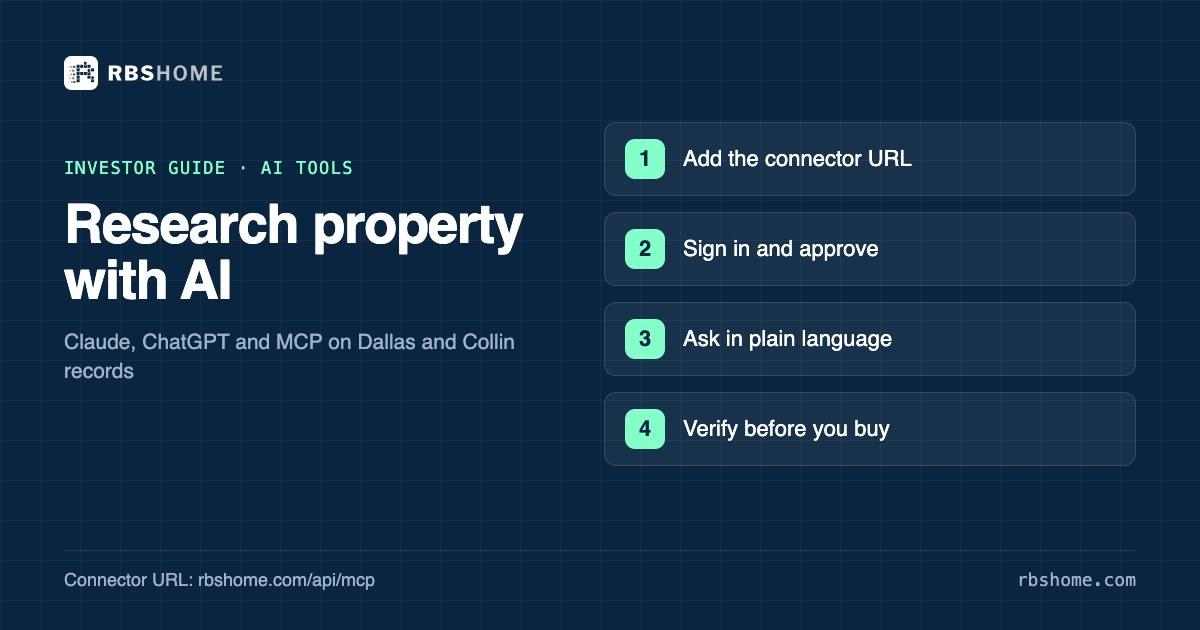
Every app uses the same connector URL and the same RBSHome sign-in. The connectors page has the current steps for each app; here's the shape of it.
Claude (web, desktop and mobile). Open Customize, then Connectors. If RBSHome is listed under Browse connectors, choose it and click Connect. Otherwise choose Add custom connector, name it RBSHome, paste the connector URL and connect. Sign in with your RBSHome investor account and approve. A connector added on the web also works in the desktop and mobile apps. On Team and Enterprise plans, an organization owner may need to add it first.
Claude Code. Add the server from a terminal with the command shown on the connectors page, then run /mcp, choose rbshome, authenticate, sign in and approve. If the machine has no browser, you can create a personal access key under Profile, then AI connectors, on RBSHome and pass it as a header instead. Keys last 90 days. Treat one like a password.
ChatGPT. ChatGPT connects through the RBSHome plugin in its Plugins directory once the plugin is listed there: find RBSHome, connect, sign in and approve, then pick RBSHome in a new chat. On Enterprise and Edu workspaces, an admin must enable it first. Adding RBSHome by URL as a custom MCP server is a developer path with sign-in caveats, which the connectors page explains.
Other MCP apps. Any app that connects to remote MCP servers over Streamable HTTP with OAuth sign-in can use it. Give it the URL exactly as shown, with no www and no trailing slash.
During sign-in, the approval page shows which app is asking, where it will return to and exactly what it can do. To disconnect later, go to Profile, then AI connectors, on RBSHome. Access stops within about a minute.
Example prompts that work
These come from the connectors page and the tool catalog. Each works as written on an investor account. Where a prompt needs a specific property, replace the address or account with one you're researching.
Build and save a list.
- "How many Tier A or B tax-delinquent vacant lots between 0.25 and 2 acres in Collin County have out-of-state owners? Show the top 25 by balance with the map link."
- "Save this search as 'Collin absentee lots' plus today's date so I can open it on the RBSHome map."
- "Only lots with at least 50 ft of road frontage and no flood zone. How current is that data?"
Tax sales.
- "List Dallas County leads with the nearest tax-sale dates."
- "Is this property scheduled for a tax sale? When is the sale, and what is the minimum bid?"
Owners.
- "What else does the owner of the first lead on that list own, and which of those are delinquent?"
- "Who is behind the LLC that owns this property, and what other companies share its mailing address?"
Markets and buyers.
- "Rank Collin County ZIP codes by Tier A delinquent leads next to how many parcels changed hands in the last 12 months."
- "Which builders would want the lot at this address?"
- "Who are the most motivated sellers within half a mile of this address?"
Land value and deal math.
- "What are the land comps for this address, and what is the lot worth?"
- "The seller wants 85,000 dollars. Is that a deal? What should I offer?"
Follow-up questions work because the assistant keeps the earlier results in the conversation. "That list" and "the first lead" refer back to what it just fetched.
A research session from ZIP to offer letter
Here's how a typical session might run for a land investor looking at Collin County.
1. Screen ZIPs. Ask for a ranking of Collin ZIPs by Tier A delinquent leads next to recent ownership transfers. The answer comes with caveats, returned with every ranking: transfers count current owners' deeds only over a 27-month window, institutional owners aren't counted, parcels without a map pin are excluded, and cash purchases and prices can't be identified. Compare it with the Collin County hub, which ranks every ZIP on builder demand and lot values.
2. Build a buy box. Ask for delinquent vacant lots in two or three ZIPs, within a lot-size range, with out-of-state owners. Ask for a count first. The assistant can count a list without using your lead-row allowance.
3. Open the best leads. For the top few, ask for the full property record with terrain. You get the tax balance, years delinquent, tax suit, next sale date, appraised values, flood zone and slope, each with its source and date.
4. Check the owner. Ask what else the owner holds. An owner with several delinquent properties is in a different position from an owner with one. If the owner is an LLC, ask who's behind it.
5. Value the land. Ask for land comps. The answer is a CAD-based range, labelled as such, with how many comparable lots changed hands recently.
6. Find the exit. Ask which builders or investors are most likely to buy a lot like this in that ZIP. That tells you whether there's a market before you make an offer. For the county-wide picture, see where builders are buying land in Dallas and Collin County, and the builder-demand view.
7. Run the numbers and draft. Give the asking price and your own assumptions and ask for the maximum allowable offer. If it works, ask for a draft offer letter at your price. The text comes back for you to edit. Nothing is sent, and the PDF is made on the property's Offer tab in RBSHome.
8. Save the filter. Save the buy box so it opens on your RBSHome map next week with updated data.
That's a few minutes of conversation in place of an afternoon of tabs. It's also only the first pass, as the last section explains.
What it will not do
The limits are deliberate.
- No sale prices or appraisals. Texas doesn't disclose sale prices. Land-value ranges, comps and the deal calculator use appraisal-district values and say so. For closed sales, work with a licensed agent or appraiser.
- No phone numbers or email addresses, and it never contacts an owner.
- No exports, skip traces, purchases or plan changes. Those happen on the RBSHome site, if at all.
- No changes to your account beyond adding a new saved filter. It can't edit or delete saved filters or anything else.
- No other counties. Dallas and Collin only.
The assistant can still get it wrong
One more limit is the assistant itself. The connector returns records; the assistant writes the summary. Assistants can still misread a field, round a number or overstate a conclusion. When a figure matters, open the linked record.
Data sources and freshness
Every property record and lead list names its public-record sources and their data dates, and lead data shows when it was last refreshed. A stale figure is visibly stale.
The rhythms differ by source. Tax delinquency is tracked week by week. Tax-sale listings are updated weekly. The likely-buyer rankings are rebuilt weekly from the last 27 months of deed dates. Appraised values follow the appraisal districts' yearly cycle, with values as of January 1. Attribute filters such as frontage, flood zone, slope and zoning carry their own coverage and dates, which you can ask for.
Two consequences for investors. First, between weekly refreshes, an owner may have paid their taxes or a tax sale may have been cancelled. Check the county tax office before you act on a balance. Second, appraisal-district values can trail the market, especially in fast-growing Collin ZIPs, so treat any CAD-based range as a screen, not a price.
Privacy and limits
What RBSHome receives. Only the requests the assistant makes for you, such as a county, a search or a filter. RBSHome never receives your chats, your files or the assistant's memory.
What results contain. Public records: property addresses, owners and mailing addresses of record, tax balances and deed dates. Never phone numbers or email addresses. Your assistant's provider receives those results and handles them under its own privacy policy, so read it.
Logging. RBSHome logs each request, with the search text replaced by a fingerprint, to enforce limits and fix problems, and deletes the log after 90 days. Calls made without an account are logged with a one-way hash of the IP address, never the address itself.
Limits. Each account has per-minute and daily limits on tool calls, lead rows, property lookups and saved filters. Daily limits reset at midnight Central time. Counting a list uses no lead rows, and searches that find nothing don't count against your allowance. Ask "How many RBSHome lookups do I have left today?" and the assistant will check. The current numbers are on the connectors page.
If you think you've found a security problem, the connectors page explains how to report it.
Verify before you buy
An AI assistant connected to good records is a fast research desk. It is not due diligence. Before you make an offer or bid:
- Open the source. Follow the links to the appraisal district record at DCAD or Collin CAD, and to the county tax office for the current balance.
- Pull title. Recorded liens, federal tax liens, HOA liens and city liens don't all show up in appraisal or tax data. A title company or attorney should review them.
- Get real value evidence. Closed sales come from a licensed agent or appraiser, not from CAD data.
- See the property. Flood zones and slope from federal map data are a guide. Drainage, access, occupancy and condition need eyes on site.
- Check the law for your plan. Tax-sale rules, redemption periods and outreach rules have real consequences. Our guides on Dallas County tax delinquency and on the Dallas County distressed property leads page explain the context behind the data.
Used that way, the connector removes the slow part of research and leaves the judgment where it belongs, with you.
This article is general information, not legal or tax advice. For your situation, talk to a Texas attorney, CPA or your title company.
Setup steps for Claude, Claude Code, ChatGPT and other MCP apps