TL;DR
Dallas County tax sales are run by the Sheriff as a live online auction on the first Tuesday of each month. You need a Written Statement from the tax office showing you owe no delinquent taxes, a funded deposit, and payment of the balance within 24 hours. You get a sheriff's deed without warranty, subject to a redemption period of 2 years for homesteads and agricultural land or 180 days for other property. Properties that don't sell are struck off to the taxing units and later resold by the county, mostly by sealed bid.
In this article
- 1. Who runs Dallas County tax sales
- 2. How a property ends up at auction
- 3. The first-Tuesday online auction, step by step
- 4. Minimum bids and what the numbers show
- 5. Struck-off property and county resales
- 6. The deed you get
- 7. Redemption: who can redeem, when and for how much
- 8. The risks most bidders underestimate
- 9. A due-diligence checklist before you bid
Who runs Dallas County tax sales
Three offices are involved, and it helps to know which does what.
- The taxing units and their attorneys file the delinquent-tax lawsuits and get the judgments. The county's own list of tax-sale properties links to a map run by the law firm that handles many of these suits for local taxing units.
- The Dallas County Sheriff conducts the sale. The Sheriff's Writ Enforcement Section runs the official online tax sales on the first Tuesday of every month.
- Dallas County Public Works, Property Division, resells struck-off property that didn't sell at the Sheriff's auction, as trustee for the taxing units.
The Dallas County Tax Office sits beside all three. It collects the taxes, publishes the delinquent roll and issues the Written Statement every buyer needs.
The legal framework is Chapter 34 of the Texas Tax Code. Section 34.01 says property ordered sold to foreclose a tax lien is sold by the officer charged with selling it, in the manner similar property is sold under execution. Subsection (a-1) lets a county's commissioners court authorize online auctions, which is the format Dallas County uses.
How a property ends up at auction
A tax sale is the last step in a long process, and knowing the steps helps you judge how a listing might behave.
- Taxes go unpaid. Texas property taxes become delinquent on February 1 if unpaid. Penalties and interest start running under Tax Code §33.01, with the penalty reaching 12 percent by July 1 of the first year.
- A delinquent-tax suit is filed. The taxing units sue the owner and, ideally, everyone else with an interest in the property, such as lienholders.
- A judgment and order of sale. The court enters a judgment for the taxes, penalties, interest and costs, and sets an adjudged value for the property. It then issues an order of sale to the Sheriff.
- Notice and listing. The Sheriff gives written notice to the defendants and the sale is advertised. Listings appear on the county's tax-sale property list.
- Auction. The property is offered on a first Tuesday. It sells to the highest bidder, is bid off to the taxing unit, or is pulled.
At any point before the sale, the owner can usually stop it by paying what is owed. Owners who are 65 or older, disabled or qualifying disabled veterans may be able to defer taxes on a homestead under Tax Code §33.06. That's why many listings never reach the auction block. In our listing history for Dallas County, 31 listings were recorded as cancelled against 8 recorded as sold. Expect a lot of attrition between the list and the sale.
As of November 3, 2026, 90,298 Dallas County accounts carried a delinquent balance on the latest roll, and 7,040 of them had a delinquent-tax suit. Only a small fraction of delinquent accounts ever reach a sale. For the full picture of delinquency across both counties, see our Dallas and Collin County tax delinquency report.
The first-Tuesday online auction, step by step
The Sheriff's office says the tax sale is held online through the county's auction vendor on the first Tuesday of every month, beginning at 9 a.m. Central, and that payments are received by wire transfer only. The county's Public Works page describes the same thing: tax sale properties are "sold by the Dallas County Sheriff via Live Online Auction held the first Tuesday of every month." Older guides that describe bidding on the courthouse steps are out of date.
Here's what the process looks like, based on the auction site's FAQ and the Sheriff's instructions.
1. Get a Written Statement. Under Tax Code §34.015, the officer can't deliver a deed unless the buyer shows an unexpired written statement from the county assessor-collector saying the buyer owes no delinquent taxes to the county or to the school districts and cities in it. In Dallas County, you complete and notarize a Request for Written Statement and send it to the Tax Office with a fee. The auction FAQ says the statement, also called a bidder certificate, is valid for 90 days and takes 3 to 5 business days to issue.
2. Send the statement to the Sheriff. The certified Written Statement has to reach the Sheriff's office at least 2 business days before the sale you plan to bid in. The FAQ is blunt: no valid statement on file, no deed.
3. Register on the auction site. The site asks bidders to register at least five business days before the auction.
4. Fund a deposit. You need a deposit of 5 percent of your intended maximum bid, sent by ACH or wire and fully credited before the auction starts. The FAQ warns that ACH can take five banking days.
5. Bid. Properties are auctioned in order and sold to the highest bidder. The FAQ says sales run between 9 a.m. and 4 p.m. Central, and any property can be removed from the sale by the county without notice.
6. Pay the balance. Your deposit is applied to the winning bid and the remainder is due within 24 hours.
7. Receive the deed. The county issues a tax sale deed. The site says to allow 3 to 5 weeks.
Rules change, and the auction site is the controlling source for deposits, deadlines and payment methods. Read it in full before each sale you bid in.
Minimum bids and what the numbers show
The minimum bid comes from the judgment. Under §34.01(b), the officer calculates the total amount due under the judgment, including taxes, penalties, interest, any other amount awarded, court costs and the costs of the sale, such as advertising, auctioneer fees and deed recording fees.
Under §34.01(j), if no one bids at least the lesser of that total or the property's adjudged value, the taxing unit can either end the sale or have the property bid off to itself. That's how properties become "struck off," covered in the next section.
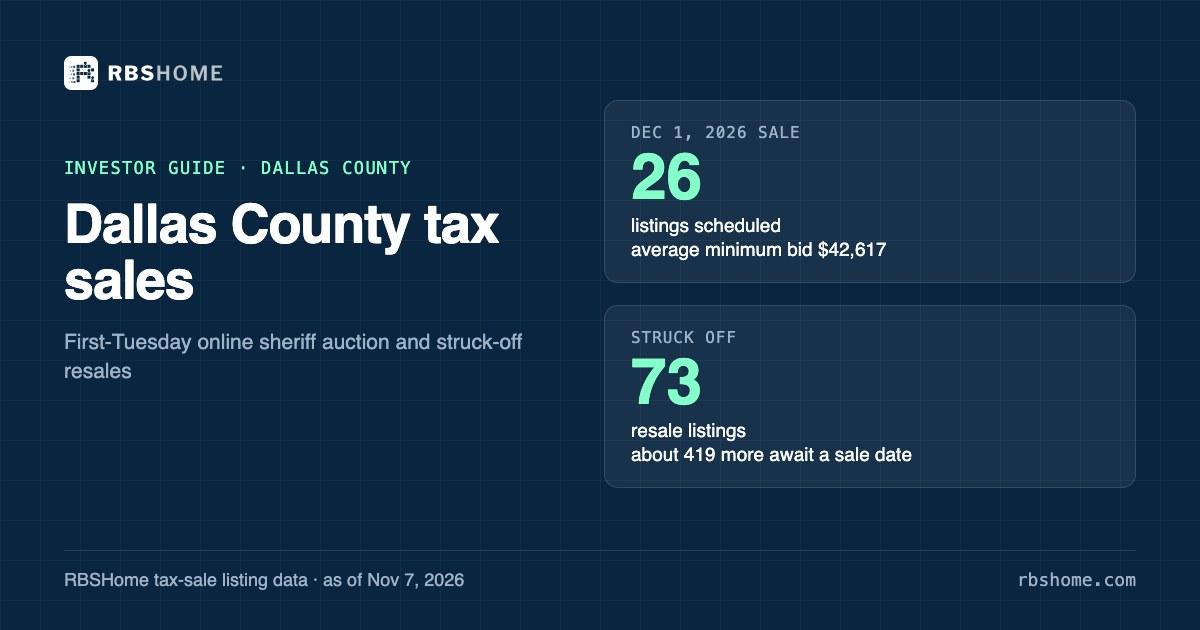
Here is what our data shows for Dallas County as of November 7, 2026:
| Dallas County tax-sale listings | Count or amount |
|---|---|
| Listings scheduled for the December 1, 2026 sale | 26 |
| Average minimum bid, December 1 listings | $42,617 |
| Median adjudged value, December 1 listings | $116,750 |
| Accounts listed for a future sale with no date yet | About 419 |
| Listed as struck-off resale property | 73 |
| Recorded as sold in our listing history | 8 |
| Recorded as cancelled in our listing history | 31 |
Two cautions about these figures. First, the minimum bid is a starting point set by the debt, not a measure of value. An average minimum bid of $42,617 next to a median adjudged value of $116,750 does not mean the properties sell at a third of their value. Competitive listings get bid up, and many listings are cancelled before the sale. Second, the adjudged value is the court's figure from the judgment. It can be stale and it says nothing about condition.
Listings cluster in the southern half of the county. Among our ZIP pages, the most upcoming tax-sale listings are in 75216 South Oak Cliff with 73, followed by 75215 and 75159 Seagoville with 34 each. The full, current list is on our Dallas County tax-delinquent property list.
Struck-off property and county resales
When a property gets no qualifying bid, the Sheriff bids it off to the taxing unit that requested the sale. Under §34.01(k), that taxing unit takes title for itself and the other taxing units in the suit, subject only to the former owner's right of redemption. In Dallas County, the county holds these as trustee.
These struck-off properties can be resold under Tax Code §34.05. The taxing unit may sell at any time by public or private sale, and a resale under certain subsections may be for any amount. The redemption period for struck-off property starts on the date the deed to the taxing unit is recorded.
Dallas County's Property Division resale page and its tax foreclosure resale FAQ describe how it works in practice:
- Sealed bids, not a fixed schedule. Properties on the struck-off list may show "hold for sealed bids." The county advertises a sealed-bid solicitation when it's ready and posts instructions then. There's no regular calendar.
- Commissioners Court approval. After bid opening, the highest qualified bids go to the Commissioners Court, which meets on the first and third Tuesday of each month. The FAQ estimates six to eight weeks from bid opening to acceptance.
- Deposit and balance. A deposit goes with the bid and counts toward the price. Once the court accepts, the full balance is due within 30 days. The county doesn't offer financing.
- No change of heart. After the court's acceptance the deposit isn't refundable, and once the deed issues the sale is final.
- A quitclaim deed. The county conveys the taxing units' right, title and interest by quitclaim deed, subject to any remaining redemption right.
- No guarantee of clean title. The FAQ says there is no guarantee that every ownership and lien interest was accounted for and extinguished by the judgment, and it recommends a title search and an attorney's review.
In our data, 73 Dallas County listings were struck-off resale property as of November 7, 2026. Struck-off property can be a quieter market than the monthly auction, but each one has already failed to attract a bid at the minimum. Find out why. Common reasons are a tiny or landlocked lot, a flood problem, a structure that needs demolition, or a title tangle that scared bidders away.
The deed you get
At the Sheriff's sale, the auction FAQ says purchasers receive "an ordinary type of sheriff's deed which is WITHOUT WARRANTY, express or implied." Title is not guaranteed. At a county resale, you get a quitclaim deed.
The statute gives the tax-sale deed real strength in some ways. Under §34.01(n), the deed vests title to the defendant's interest in the property, including the right to use and possess it, and it may be impeached only for fraud. But that title is subject to:
- the former owner's right of redemption;
- certain recorded restrictive covenants and the liens that arise under them, if recorded before January 1 of the year the tax lien arose and not extinguished by the judgment;
- easements of record recorded before January 1 of the year the tax lien arose.
And it only conveys the interest of the defendants who were properly in the suit. If a lienholder or co-owner was left out of the lawsuit, their interest may survive the sale. That's the main reason title companies are cautious with tax deeds.
Plan for the deed to be hard to insure
The auction FAQ warns that a title insurance policy may be difficult to obtain. Dallas County's resale FAQ says underwriting varies by title company. Before you bid, ask a title company whether it will insure a tax-sale purchase, after what waiting period, and what it needs from you. Without title insurance, a property is harder to finance and harder to resell.
Redemption: who can redeem, when and for how much
Texas gives the former owner a right to buy the property back after a tax sale. Tax Code §34.21 sets the terms.
The periods.
- Two years for property that was the owner's residence homestead, or land designated for agricultural use, when the suit was filed. The clock runs from the date the purchaser's deed is filed for record.
- 180 days for all other property, from the same starting point.
What the owner pays you. To redeem from a private purchaser, the owner pays the amount you bid, the deed recording fee, and what you paid in taxes, penalties, interest and costs on the property, plus a premium:
- 25 percent of that total if redeemed in the first year;
- 50 percent if redeemed in the second year;
- for non-homestead, non-agricultural property, a premium of no more than 25 percent.
"Costs" has a specific meaning in §34.21(g). It includes reasonable amounts spent maintaining, preserving and safekeeping the property, such as property insurance, repairs or improvements required by a local ordinance or building code or by a lease in effect at the sale, municipal health and safety liens you discharge, property owners' association dues, and certain impact or standby fees. The owner can ask for a written itemization, and only costs on that itemization count. Voluntary renovation isn't on the statute's list, so a big rehab during the redemption period is a risk.
Possession. The redemption right doesn't give the former owner a right to use or possess the property or collect rents while it lasts (§34.21(h)). The tax deed includes the right of use and possession (§34.01(n)). In practice, if someone is living there, getting possession may take a court process.
The owner can't sell the right. Under §34.21(l), a transfer of the right of redemption to another person is void.
If you buy at a tax sale, plan for two outcomes. Either the period passes and you own the property subject to the title questions above, or the owner redeems and you get your money back with the premium. Both can be fine. What hurts is spending heavily on the property and then being redeemed, or discovering a title defect you can't fix.
The risks most bidders underestimate
Federal tax liens. If the IRS has a filed tax lien and the United States wasn't joined in the suit, federal law says the judicial sale is made subject to that lien (26 U.S.C. §7425(a)). If the United States was joined and its lien was junior, federal law gives it one year to redeem (28 U.S.C. §2410(c)). Search for federal tax liens against every owner in the chain before you bid, and have an attorney read the judgment to see who was named.
Occupants. Many tax-sale properties are occupied by the former owner, relatives or tenants. Removing anyone takes a lawful court process, time and money. Never try to force someone out yourself. Budget for it and talk to an attorney.
Post-judgment taxes. Taxes that accrue after the judgment aren't in the minimum bid. The auction FAQ says the purchaser takes title subject to them. The resale FAQ also notes that the county tax office doesn't collect for every taxing unit, so check with each one.
City liens and code problems. Mowing, weed and demolition liens filed by cities may or may not be cleared depending on when they were filed. Check with the city. If the house has a demolition order, find out before you bid. Our guide on tax delinquency and legacy homes in 75212 covers how these problems stack up in older Dallas neighborhoods.
Condition you can't inspect. You usually can't go inside before the sale. Assume the worst about the interior.
Wrong property. The address on a listing can be an approximation from tax records. Match the legal description and account number to the appraisal district record and a map before you bid.
Redemption timing. The two-year homestead period is long. Money tied up in a property you can't safely improve or sell has a real cost.
A due-diligence checklist before you bid
- Confirm the property on the Dallas Central Appraisal District site by account number and legal description, and look at it on a map and in person from the street.
- Read the judgment and the petition. Note every defendant and check whether any lienholder appears to be missing.
- Run a title search for liens, including federal tax liens, city liens and HOA liens.
- Work out which redemption period likely applies, and ask an attorney if it isn't clear.
- Call a title company about insurability.
- Check post-judgment taxes with each taxing unit.
- Check city records for open code cases and demolition orders.
- Set your maximum bid from the after-repair value, minus repairs, holding costs through the redemption period, eviction costs if occupied, title costs and your margin. Then don't exceed it in the heat of the auction.
- Get your Written Statement, registration and deposit done early.
If you'd rather buy before a property reaches the auction, the owner may be willing to sell directly while there's still equity to protect. Our distressed property leads for Dallas County track accounts with tax suits and other signals, and our AI connector can pull a property's tax-sale listing history, including sale dates, status and minimum bid from the sale notice.
This article is general information, not legal or tax advice. For your situation, talk to a Texas attorney, CPA or your title company.
Dallas County tax-sale listings, delinquency and lead data