TL;DR
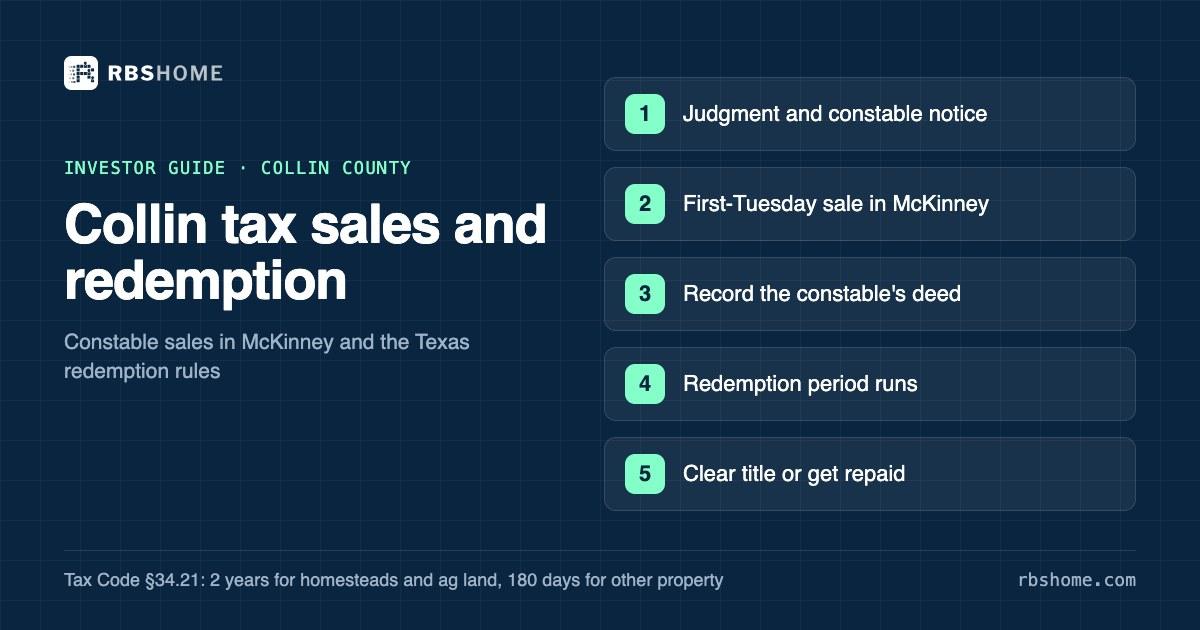
Collin County tax sales are held in person at the courthouse in McKinney on the first Tuesday of each month, conducted by the constable for the area where the property is located. You pay by cashier's check, money order or cash, show a Written Statement from the tax office, and receive a constable's deed without warranty. The former owner can redeem within 2 years for a homestead or agricultural land, paying your bid and allowed costs plus a 25 percent premium in year one or 50 percent in year two; other property has 180 days and a 25 percent cap.
How Collin County tax sales work
In Collin County, tax sales are run by the constables. The Collin County Tax Assessor's properties-for-sale page explains that the officer charged with the sale is the officer who posts it, and in Collin County that's "the Constable for the city in which the property is located." If you have a question about a specific property, you contact that constable's office. The same page also refers to sales and deeds by the Constable or Sheriff, so read each notice to see which officer is selling.
When and where. The county's constable sales page says the sale is held on the first Tuesday of each month between 10 a.m. and 4 p.m. at the Russell A. Steindam Courts Building, which is the courthouse at 2100 Bloomdale Road in McKinney. The Tax Assessor's page describes it as the courthouse steps, east side. Unlike Dallas County, which runs its tax sale online, Collin County's constable sales are live, in-person auctions with oral bids.
Notice. Sales are published in the McKinney Courier Gazette or the Collin County Commercial Record, posted at the courthouse and the constables' offices, and listed online on the constable sales page. Each notice names the court and cause number of the underlying lawsuit, which you'll want for due diligence.
The legal process behind it. The steps match the rest of Texas. Taxes become delinquent on February 1 if unpaid. The taxing units sue, the court enters a judgment and order of sale, and the officer sells the property under Tax Code §34.01 in the manner property is sold under execution. If no one bids at least the lesser of the judgment amount or the adjudged value, the property can be bid off to the taxing unit, which is how it becomes struck-off property.
Not a lien sale. The constables' pages are explicit: "This is NOT a tax lien certificate." The real property is sold, and "There is no Tax Lien Certificate Sale in Collin County." What you buy is a deed subject to a right of redemption.
What our Collin County data shows
Collin County has far less tax delinquency than Dallas County, and far fewer tax sales. Here's our snapshot.
| Collin County measure | Count | As of |
|---|---|---|
| Accounts with a delinquent balance on the latest roll | 20,345 | Nov 3, 2026 |
| Delinquent accounts with a delinquent-tax suit | 1,026 | Nov 3, 2026 |
| Delinquent accounts that are homesteads | 2,234 | Nov 3, 2026 |
| Pending constable sales in our data | 6 | Nov 7, 2026 |
| Future sales in our data | 1 | Nov 7, 2026 |
Two things follow. First, about 5 percent of delinquent Collin accounts had a suit as of November 3, 2026, and only a handful were set for sale. Most delinquent accounts never get near an auction because owners pay, often once a suit is filed. Second, a single month's Collin sale list can be short. If you want to buy Collin property through the tax process, you need patience, or you need to approach delinquent owners before a sale while they still have equity to protect.
For comparison with Dallas County, and for the ZIP-by-ZIP picture, see our Dallas and Collin County tax delinquency report and the Collin County hub, which ranks every Collin ZIP.
Buying at a constable sale
The constables' sale pages, such as Precinct 1's sale information, set out the rules. Read the page for the precinct holding your sale, since details can differ. The main points:
Written Statement. Under Tax Code §34.015, the officer can't deliver a deed unless you show an unexpired written statement from the county assessor-collector saying you owe no delinquent taxes in the county. The Tax Assessor's page says the statement costs $10, requires a notarized request, is good for 90 days, and the Tax Office will provide a notary. You must present it to the constable before you get the deed.
Payment. The precinct pages say payment is by cashier's check, money order or cash, payable to that precinct's constable office. Precinct 3's page says at least the minimum bid is due at the sale with any balance due immediately, with no refunds and no letters of credit. Precinct 1 takes payment at its office in the Collin County Administration Building at 2300 Bloomdale Road. Bring certified funds that cover your top bid.
Additional taxes. The precinct pages warn that taxes may have accrued since the judgment. The Tax Assessor's page adds that current taxes are the purchaser's responsibility if they aren't in the minimum bid.
Failing to pay your bid. Precinct 1's page warns that a successful bidder who fails to make payment can be held liable for 20 percent of the value of the property, the penalty Rule 652 of the Texas Rules of Civil Procedure allows. Don't bid more than the certified funds you brought.
The deed. You receive a constable's deed "without warranty, express or implied." The Tax Assessor's page says property is sold "as is and where is" with no warranties, that title insurance is the purchaser's responsibility, and that a policy may be difficult to obtain.
Record it yourself, promptly. The precinct pages say the purchaser is responsible for filing the deed with the County Clerk. The redemption period runs from the date the deed is filed for record, so every day you wait to record is a day added to the end of the period.
Possession and occupants. The precinct pages say purchasers have the right of possession during the redemption period. That's consistent with Tax Code §34.21(h), which says the right of redemption doesn't give the former owner the right to use or possess the property. But the Tax Assessor's page also says that if the property is occupied, eviction is the purchaser's responsibility, and the county discourages improvements until the redemption period expires.
Buyer beware. All sales are as is, to the highest bidder, on a "Buyer Beware Basis," and the constables won't answer legal questions. The addresses in notices come from tax records and may not be accurate.
The redemption period explained
Texas gives the former owner a statutory right to buy the property back from you. Tax Code §34.21 controls.
Two periods. If the property was the owner's residence homestead, or land designated for agricultural use, when the suit was filed, the owner can redeem on or before the second anniversary of the date your deed is filed for record. For all other property, the owner has 180 days from that date. The constables' pages repeat this and add a warning: "Collin County makes no representation as to which redemption period applies." Working that out is your job.
What the owner pays. To redeem from a private buyer, the owner pays:
- the amount you bid;
- the deed recording fee;
- what you paid as taxes, penalties, interest and costs on the property;
- plus a redemption premium on that total: 25 percent in the first year, or 50 percent in the second year.
For non-homestead, non-agricultural property, the premium can't exceed 25 percent, and the period is only 180 days anyway.
What counts as costs. Section 34.21(g) defines costs as amounts reasonably spent maintaining, preserving and safekeeping the property, including property insurance; repairs or improvements required by a local ordinance, a building code, or a lease in effect at the sale; discharging a city lien for remedying a health or safety hazard; property owners' association dues under a recorded covenant; and certain impact or standby fees paid to a political subdivision. Voluntary renovation isn't on that list.
The itemization rule. The owner can send you a written request for an itemization of costs. You must deliver it within 10 days after you receive the request, and only the amounts on your itemization count. Keep receipts for everything from day one.
Other rules worth knowing.
- If the owner can't find you, or you won't agree on the amount or give a quitclaim deed, the owner can pay the county assessor-collector with an affidavit, and the recorded receipt is notice that the property has been redeemed (§34.21(f)).
- A transfer of the right of redemption to someone else is void (§34.21(l)). Anyone offering to buy the owner's redemption right is offering something the law doesn't allow.
- A person who had title or possession when the suit was filed or the property was sold can redeem, and a defect in their chain of title doesn't defeat the offer to redeem (§34.22).
A worked example of the redemption math
The numbers below are hypothetical, chosen to show how the statute's formula works. They aren't drawn from any real Collin County sale.
Say you win a Collin County constable sale with a bid of $60,000 on a property that was the owner's homestead when the suit was filed. After the sale you pay $50 to record your deed, $1,800 in property taxes that come due, $900 for property insurance and $250 for a city-required repair. You document all of it and deliver a proper itemization.
| Line | Redeemed in year one | Redeemed in year two |
|---|---|---|
| Your bid | $60,000 | $60,000 |
| Deed recording fee | $50 | $50 |
| Taxes you paid | $1,800 | $1,800 |
| Itemized costs (insurance, required repair) | $1,150 | $1,150 |
| Aggregate total | $63,000 | $63,000 |
| Premium (25% or 50%) | $15,750 | $31,500 |
| Owner pays you | $78,750 | $94,500 |
Now change one fact: the property was a vacant lot, not a homestead or agricultural land. The owner then has only 180 days to redeem, and the premium can't exceed 25 percent. The most you'd receive on the same figures is $78,750, and only if the owner redeems within 180 days of your recording.
What the example leaves out matters as much as what it shows.
- Your money is tied up. Two years at no return, followed by a redemption, is a very different result than the premium makes it look.
- Spending beyond the statute's list is at your risk. If you put $40,000 into a renovation that no ordinance required, and the owner redeems, you shouldn't expect it back as a cost under §34.21(g). This is why the county discourages improvements during the redemption period.
- Your own costs aren't covered. Attorney fees, title work, travel and your time aren't in the formula.
- An owner who redeems may be the best outcome. If the property turns out to have a title problem, getting your bid back with a premium can beat owning it.
Excess proceeds after the sale
When a property sells for more than the judgment and costs, the excess goes to the court's registry. Two sections of the Tax Code control what happens next.
Under §34.03, if the excess is more than $25, the clerk must send the former owner a written notice within 30 days stating the amount and explaining the right to claim it. The clerk holds the money for two years after the sale, unless the court orders otherwise. If no one establishes a claim in that time, the money is distributed to the taxing units.
Under §34.04, a claimant petitions the court that ordered the sale, before the second anniversary of the sale date. The petition can be filed under the original cause number. The court pays established claims in this order:
- the tax-sale purchaser, if the sale was later adjudged void and the purchaser won a final judgment against the taxing units;
- a taxing unit, for taxes that came due after the judgment or were omitted by mistake;
- other lienholders, in their order of priority;
- a taxing unit, for judgment amounts the sale didn't cover;
- former owners who were defendants in the judgment, relatives within the third degree of a defendant owner, or those who inherited a defendant owner's interest.
No interest or costs are allowed on the claim.
Rules for anyone buying claims. Section 34.04(f) restricts assignments of an owner's claim. An assignment can't be taken until the 36th day after the money is deposited, must be in writing and signed, can't result from in-person or telephone solicitation, and must pay the owner at least 80 percent of the claim on the date of the assignment, with a sworn statement covering a list of required facts. If you're thinking about working in excess proceeds, have an attorney build your process around this section.
If you were the owner
If your property sold at a tax sale for more than you owed, you may be entitled to the excess. Watch for the clerk's notice, and talk to an attorney about filing a claim under §34.04 before the two-year deadline. You don't have to sell your claim to anyone to get paid.
Struck-off property in Collin County
When nobody bids enough, the property is bid off to the taxing unit. The Collin County Tax Assessor's page calls these struck-off properties: the taxing entity becomes the owner of record and a deed is filed with the County Clerk.
The Tax Assessor's page says these properties may be sold through a private bidding process if all the taxing entities with a claim agree or approve offers, and it names the law firm that processes those bids for Collin County. The constables don't keep a struck-off list; the precinct pages point you to the Tax Assessor. Resales of struck-off property are governed by Tax Code §34.05, and any remaining redemption right still applies, measured from when the deed to the taxing unit was recorded.
As with any struck-off property, ask why it didn't sell. The usual reasons are size, access, flood exposure, condition or title.
Due diligence before you bid
- Pull the lawsuit. The notice names the court and cause number. Read the petition and judgment. List every defendant and look for lienholders who should have been named but weren't.
- Search the property records. Start at the County Clerk's land recordings page. Look for deeds of trust, releases, federal tax liens, HOA liens, city liens and abstracts of judgment. The clerk notes its online database isn't the official repository, so confirm important documents.
- Check federal tax liens closely. If the United States had a filed lien and wasn't joined in the suit, federal law says the sale is subject to it (26 U.S.C. §7425(a)). If the United States was joined and its lien was junior, it has one year to redeem (28 U.S.C. §2410(c)).
- Confirm the property. Match the legal description and account number to the Collin Central Appraisal District record. Notice addresses can be wrong.
- Work out the redemption period. Was it a homestead or agricultural land when the suit was filed? The appraisal records for that year usually tell you, but ask an attorney if it's close.
- Talk to a title company first. Ask whether it will insure a constable-deed purchase and on what conditions.
- Look at it. Drive by. Note occupancy, condition and access. Assume you won't see inside.
- Price it with a range. Value comes from closed sales through an agent and from the land market. Our ZIP pages show median appraisal-district land values per square foot for every Collin ZIP, such as McKinney 75071. Set your top bid from the low end of your range, minus repairs, holding costs through the full redemption period, title work and your margin.
- Prepare your paperwork. Written Statement, certified funds and a plan to record the deed the same day you get it.
If you'd rather reach owners before a sale, our AI connector can list a Collin County property's constable sale notices, minimum bid and status, and our plans include Collin delinquency data. Many owners prefer to sell on their own terms while they still have equity. If that's you, our guide to selling land in Collin County explains how a direct sale works.
This article is general information, not legal or tax advice. For your situation, talk to a Texas attorney, CPA or your title company.
Collin County delinquency, constable sale listings and ZIP land data