TL;DR
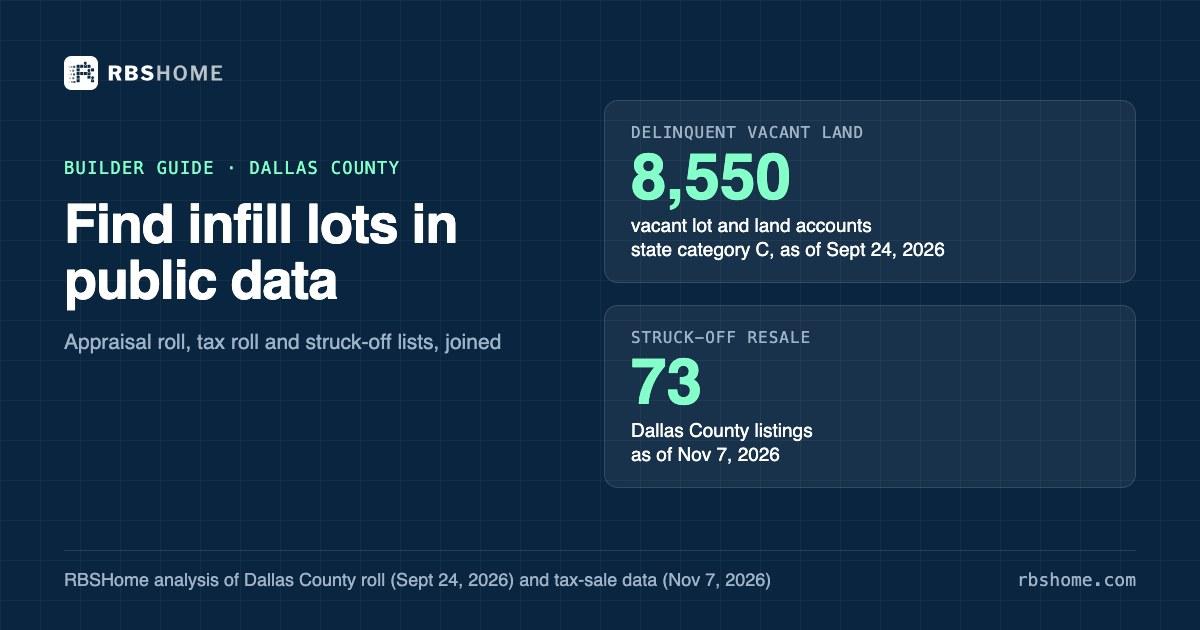
Start with the Dallas Central Appraisal District's free data files and filter for vacant-land category codes. Join them to the Dallas County Tax Office's weekly TRW file by account number to find the vacant lots that owe back taxes: 8,550 delinquent vacant lot and land accounts as of September 24, 2026. Add sheriff-sale and struck-off lists, then screen every lot for building-site status, frontage, zoning, utilities and floodplain on the City of Dallas maps before you contact an owner.
In this article
- 1. What counts as an infill lot, and why public data works here
- 2. Source 1: Dallas CAD records and the vacant-land category
- 3. Source 2: The TRW file and delinquent vacant land
- 4. Source 3: Tax sales, struck-off resales and the city land bank
- 5. Source 4: City of Dallas zoning and GIS maps
- 6. Where builder demand and lot supply overlap
- 7. The buildability screen: five checks before you call an owner
- 8. Reaching owners and making an offer
- 9. A weekly workflow you can repeat
Most infill lots that sell to small builders in Dallas County never reach the MLS. They're owned by heirs, out-of-state relatives, investors who bought decades ago, or the taxing units after a failed tax sale. The good news is that almost everything you need to find them is public and free. The hard part is joining the sources together and throwing out the lots you can't build on.
This guide walks through the four public sources we use, how to combine them, and the screen that separates a buildable lot from a cheap problem. It's written for builders and developers working inside Dallas County. If you need the zoning detail for north Dallas teardown districts, our zoning and setbacks guide for 75205, 75209 and 75220 covers that. This post is about finding the lots in the first place.
What counts as an infill lot, and why public data works here
An infill lot is a parcel inside an existing neighborhood, with streets and usually water and sewer already in place, that's vacant or carries a structure worth less than the land. For a builder, that means two different hunts: vacant lots, and teardowns where the house is near the end of its life.
Dallas County suits a data-driven search for three reasons.
- It's built out. New lots come mostly from vacant parcels and redevelopment, not raw land. That makes the existing parcel roll the main source of supply.
- The records are machine-readable. The appraisal district and the tax office both publish bulk files you can load into a database.
- The delinquency pool is large. As of September 24, 2026, our analysis of the Dallas County roll counted 960,281 accounts, 94,216 of them delinquent, and 8,550 of those delinquent accounts were vacant lots or land (state category C). A delinquent vacant lot is often owned by someone who isn't using it and may be open to selling.
A delinquent account is a signal, not a guarantee. Plenty of owners pay late every year and have no interest in selling. Treat the data as a way to decide whom to research first.
Source 1: Dallas CAD records and the vacant-land category
The Dallas Central Appraisal District appraises every parcel in the county. Its Data Products page offers downloadable appraisal data files, including the current-year data with the most recent ownership and the certified files with supplemental changes. The files are large zipped downloads with reference documents, and DCAD says it can't provide technical support for using them, so plan on a database rather than a spreadsheet.
What you get for each account:
- Owner name and mailing address. The mailing address tells you whether the owner lives at the property, elsewhere in Dallas, or out of state.
- Situs address and legal description. The legal description often names the addition, block and lot. That's your first clue to whether the parcel is platted.
- Land area and land value. Divide land value by square feet to get the appraised land rate. It's the same measure we use for lot medians on our ZIP pages.
- State property category code. Texas appraisal districts classify property into state categories. In the Comptroller's classification guide, category C1 is vacant lots and land tracts. Each DCAD download includes reference documents that describe its fields, so check how the file records the category before you filter on it.
Filter the roll for the vacant categories and you have a county-wide inventory of vacant parcels. Expect noise. Some "vacant" accounts are slivers left over from road projects, drainage tracts, landlocked strips or common areas owned by an association. Size and shape filters remove most of them: drop parcels below the minimum lot size of the zoning districts you build in, and flag anything narrower than you can design for.
Appraised value is not a sale price
Texas doesn't require sale prices to be disclosed to the public, so appraisal-district land values are the best public measure of what land is worth by ZIP. They lag the market and vary by neighborhood. Use them to rank and compare lots, not as your offer price.
For teardowns, flip the filter. Look for improved residential accounts where the land value makes up most of the total appraised value and the improvement is old and small. In high-value ZIPs, that ratio is often the best public sign that a builder, not a homeowner, is the likely buyer.
Source 2: The TRW file and delinquent vacant land
The Dallas County Tax Office publishes a weekly bulk file called the Tax Roll, or TRW. According to the tax office's own TRW FAQ, the file covers the current-year roll for the taxing units it collects for, paid and unpaid, plus unpaid balances for prior years. It's created after close of business each Friday and posted the following Monday, holidays excepted. There's no charge for it.
A few details from the TRW FAQ matter for builders:
- How to spot delinquency. The tax office says a delinquent account carries a due date in the past.
- No legal descriptions. The TRW doesn't include them. The tax office tells users to download DCAD's certified data files and cross-reference by account number.
- No auction flag. The file contains delinquent accounts but doesn't mark which ones are headed to a tax sale.
- Paying someone's taxes gets you nothing. The FAQ states plainly that paying taxes on a property doesn't give you possession of it under Texas law.
Join the TRW to the DCAD roll on account number, keep the vacant categories, and keep accounts with a past due date. That's the list that produced our count of 8,550 delinquent vacant lot and land accounts as of September 24, 2026.
Then rank the list. In the same snapshot, 31,309 delinquent accounts of all types owed for three or more tax years, 7,235 had a delinquent-tax suit filed, and 4,861 had an out-of-state mailing address. Several years of unpaid taxes, a pending suit and an owner who lives far away is a typical profile of a lot that will sell. A suit also means the clock is running toward a tax sale, which changes the owner's options. You can see current counts by ZIP on our Dallas County tax-delinquent property list and the wider distressed property leads page. Our Dallas and Collin County tax delinquency report has the county-level trend.
Texas property taxes become delinquent on February 1 if they're unpaid. So a file pulled in early spring shows a lot of short-term delinquency that clears by summer. Weight multi-year delinquency more heavily than a single missed year.
Source 3: Tax sales, struck-off resales and the city land bank
Some lots come to market through public sales rather than private deals.
Sheriff's tax sales. Dallas County's Public Works Property Division page says tax-foreclosed properties are sold by the Dallas County Sheriff through a live online auction on the first Tuesday of every month, and links to the current list of tax-sale properties. In RBSHome's tax-sale data as of November 7, 2026, 26 Dallas County listings were scheduled for the December 1, 2026 sale, with an average minimum bid of $42,617, and about 419 more accounts were listed for a future sale with no date. Many listings never reach the block, because owners pay before the sale.
Struck-off resales. When a property gets no qualifying bid, it's struck off to the taxing units and can be resold later. As of November 7, 2026, our data showed 73 Dallas County listings marked as struck-off resale property. They can suit builders who are patient with paperwork, but they come with tax-sale caveats. A redemption period may apply, and you should ask a title company whether it will insure the title before you bid. Under Tax Code §34.21, the owner can redeem within two years for a residence homestead or agricultural land and within 180 days for other property. A vacant lot usually falls in the 180-day group, but confirm the property's status with a title company before you bid.
The City of Dallas land bank. The City's housing department describes a Land Bank and a Land Transfer Program that sell lots to qualified developers for affordable housing for income-eligible households. If your business model fits those terms, it's a source of lots that private searches won't show. The housing department's program pages set the eligibility and building terms. Read them closely before you apply, and expect conditions on who you can sell the finished house to.
Source 4: City of Dallas zoning and GIS maps
Once you have a candidate lot, the City's maps tell you what you can build. The Zoning Resources page names the City of Dallas Map Hub as its main public map. It has address search and layers for zoning and zoning cases, area plans, conservation districts and authorized hearings. The same page links the older zoning map, the City's interactive maps homepage (thoroughfare plan and capital improvements layers among them), a zoning case log, and a chart summarizing the standards for each zoning district.
What to pull for each lot:
- Base zoning district. It sets minimum lot area, frontage, setbacks, height and lot coverage. Check the district chart, then confirm in the Dallas Development Code.
- Overlays and special districts. Conservation districts, historic districts and planned development districts can carry their own rules that override the base district.
- Deed restrictions where the City is a party. The City's preliminary plat checklist asks for a copy of any such restrictions, so look for them in the deed records early.
- Open zoning cases nearby. A pending case on the next block can change what the neighborhood looks like in two years.
The Zoning Resources page calls its district chart a quick reference and tells users to check the code for current rules. Treat the maps the same way: use them to screen, then confirm with the code, the City's zoning staff and a survey.
Where builder demand and lot supply overlap
A lot is only worth buying if someone will build and sell on it. Our ZIP data combines the supply side (distressed properties tracked, upcoming tax-sale listings) with the demand side (how many builders bought in the last 12 months, and at what land values). Here are the Dallas County ZIPs where both sides are active, as of November 7, 2026.
| ZIP | Distressed properties tracked | Upcoming tax-sale listings | Distinct builders buying (12 mo) | Median lot land value / sq ft |
|---|---|---|---|---|
| 75216 South Oak Cliff | 2,106 | 73 | 48 | $9.47 |
| 75241 South Dallas | 1,123 | 30 | 28 | $7.08 |
| 75215 South Dallas / Fair Park | 998 | 34 | 56 | $10.00 |
| 75212 West Dallas | 970 | 16 | 46 | $15.66 |
| 75203 North Oak Cliff | 543 | 24 | 24 | $13.32 |
| 75210 South Dallas | 453 | 25 | 22 | $10.00 |
Two patterns stand out. First, the ZIPs with the most distress in the county are also where dozens of small builders are buying. That's not a coincidence: low land values and a steady supply of vacant and delinquent lots make the numbers work for a builder doing one or two houses at a time. Second, the land values are low in absolute terms, so the lot price is rarely what makes or breaks the deal. Site costs are. To take a hypothetical example, a $60,000 lot that needs a sewer extension or sits in a floodplain can cost more than a $120,000 lot that's ready to build.
North Dallas works differently. In 75229, 62 different builders bought in the same 12 months, with a median lot land value of $35.68 per square foot and a median lot of 14,710 square feet. In 75214 the median was $58.50 and in 75209 $67.37. Those are mostly teardown markets, where the supply comes from older houses rather than vacant land, and our teardown economics post explains how the math changes. Every ZIP is ranked on the Dallas County market page.
The buildability screen: five checks before you call an owner
Most cheap lots are cheap for a reason. Run these five checks first. Each can be done from public sources in under half an hour.
1. Is it a legal building site?
The City of Dallas platting guidelines (December 2024) say a plat establishes a legal building site and is generally required before a building permit or certificate of occupancy can be issued. They also say a plat isn't the same as a "tax plat" created by a deed. The guidelines list exceptions for older lots. A lot that has stayed in the same configuration since September 11, 1929, or since before annexation, may qualify. So may a parcel where building permits were issued before August 1, 1984. If the lot was cut out of a larger tract by metes and bounds, expect to plat or replat it. The City's platting guidelines direct questions on prior platting to the City's survey records vault or the county records building.
2. Frontage and access
Check that the lot fronts a public street and meets the district's minimum frontage. Landlocked parcels and lots that front only an unimproved or abandoned right-of-way are common in older parts of southern Dallas. Look at the street on aerial imagery and confirm on the plat that the right-of-way was actually dedicated.
3. Zoning fit
Compare the lot's area and width with the zoning district minimums. A lot that's undersized for its district may still be buildable if it was legally created before the current rules. That's a question for the City's zoning staff, not a guess. Also check whether a duplex, townhouse or accessory unit is allowed, since that can change what the lot is worth to you.
4. Water, sewer and drainage
Inside the City of Dallas, water and sewer service comes from Dallas Water Utilities, but don't assume there's a tap at the lot line. Check for nearby water and sewer mains on the City's maps and ask about tap and impact fees before you price the lot. Drainage matters too. The City's 2019 Drainage Design Manual requires detention when development increases peak flow or velocity, but it exempts infill and redevelopment on parcels under one acre that add less than 5,000 square feet of impervious surface. Many single-lot projects fall under that line. Small assemblages may not.
5. Floodplain and creeks
Look up the lot on FEMA's Flood Map Service Center and turn on the FEMA NFHL Flood Zones layer in DCAD's map, one of the screening tools the City's floodplain page suggests. The City's floodplain page says building a new structure in the 100-year floodplain needs a floodplain fill permit and final approval by the City Council. That's a months-long engineering process, not something to take on for a single house. If any part of the lot is mapped, find out how much before you go further.
Title problems hide in cheap lots
Delinquent vacant lots often have more than one problem: unpaid taxes, a city lien for mowing or demolition, an unprobated estate, or several heirs who each own a share. Order a title commitment early, and budget time for curative work if the owner of record has died.
Reaching owners and making an offer
The DCAD mailing address is your starting point. A short, plain letter that names the lot by address and legal description, says you're a builder interested in buying it, and gives a direct phone number works better than a postcard that could be about anything. For out-of-state owners, mention that you can close through a Dallas title company without them traveling.
Some practical notes:
- Check the owner is alive and the entity active. A deceased owner means heirs and possibly probate. An LLC owner that's forfeited its charter may need to be reinstated before it can sign a deed. Ask your title company.
- Respect the owner's situation. A delinquent owner may be dealing with illness, a family death or money trouble. Make a fair offer, put it in writing, and give them time to get advice.
- Price from the site, not the tax bill. Back taxes, penalties and interest are paid off at closing out of the sale price, so a large balance doesn't make the lot worth less to the owner than it's worth to you. Start from what a finished house sells for, subtract build and site costs and your margin, and that's your ceiling.
- Write contingencies for the screen. If you couldn't confirm building-site status or utilities before signing, put a feasibility period in the contract and use it.
A weekly workflow you can repeat
The data changes weekly, so a one-time pull goes stale quickly. A simple routine:
- Monday: Download the new TRW file and refresh the join to your DCAD extract. Note which accounts became delinquent or paid off since last week.
- Monday: Check the sheriff-sale list and struck-off listings for new vacant parcels in your target ZIPs.
- Tuesday: Run the five-point screen on new candidates. Most will fail. That's the point.
- Wednesday: Send letters to owners of the lots that pass. Log each contact so you don't double-mail.
- Monthly: Re-check builder activity by ZIP. If a ZIP's builder count is rising and its lot values aren't, that's where to focus.
If you'd rather not build the database yourself, RBSHome's platform joins these sources for Dallas and Collin County. It has ZIP market pages, a builder-demand view that shows which builders are buying where, and an AI connector for researching parcels in plain language. Whatever tools you use, the screen is the same: find the lot, confirm you can build on it, then make the offer.
This article is general information, not legal or tax advice. For your situation, talk to a Texas attorney, CPA or your title company.
Dallas and Collin County ZIP data, updated weekly.