TL;DR
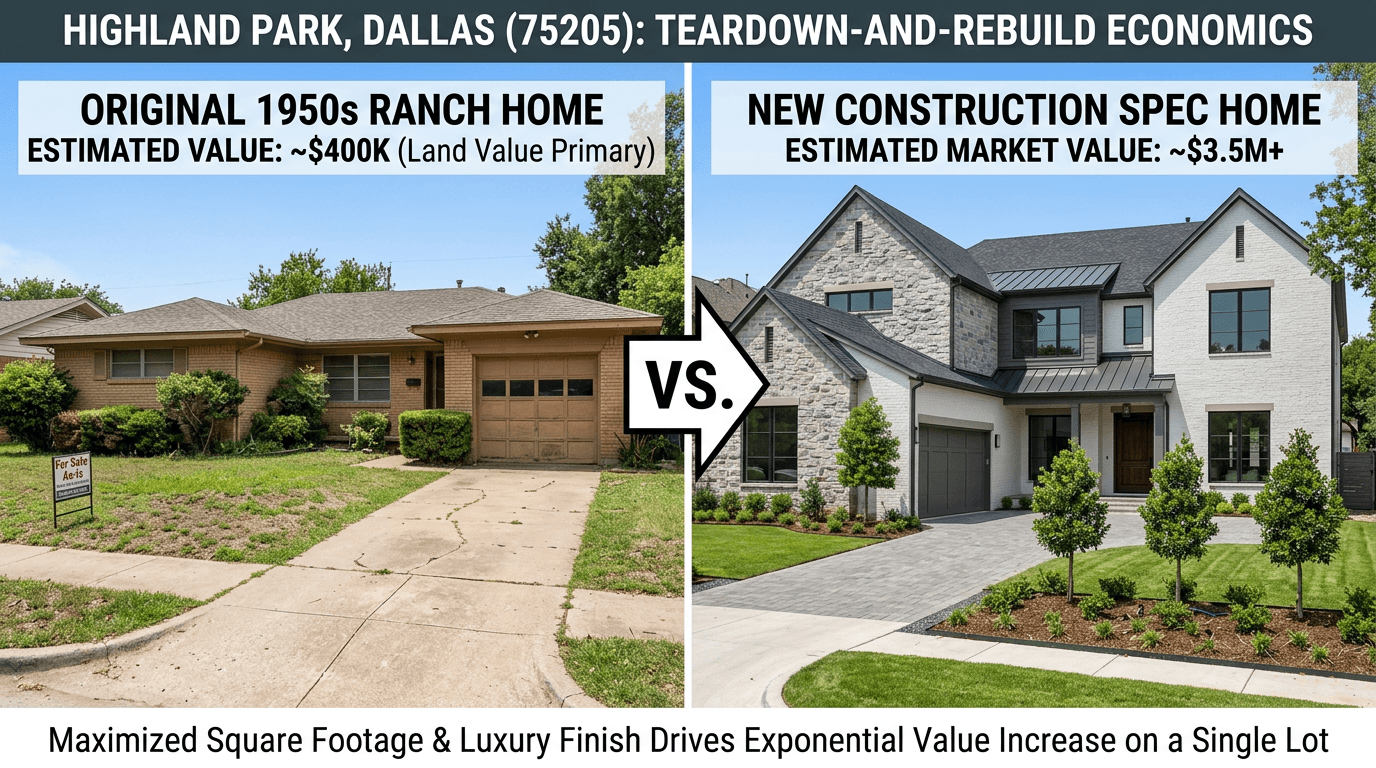
In the premier enclaves of Highland Park (75205), the traditional rules of real estate appraisal no longer apply to older homes. Because Dallas suffers from an extreme scarcity of infill dirt, luxury custom builders are heavily acquiring 1940s-1960s homes solely to bulldoze them, paying massive premiums based entirely on the underlying land value.
If you own a home built between the 1930s and 1960s in Highland Park (75205), University Park (75225), or the surrounding Park Cities corridors, you are sitting on one of the most highly contested asset classes in the Texas real estate market.
When homeowners in these elite ZIP codes decide to sell, they often assume they need to spend $150,000 updating their kitchens, repairing aging pier-and-beam foundations, and staging the property for the MLS. However, for a significant portion of 75205 properties, this capital expenditure is a total waste of money.
Why? Because the retail buyer you are trying to attract does not exist. The most aggressive, highest-paying buyers in Highland Park are luxury infill builders who view your physical house as a liability to be demolished. In this deep dive, we explore the exact economics of Dallas teardowns, how builders underwrite your dirt, and why 75205 trades almost exclusively at a land-only premium.
The Principle of Functional Obsolescence in the Park Cities
To understand teardown economics, you must understand the concept of "Functional Obsolescence."
Imagine you own a meticulously maintained, 2,200-square-foot, 3-bedroom ranch home built in 1955, situated on a premium 0.25-acre interior lot in Highland Park. By normal suburban standards, this is a beautiful, highly valuable home.
However, the 2026 Highland Park buyer demographic consists of high-net-worth individuals, executives, and athletes who demand 5,500+ square feet, three-car garages, 12-foot ceilings, and smart-home integration. Your 1955 ranch, no matter how well-kept, is fundamentally obsolete for the demands of the current micro-market.
Furthermore, Texas faces a severe scarcity of urban core land. While 6.9% of all new single-family homes nationally are teardowns, the West South Central region has an infill rate of just 9.7%. Because Highland Park is landlocked by the City of Dallas, there is absolutely zero geographic expansion possible. To build the $5 Million estates that modern buyers demand, builders have no choice but to acquire your lot and bulldoze your obsolete structure.
Therefore, your property's appraisal is driven 100% by the dirt, not the bricks.
DFW Infill Rebuild Economics: Understanding the Finished Exit Band
So, how does a builder decide what they are willing to pay for your property? They work backward from the future.
Professional builders do not care about "comps" of other aging 1950s homes. They underwrite your lot based on a strict finished exit band. In the premium corridors of 75205, 75220, and 75209, new construction consistently clears finished retail values between $1.6 Million and $3.75 Million (and frequently much higher for custom specs).
The Builder's Math
Here is the simplified formula builders use to generate your cash offer:
Projected New Build Resale Value (e.g., $3.5M) – Vertical Construction Costs (Materials/Labor) – Holding Costs/Financing – Target Profit Margin = Maximum Allowable Land Basis (Your Cash Offer).
Because luxury vertical construction in 75205 can command anywhere from $800 to $1,200+ per square foot upon resale, the math allows builders to pay millions of dollars just to secure the dirt pad.
Why Top-Tier Builders Pay 10–25% Above "Flipper" Offers
Many homeowners mistakenly lump all "Cash Buyers" into the same category. There is a massive financial difference between a "We Buy Houses" flipper and an institutional luxury builder.
A traditional flipper operates on tight margins. They want to buy your 75205 home at a steep discount, put lipstick on a pig (fresh paint, cheap flooring), and resell it to a retail buyer. Because they are capped by the functional obsolescence of the small floor plan, their cash offer will be aggressively low.
A luxury infill builder is unlocking the highest and best use of the land. Because they are creating an entirely new, massive asset with a $3.75M exit value, they can absorb higher acquisition costs. Serious builders regularly pay premiums of 10% to 25% above what generic flippers or wholesalers will offer for the exact same property, provided the lot passes their strict adjacency filters.
The Hard Limits: Why We Blacklist Arterial Streets in 75205
While Highland Park dirt is incredibly valuable, not every lot is buildable. The most critical factor in teardown economics is adjacency.
A builder cannot erect a $3.5 Million architectural masterpiece on a lot that suffers from incurable location defects. High-net-worth retail buyers will simply not tolerate heavy traffic noise, lack of privacy, or commercial adjacencies at that price point.
When RBS Home Buyers screens off-market teardowns for our builder partners, we enforce strict disqualifiers ("Hard NOs"). If your property falls into any of these categories, its value drops significantly:
- Arterial Backing: Properties that back up to or corner on an arterial road, frontage road, or highway on-ramp.
- Commercial Neighbors: Lots situated directly across the street from a church, school, or retail center.
- The Blacklist: We actively avoid properties situated directly on major thoroughfares. For the Dallas infill market, we officially blacklist: Walnut Hill, Royal Ln, Forest Ln, Midway, Inwood, Hillcrest, Marsh Ln, NW Highway, and Webb Chapel Rd.
If your home sits on a quiet, tree-lined interior street in Highland Park, you hold a premium asset that builders are desperate to acquire off-market. Find out what your lot is worth →
Skip the MLS and realtor fees. Get a builder-premium cash offer today.