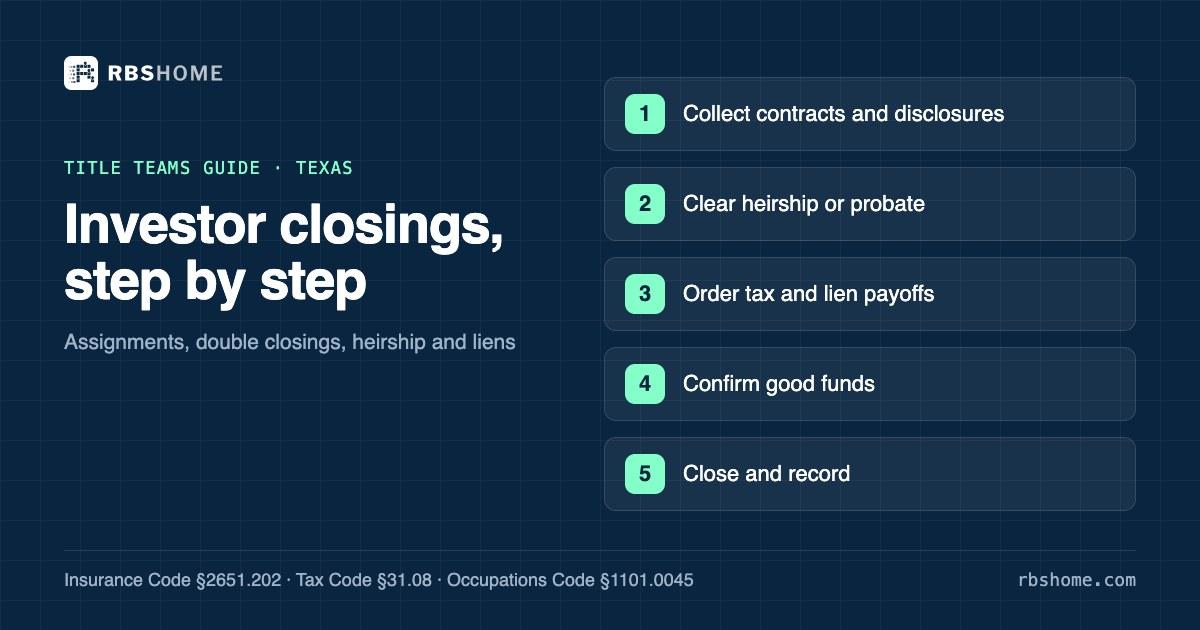
TL;DR
Investor files close cleanly when the title team knows which structure it has, an assignment with one deed or a double close with two, and gets the contract chain and the section 1101.0045 equitable-interest disclosures at opening. Double closings turn on the good funds rule: no disbursement until good funds covering it are received and deposited. Estate files depend on the right authority, whether letters with a power of sale, a muniment order, a recorded heirship affidavit the underwriter accepts, or a court judgment. Order tax certificates and city lien payoffs on day one, and set expectations with investor buyers in writing.
In this article
- 1. Two structures: assignment and double close
- 2. The section 1101.0045 disclosure
- 3. Funding a double close
- 4. Heirship and probate: what title can accept
- 5. Delinquent taxes and tax certificates
- 6. Municipal liens and code costs
- 7. TDI rules that touch investor closings
- 8. Communication habits that keep investor files moving
Investor closings make up a steady share of the files at Dallas and Collin County title companies. As of November 7, 2026, RBSHome's records show 9,237 investor purchases in Dallas County and 19,650 in Collin County over the previous 12 months. The Dallas County and Collin County hubs rank every ZIP by that activity. Those files tend to bring the same handful of issues: an assignment or a second, linked transaction, a seller who is an estate or a set of heirs, delinquent taxes, and city liens.
This guide is for escrow officers, title examiners and closers who handle these files. It doesn't tell you what your underwriter will accept; only your underwriter can do that. It lays out the Texas rules that sit behind the common requests, so you can ask for the right documents at opening instead of the week of closing.
Two structures: assignment and double close
The first question on an investor file is how the investor plans to close.
Assignment. The investor (the assignor) signed a purchase contract with the owner and assigns its rights to an end buyer (the assignee). One closing happens, with one deed from the seller directly to the end buyer. The assignor is usually paid an assignment fee at closing. Your file needs the original contract, any amendments, the assignment agreement, and confirmation that the contract permits assignment or that the seller has consented.
Double close. The investor buys from the seller in one transaction and sells to the end buyer in a second, often the same day. Two deeds, two settlement statements, two sets of closing costs. Your file needs both contracts, and you need a plan for funding the first transaction.
| File item | Assignment | Double close |
|---|---|---|
| Contracts in file | Original contract plus assignment agreement | Two separate purchase contracts |
| Deeds recorded | One, seller to assignee | Two, seller to investor and investor to end buyer |
| Settlement statements | One, often showing the assignment fee | Two, each showing its own price |
| Funding question | End buyer funds the purchase | Good funds for the first leg must be in hand before disbursing |
| Policies | Owner's policy to the end buyer | Depends on what each buyer orders; ask your underwriter about back-to-back policies |
Ask at opening, and write the answer in the file notes. A file that starts as an assignment and turns into a double close the day before closing is how errors happen.
A few checks help on either structure:
- Assignment clause. Read the contract's assignment language. Some forms prohibit assignment without consent. If the seller didn't consent, ask for a signed consent or an amendment.
- Entity documents. Many investors buy in an LLC. Ask for the certificate of formation, the company agreement or a resolution showing who can sign, and confirm the entity's status with the Secretary of State.
- Who is the end buyer? Know whether the end buyer is financing. A lender may have its own rules about a property that changed hands minutes earlier, and those rules can stop a double close at the last minute.
The section 1101.0045 disclosure
Texas lets a person who holds an option or a contract to buy real property sell the option or assign the contract without a real estate license, but only on conditions. Occupations Code section 1101.0045 requires that the person not use the contract to engage in real estate brokerage, and that it disclose in writing the nature of the equitable interest to any seller or potential buyer. A person who assigns or offers to assign without that written disclosure is engaging in brokerage under subsection (b).
TREC's summary of the 2023 change says Senate Bill 1577 requires the notice to the potential buyer to be in writing and requires the same notice to the seller, effective January 1, 2024. TREC also reported, in its 2022 wholesaling survey results, that title professionals found these transactions take longer, cancel more often, and often involve sellers who don't know they are ultimately selling to someone else.
The statute puts the disclosure duty on the assignor, not on the title company. Still, asking for a copy of the signed disclosures at opening is a sensible habit:
- It surfaces sellers who don't understand the transaction while there is still time to resolve it.
- It reduces the chance of a seller refusing to sign at the closing table when they see the assignment fee.
- If the assignor is a license holder, Occupations Code section 1101.652(b)(16) allows discipline for acting as broker and undisclosed principal, so a disclosure of license status matters too.
The title company doesn't decide whether a wholesaler needed a license. If the file raises that question, refer the parties to their own attorneys.
Funding a double close
The good funds rule shapes every double close in Texas.
Insurance Code section 2651.202 says a title insurance company, title agent or direct operation may not disburse funds from a trust fund account until good funds related to the transaction have been received and deposited in amounts sufficient to fund any disbursements from the transaction. TDI implements it through Procedural Rule P-27 in the Basic Manual of Rules, Rates and Forms.
P-27 defines good funds to include cash and wire transfers, cashier's, certified and teller's checks, uncertified items under $1,500, larger uncertified items once collected, and certain government checks. It says good funds equal to all disbursements must be received and deposited before any disbursement is made, and partial disbursements before then aren't allowed. A wire counts as received when the financial institution notifies the trustee.
For a double close, that means:
- Each leg needs good funds behind its disbursements. The seller in the first transaction can't be paid until good funds for that transaction are in the account.
- Using the end buyer's funds for the first leg is a policy question. Whether, and how, the end buyer's wired funds can support the first transaction is something the title company and its underwriter decide. Some require the investor to bring its own funds or a transactional loan for the first leg. Confirm the rule before either contract is signed, not after.
- Wires take time. If the end buyer is financing, the lender's wire may arrive late in the day. Build that into the closing schedule, and tell the first seller when to expect funds.
- Separate statements protect privacy, within limits. Each party receives its own settlement statement. The deeds are public, but Texas doesn't require disclosure of sale prices to the public, and recorded deeds typically don't state the price.
Heirship and probate: what title can accept
Estate sellers are common on investor files, because heirs often prefer an as-is sale. Every path below puts a different person, or group of people, on the deed. The underwriter decides what it will insure on.
Letters and an independent executor. Under Estates Code section 402.053, a good-faith buyer who isn't an heir or devisee doesn't have to inquire into an independent executor's or administrator's power of sale if the will grants it, the court's order grants it under section 401.006, or the representative records a sworn affidavit that the sale is necessary or advisable to pay expenses or claims. Heirs' joinder isn't needed to convey the estate's title. Ask for recently certified letters and the instrument that grants the power of sale.
Dependent administration. Estates Code section 356.001 requires a court order to sell. After the property is under contract, the representative reports the sale and the court approves it under section 356.556 if satisfied the price is fair and the sale was properly made. Your file needs the order of sale and the order approving the sale, and the closing date has to allow for both.
Muniment of title. When there is a will and the estate owes no unpaid debts other than debts secured by liens on real estate, or the court finds for another reason that no administration is needed, a court can admit the will as a muniment of title under section 257.001. Section 257.102 makes the order sufficient authority for anyone who purchases from the estate, and the devisees sign the deed.
Affidavit of heirship. With no will, many families rely on a recorded affidavit of heirship. Under section 203.001, once such an affidavit has been of record for five years or more in the right county, a court must receive it as prima facie evidence of the facts it states. Before five years, it's simply a sworn record the underwriter may or may not accept. The Texas State Law Library notes that real estate buyers and title companies commonly accept affidavits of heirship as proof of title, that doing so carries some risk for the buyer, and that no law requires third parties to accept them. In practice, every heir signs the deed.
Small estate affidavit. Under section 205.006, a small estate affidavit transfers title to the decedent's homestead only if it's the only real property in the estate, and the approved affidavit must be recorded in the county where the homestead sits. It doesn't transfer rentals, lots or second homes.
Determination of heirship. For complicated family histories, a court judgment under chapter 202 names the heirs and their shares. Section 202.0025 allows the proceeding at any time after death. In Dallas County, the probate courts' FAQ says an attorney ad litem is appointed in every heirship case, so allow for that time.
For a seller-facing explanation of these options that you can share with heirs, see our guide to which probate path lets you sell an inherited house.
Delinquent taxes and tax certificates
Delinquent taxes are routine on investor files, especially on estate houses and long-held rentals. As of November 3, 2026, RBSHome's records show 90,298 Dallas County accounts with a delinquent balance on the latest roll, including 7,040 with a delinquent-tax suit. In Collin County, 20,345 accounts were delinquent, 1,026 of them with a suit. Our November 2026 tax delinquency report has the detail, and the Dallas County tax-delinquent property list shows how those accounts are spread across the county.
The rules that matter at closing:
- The lien. Under Tax Code section 32.01, a tax lien attaches every January 1 to secure the year's taxes, penalties and interest. Section 32.05 gives it priority over a homestead interest and over most other liens.
- Delinquency. Taxes not paid before February 1 of the following year are delinquent, and penalties and interest begin.
- The certificate. Under Tax Code section 31.08, a collector must issue, on request, a certificate showing delinquent taxes, penalties, interest and known costs due to each taxing unit it collects for, for a fee of no more than $10 per certificate.
- Reliance. Section 31.08(b) says if property is transferred with a certificate that erroneously shows no delinquency, the taxing unit's lien is generally extinguished and the purchaser is absolved, while the person liable for the tax stays personally liable. Subsection (c) voids certificates issued through fraud or collusion, and subsection (d) carves out certain related-party transfers involving a cancelled homestead exemption.
Order certificates for every taxing unit at opening. Properties in a delinquent-tax suit will also carry court costs and attorney's fees that the certificate may show only as "known costs," so ask the delinquent-tax attorney's office for a written payoff when there is a suit. Dallas County taxes are collected through the Dallas County Tax Office, and Collin County certificates are requested through the Collin County Tax Assessor-Collector. Some cities and school districts collect their own taxes, so confirm every collector for the account.
Watch for deferrals. Tax Code section 33.06 lets older and disabled homeowners defer taxes on their homestead, with interest at 5 percent a year and the lien remaining on the property. When an estate sells the house, the deferred amount is due, and it can be much larger than one year's bill.
Municipal liens and code costs
Investor files often involve houses that sat vacant or neglected, and those can carry city liens for mowing, debris removal, securing open structures or demolition. These liens are recorded in the county clerk's records, so a good search finds them, but the payoff has to come from the city.
Weed and cleanup liens. Under Health and Safety Code section 342.007, a city may assess its cleanup expenses against the property. The lien attaches when the city files a statement of expenses with the county clerk, secures the cost plus 10 percent interest from the date the city paid, and is inferior only to tax liens and liens for street improvements.
Substandard building and demolition costs. Local Government Code section 214.001 lets a city assess certain expenses for dealing with a substandard building and gives the city a lien against the property, unless it is a homestead protected by the Texas Constitution. The lien attaches when the notice is recorded with the county clerk, and it is extinguished when the expenses are reimbursed.
Practical points:
- Request payoffs early. Cities don't always turn around payoff letters and releases quickly. Request them at opening.
- Look beyond recorded liens. Open code cases and unpaid fines that haven't become liens yet won't show in the deed records but can follow the property. Ask the seller directly, and check the city's records where available.
- Get the release recorded. Paying a city lien at closing is only half the job. Track the release until it's recorded.
TDI rules that touch investor closings
Texas title insurance is heavily regulated. The Texas Department of Insurance publishes the Basic Manual of Rules, Rates and Forms, which contains the promulgated policy forms, rate rules, procedural rules and administrative rules every Texas title agent follows. A few procedural rules come up more often on investor files:
- P-27, Disbursement From Escrow or Trust Fund Accounts, the good funds rule discussed above.
- P-53, Rebates and Discounts Prohibited. Investors who close often sometimes ask for a volume discount. The Basic Manual's procedural rules include a prohibition on rebates and discounts, and TDI's consumer guidance says all Texas companies charge the same rates for title insurance. Point repeat buyers to the published rate rules rather than negotiating.
- P-18 and P-21, the commitment and its Schedule D. P-18 covers the commitment for title insurance, and P-21 sets the contents of Schedule D. Investors who are new to Texas may not know how the commitment's requirements and disclosures are laid out. A short explanation at opening saves calls later.
- P-73, Closing Disclosure and Texas Disclosure (T-64). Applies to the settlement disclosures used on the file.
When a question isn't covered by your own procedures, the Basic Manual and your underwriter's bulletins are the place to look. TDI's main title insurance page links the manual sections, rate orders and consumer resources.
Communication habits that keep investor files moving
Most delays on investor files come from missing information, not from the law. These habits help both sides:
At opening
- Ask whether the file is an assignment or a double close, and record the answer.
- Collect every contract, amendment, assignment and the signed section 1101.0045 disclosures.
- Collect entity documents for every LLC or trust on either side.
- If the seller is an estate or heirs, ask for the death certificate, cause number and what the family plans to rely on, then tell them in writing what the underwriter will need.
- Order tax certificates, HOA statements, mortgage payoffs and city lien payoffs the same day.
During the file
- Send the commitment to everyone, including the seller, with a plain-language note on any requirement the seller has to satisfy.
- Give the investor a firm date by which all requirements must be cleared to hold the closing date.
- Ask the investor early which wire instructions will be used, and verify them by phone at a known number.
- Tell the seller what the settlement statement will look like, including any assignment fee, before closing day.
At closing
- Confirm good funds are received and deposited before any disbursement.
- Record in the right order on a double close, and track every release.
- Send the tenant notice and security-deposit acknowledgment if the property is occupied, or remind the buyer to.
A predictable file is what repeat investors and first-time estate sellers both want, and these habits are how you deliver it.
RBSHome buys houses and land as-is in Dallas County and Collin County, and its closings happen at a title company. Sellers get a written, itemized offer, usually within 24 hours, there are no agent commissions, and the seller picks the closing date. If you're a title or escrow team that wants to talk about how we handle estate, assignment or tax-delinquent files, reach out through our contact page.
This article is general information, not legal or tax advice. For your situation, talk to a Texas attorney, CPA or your title company.
Title and escrow teams: tell us about the file and the question.