TL;DR
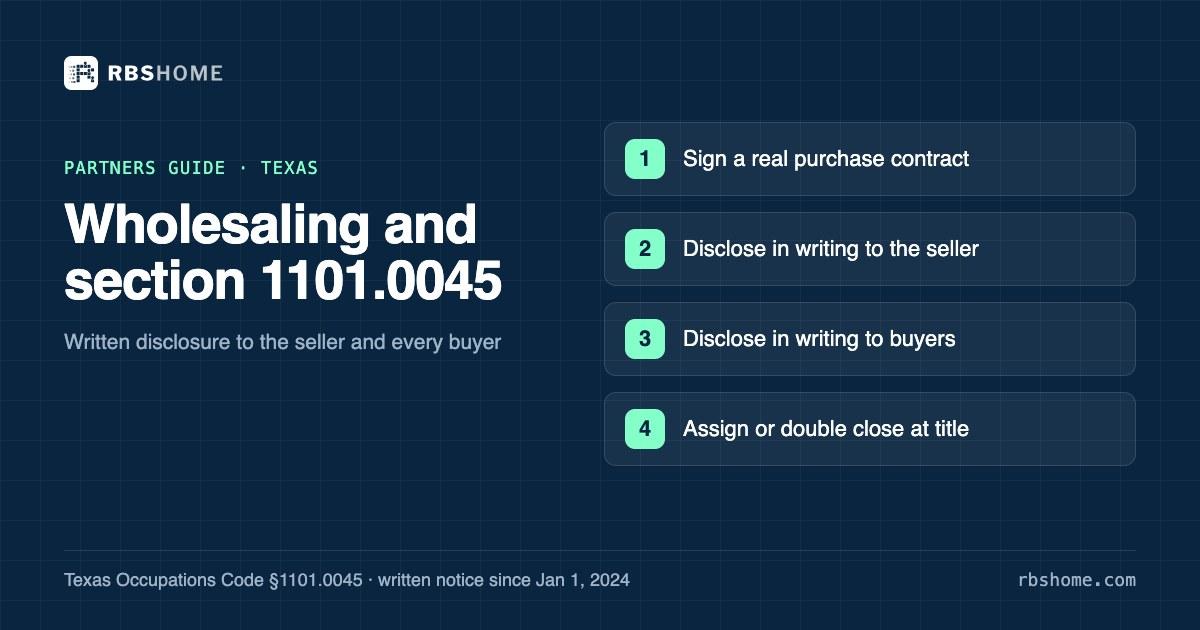
Texas lets you assign a purchase contract or sell an option without a real estate license if two things are true: you disclose the nature of your equitable interest in writing to the seller and to every potential buyer, and you don't use the contract to engage in brokerage. Skip the written disclosure and the statute says you are brokering, which requires a license. Assignments and double closings are both legal, but they look different to the seller, the end buyer and the title company. Earnest money, timelines and plain answers to the seller decide whether a wholesale deal closes cleanly.
In this article
- 1. What section 1101.0045 says
- 2. What the written disclosure should cover
- 3. When wholesaling becomes brokerage
- 4. Assignment versus double close
- 5. Earnest money that is fair to the seller
- 6. Honest communication with sellers
- 7. Marketing a contract to buyers
- 8. Federal reporting on cash transfers
- 9. How RBSHome works with JV partners
Wholesaling means putting a property under contract and then selling your position in that contract, either by assigning it to an end buyer or by closing on the property and reselling it the same day. It's common in Dallas and Collin County, where investor buying is steady: as of November 7, 2026, RBSHome's records show 9,237 investor purchases in Dallas County and 19,650 in Collin County over the previous 12 months.
It's also an area where Texas law has changed twice in the last decade, and where sellers, title companies and TREC have all raised concerns. This guide sets out what the statute requires, where the license line sits, and the habits that keep a wholesale deal clean.
What section 1101.0045 says
The rule is in the Real Estate License Act, Occupations Code section 1101.0045, titled "Equitable Interests in Real Property." It has two parts.
Subsection (a) says a person may acquire an option or an interest in a contract to purchase real property, and then sell or offer to sell the option, or assign or offer to assign the contract, without a license, if the person:
- does not use the option or contract to purchase to engage in real estate brokerage; and
- discloses in writing the nature of the equitable interest to any seller or potential buyer.
Subsection (b) is the consequence. A person who sells or offers to sell an option, or assigns or offers to assign a contract interest, without making that written disclosure is engaging in real estate brokerage.
Two details in the wording matter:
- "Offer to" counts. The disclosure duty attaches when you offer to assign, not only when you assign. Marketing a contract to a buyers list is an offer.
- Both sides get it. The disclosure goes to the seller and to any potential buyer, not only to the buyer who ends up taking the assignment.
How the rule got here
The section was added in 2017 by Senate Bill 2212, effective September 1, 2017. The 2023 amendment, Senate Bill 1577, is the one most wholesalers know. TREC's 88th Legislative Session update summarized it: SB 1577 requires the notice to a potential buyer to be in writing and requires the same written notice to the seller, and a person engaged in wholesaling who doesn't provide notice is engaged in unlicensed brokerage activity. TREC reported the change took effect January 1, 2024.
TREC's 2022 wholesaling survey results explain why lawmakers focused on disclosure. Some sellers said they felt misled about the nature of the transaction, or weren't sure whether the wholesaler was the end buyer or an agent. Some buyers cited a lack of transparency. Title professionals reported that wholesale transactions take longer, that sellers often don't know they are ultimately selling to someone else, that these contracts cancel more often, and that some title companies won't accept them.
What the written disclosure should cover
The statute requires disclosure of "the nature of the equitable interest" in writing. It doesn't prescribe a form. That leaves room for interpretation, so have a Texas real estate attorney review your disclosure language. As a practical matter, a disclosure that does its job tells each reader:
To the seller:
- that you are buying under a contract and may assign the contract or resell the property before or at closing;
- that the person or company that ends up closing may be someone other than you;
- that you expect to profit from the assignment or resale, and the seller's price doesn't change because of it;
- that you are not the seller's agent and don't represent them;
- that the seller may want to talk with an attorney or a licensed agent before signing.
To a potential buyer:
- that you don't own the property;
- that what you are offering is your interest under a purchase contract (or an option) with the owner;
- the basics of that contract that affect the buyer, such as the closing date and the title company.
Keep it separate and signed. A disclosure buried in paragraph 19 of a contract is harder to prove later than a one-page notice the seller signs and dates. Keep a copy in your file with the contract, and give the title company a copy when you open title. Many title officers will ask for it anyway.
Disclosure is the floor, not the whole job
The statute's disclosure requirement is the minimum to stay outside brokerage. Fraud, misrepresentation and deceptive-practice laws still apply to anything you say to a seller or buyer, written or not. A correct disclosure doesn't cure a false statement about price, condition or who is buying.
When wholesaling becomes brokerage
The license line comes from two places: the definition of a broker, and section 1101.0045(a)(1)'s condition that you not use the contract to engage in brokerage.
Under section 1101.002, a broker is a person who, for a commission or other valuable consideration, or expecting one, does things for another person such as selling or offering to sell real estate, negotiating a sale, procuring a prospect to effect a sale, or aiding in locating real estate for purchase. The key words are "for another person." A wholesaler who holds a real equitable interest is dealing in their own contract rights. A person who markets someone else's property for a fee is acting for another person.
Situations that put a wholesaler on the wrong side of the line:
- No contract, no equitable interest. Advertising a house you haven't put under contract, then trying to lock it up after finding a buyer, is marketing someone else's property. The equitable-interest exception only applies to an option or contract you actually hold.
- No written disclosure. Section 1101.0045(b) is explicit: assigning or offering to assign without the written disclosure is brokerage.
- Acting for the seller. If you tell the seller you'll "find them a buyer" or "get them the best price" and take a cut, you are acting for the seller.
- A contract that isn't real. A contract you never intend to perform, with no meaningful obligation on your side, invites the argument that you are using it as a tool for brokerage. That's the situation subsection (a)(1) addresses.
- Paying unlicensed bird dogs per lead. Paying someone a fee for sending you sellers or buyers can make that person an unlicensed broker under the "procures a prospect" language.
The consequences are real. Under section 1101.758, acting as a broker or sales agent without a license is a Class A misdemeanor. Section 1101.701 lets TREC impose an administrative penalty on any person who violates the chapter, licensed or not. Section 1101.806(b) says a person can't sue to collect compensation for brokerage acts unless they were licensed (or a licensed attorney) when the act began. If a seller or buyer refuses to pay, an unlicensed wholesaler who was really brokering may have no claim.
Licensed agents who wholesale
A license holder can buy and sell for their own account, but must be open about it. Section 1101.652(b)(16) allows discipline for acting in a dual capacity as broker and undisclosed principal, and section 1101.652(b)(7) for failing to make clear to all parties whom the license holder is acting for. A licensed agent who wholesales should disclose license status and the equitable interest in writing to everyone, and check the sponsoring broker's policy before doing any deal outside the brokerage.
Assignment versus double close
Both structures are legal. They differ in what each party sees, how money moves and how the title company handles the file.
An assignment transfers your rights under the purchase contract to the end buyer. The end buyer then closes directly with the seller, and you are paid an assignment fee at closing. There is one closing and one deed, from the seller to the end buyer. The assignment fee often appears on the settlement statement, so the seller and end buyer may both see it.
A double close is two separate transactions. You buy from the seller (the A to B closing), then sell to the end buyer (the B to C closing), often on the same day at the same title company. There are two deeds, two settlement statements and two sets of closing costs. Each side generally sees only its own price.
| Question | Assignment | Double close |
|---|---|---|
| Deeds recorded | One: seller to end buyer | Two: seller to you, you to end buyer |
| Who the seller closes with | The end buyer | You |
| Your spread | Assignment fee, often visible on the settlement statement | Difference between the two prices, on separate statements |
| Your funds needed | Earnest money only | Purchase funds for the first closing, unless the title company and underwriter allow other arrangements |
| Contract issue to check | Whether the contract allows assignment | Whether a quick resale affects the end buyer's financing or title policy |
A few practical points apply to both:
- Read the assignment clause. Some contracts prohibit assignment or require the seller's consent. If the contract is silent, ask an attorney before relying on it. Telling the seller up front, in the contract and the disclosure, avoids most disputes.
- Funding a double close is a title question. Texas title companies can't disburse from their trust accounts until good funds for the transaction are received and deposited, under Insurance Code section 2651.202 and TDI's Procedural Rule P-27. Whether the end buyer's funds can be used to fund your purchase depends on the title company and its underwriter. Ask before you sign with either party.
- Disclosure applies either way. Section 1101.0045 covers assigning or offering to assign a contract, and selling or offering to sell an option. If you plan to double close, you still disclose your interest when you market the deal before you own the property.
Earnest money that is fair to the seller
Earnest money is how a seller knows you're serious. In Texas, it's normally deposited with the escrow agent named in the contract, usually the title company, within a few days of the effective date. The TREC resale form, for example, requires the buyer to deliver earnest money and any option fee to the escrow agent within 3 days after the effective date, and lets the seller keep the earnest money as liquidated damages if the buyer defaults.
The pattern TREC's survey described, where contracts fall through when the wholesaler can't find an end buyer, is mostly an earnest money and timeline problem. A contract with a token deposit and a long inspection or option period ties up the seller's house while carrying almost no risk for the buyer. If the deal dies, the seller has lost weeks or months.
Habits that keep earnest money fair:
- Deposit real money, and deposit it on time. An amount that would hurt to lose shows the seller you intend to close.
- Match the option period to the work. If you need ten days to inspect and line up a buyer, ask for ten days, not thirty.
- Use the title company as escrow agent. Never ask a seller to accept earnest money by personal check to them, or to wait to deposit it.
- Don't extend by default. If you need more time, ask in writing, explain why, and offer something for it, such as releasing part of the earnest money to the seller.
- Release the house quickly if it won't work. Terminating promptly, inside the option period, is better for the seller than holding the contract hoping something changes.
Honest communication with sellers
Most complaints about wholesaling aren't about the law. They're about surprises: a seller who didn't know someone else would close, an assignment fee they first saw at the closing table, or a closing date that kept moving. Clear communication prevents almost all of them.
Say who is buying. If you might assign, tell the seller in plain words before they sign: "I may assign this contract to another buyer, and that buyer would close with you at the same price and terms." Never present yourself as the end buyer if you aren't sure you will be.
Say what happens if you can't close. Tell the seller what the contract says about termination and earnest money. If you plan to terminate if you can't find a buyer, the seller deserves to know that before the option period starts.
Be straight about price. Don't tell a seller that a repair estimate is higher than it is, that comparable sales are lower than they are, or that the house "won't sell" on the market. Many sellers check online values and talk to agents, and an inflated story falls apart.
Keep the timeline. Give the seller a short schedule: when title opens, when inspections or walkthroughs happen, when the option period ends, and the closing date. Update them when anything changes.
Respect the seller's other options. Some sellers are better off listing. If the house shows well and the seller has time, saying so builds the kind of reputation that brings referrals.
Marketing a contract to buyers
Because section 1101.0045 covers offering to assign, your marketing has to follow the same rules.
- Describe what you're selling accurately. You're offering an interest under a purchase contract, not a house you own. Don't use language that implies ownership.
- Include the disclosure, or deliver it before the buyer commits. The statute requires written disclosure to any potential buyer.
- Be careful with photos and access. Get the seller's permission before posting photos or scheduling buyer walkthroughs, and keep walkthroughs within the access the contract gives you.
- Give buyers accurate numbers. If your estimate of value or repairs is wrong, the end buyer may walk away, and the seller pays for it in lost time.
Federal reporting on cash transfers
State law isn't the only layer. Federal anti-money-laundering reporting rules can apply to some non-financed residential transfers to entities and trusts. If you buy in an LLC or trust name without a lender, ask your title company early whether it will need to file a federal report and what information it will ask you for. Build that into your timeline, especially on a double close, where your purchase and your resale are separate transfers.
How RBSHome works with JV partners
RBSHome buys houses and land as-is in Dallas County and Collin County. Sellers get a written, itemized offer, usually within 24 hours, there are no agent commissions, the seller picks the closing date, and closings happen at a title company. RBSHome also runs a data platform with Dallas County and Collin County ZIP market pages that rank every ZIP by recent investor and builder purchases, plus a builder-demand view and an AI connector for research.
If you're a wholesaler or investor and want to talk about working on a deal together, contact us. We don't publish standard joint-venture terms, and nothing in this article is an offer of any. Every deal is discussed on its own facts, and every deal we take part in should meet the disclosure rules above.
This article is general information, not legal or tax advice. For your situation, talk to a Texas attorney, CPA or your title company.
Tell us about the property, your contract and your timeline.