TL;DR
You can sell a Texas rental with the tenant in place. The lease generally stays in force and the buyer takes over as landlord, so the contract should cover the leases, the rent proration and the security deposits. Under Property Code section 92.105, the buyer becomes liable for the deposit and must give the tenant a signed statement with the exact amount. Showings depend on the access your lease allows, and any removal of a tenant has to go through an eviction suit in justice court. Selling occupied usually means a smaller buyer pool but no vacancy, and investors are buying actively in several Dallas and Collin County ZIPs.
In this article
- 1. The lease stays in place after a sale
- 2. Security deposits at closing
- 3. Telling tenants about the sale
- 4. Showings and access under the lease
- 5. Evictions go through justice court only
- 6. Month-to-month and expiring leases
- 7. Selling occupied or vacant
- 8. Where investors are buying in Dallas and Collin County
- 9. A closing checklist for landlords
Plenty of rental owners in Dallas and Collin County reach a point where they want out: the property manager's fee has gone up, the roof needs replacing, a tenant pays late every month, or the owner just wants the equity for something else. The first question is usually whether the tenant has to leave before the house can sell. The short answer is no. The longer answer depends on the lease, the deposit and the kind of buyer you want.
This guide is for individual landlords and the property managers who work for them. It covers what Texas law says about leases and deposits in a sale, how showings and notices work, why evictions must go through court, and how to decide between selling occupied and selling vacant.
The lease stays in place after a sale
Selling the house doesn't cancel the lease. The buyer generally takes the property subject to the tenant's rights under the existing lease, and becomes the landlord at closing. The tenant keeps paying rent, now to the new owner, and the lease runs to its end date on its existing terms.
The TREC resale contract that most Texas residential sales use builds this in. Paragraph 4 of the One to Four Family Residential Contract (Resale) says that after the effective date the seller may not create a new lease, amend an existing lease or convey any interest in the property without the buyer's written consent. If the property is subject to residential leases, the parties check a box and attach TREC's Addendum Regarding Residential Leases. Paragraph 13 prorates rents through the closing date, along with taxes and dues, so rent the seller collected for days after closing is credited to the buyer.
Three things can change the picture, so check them before you list:
- The lease itself. Some leases contain a clause about a sale of the property, such as a right for the landlord to end the lease early with notice if the house sells. If yours has one, read it carefully and follow it exactly. If it doesn't, assume the tenant stays until the lease ends.
- Options and rights of first refusal. If the lease gives the tenant an option to buy or a right of first refusal, that right can affect who you're allowed to sell to and on what terms. Ask an attorney before you sign with a buyer.
- Side agreements. Rent concessions, pet agreements, repair promises and move-out deals made by text or email still matter to the buyer. Gather them and disclose them.
Contrast this with a foreclosure. Under Property Code section 24.005(b), when a building is bought at a tax or trustee's foreclosure sale under a lien superior to the lease, a purchaser who chooses not to continue the lease must give a residential tenant who is current on rent at least 30 days' written notice to vacate. A voluntary sale is different: the buyer steps into your shoes as landlord.
Security deposits at closing
The security deposit is the item most likely to cause a dispute after a rental sale, because the tenant paid it to you, not to the buyer.
Property Code section 92.105 sets the rules when an owner's interest ends by sale or otherwise:
- The new owner is liable. Under subsection (a), the new owner is liable for returning security deposits from the date title is acquired.
- The new owner must tell the tenant. Under subsection (b), the new owner must give the tenant a signed statement acknowledging that it has acquired the property and is responsible for the deposit, and stating the exact dollar amount.
- The seller stays liable until the deposit moves. Under subsection (b-1), the seller remains liable for a deposit received while it owned the property until the new owner receives the deposit or assumes the liability, unless the parties agree otherwise in a written contract.
The usual way to handle this is a credit to the buyer on the settlement statement for the full deposit amount, so the buyer receives the money at closing and takes on the obligation. Get the buyer's acknowledgment in writing, and keep a copy of the statement that went to the tenant.
Get the deposit amount right. The buyer will refund it under the rest of subchapter C, which requires a refund within 30 days after the tenant surrenders the premises under section 92.103, an itemized list of any deductions under section 92.104, and no deductions for normal wear and tear. Section 92.109 sets steep penalties for bad-faith retention: $100, three times the amount wrongfully withheld, and the tenant's attorney's fees. Neither you nor the buyer wants an argument later about what the deposit actually was.
Hand over the move-in condition report, photos and any inspection records you have. Those documents are what the new owner will rely on to make fair deductions when the tenant moves out.
Telling tenants about the sale
Texas statutes don't set a single form of notice a landlord must give a tenant just because the property is for sale. The lease and common sense fill the gap, and the law does require a few things around ownership and management.
Ownership and management disclosure. Under Property Code section 92.201, a landlord must disclose to a tenant, on request, the name and address of the record title holder and, if an off-site company manages the property, the management company's name and street address. After closing, the new owner will need to give the tenant updated information, and section 92.201(e) allows corrections by the same methods as the original disclosure.
Rent payment instructions. The most practical notice is the one that tells the tenant where to pay rent after closing. Send it jointly from the seller and buyer if you can, so the tenant knows it's legitimate. A letter signed by both sides also makes it harder for anyone to impersonate the new owner and collect rent.
A plain heads-up before showings. Tell the tenant early that you're selling, what it means for them (usually nothing changes until the lease ends), how showings will be scheduled, and who to contact. Tenants who feel ambushed are less likely to cooperate with access, and less likely to keep the house clean for photos.
Showings and access under the lease
Your right to bring buyers, inspectors and appraisers into an occupied rental comes mainly from the lease. Read the entry clause before you list. Many residential leases allow the landlord to enter at reasonable times to show the property to prospective buyers or tenants, and some require advance notice. If your lease is silent, you'll have to work out access with the tenant.
A few legal guardrails apply regardless of what the lease says:
- No lockouts or removing doors and fixtures. Section 92.0081 bars a landlord from removing doors, windows, locks or landlord-furnished appliances except for bona fide repair, and from intentionally keeping a tenant out except by judicial process, with narrow exceptions.
- No retaliation. Under section 92.331, a landlord can't retaliate against a tenant who in good faith exercises a lease or legal right, complains to a code-enforcement agency, or gives a repair notice, by filing an eviction (except on grounds the statute allows), cutting services, raising rent or ending the lease, within six months of the tenant's action.
Practical habits that make showings work:
- Bundle visits. One or two showing windows a week are easier on a tenant than a stream of single appointments.
- Offer something for cooperation. A rent credit for keeping the house show-ready, or for allowing an inspection on short notice, often costs less than a month of delay.
- Consider one-buyer sales. A single walkthrough with a buyer who already owns rentals is less disruptive than open houses.
Evictions go through justice court only
If a tenant is in default and you need possession before or after the sale, Texas requires a court process. There is no lawful self-help eviction.
Where. Under Property Code section 24.004, a justice court in the precinct where the property is located has jurisdiction over eviction suits, and since January 1, 2026, section 24.0041 requires the suit to be filed in that precinct. In Dallas County, the Justice of the Peace courts list each precinct's court and a district locator. In Collin County, the Justices of the Peace pages list the four precincts.
Notice first. Section 24.005(a) requires a landlord to give a tenant who defaults or holds over at least three days' written notice to vacate before filing, unless the lease sets a shorter or longer period. For nonpayment of rent by a tenant who wasn't late before that month, the notice must be in the form of a notice to pay rent or vacate.
Judgment and writ. Under section 24.0061, a landlord who wins is entitled to a judgment for possession and a writ of possession, but the writ can't issue before the sixth day after judgment unless a possession bond is filed. The officer posts a warning on the door at least 24 hours before executing the writ.
For a sale, the timing question is who carries the eviction. If you start an eviction and then sell, the buyer may inherit a pending case and a tenant in possession. Tell the buyer exactly where things stand. Many investors will buy with an eviction in progress and finish it themselves, and price that in. An owner-occupant buyer usually won't.
Month-to-month and expiring leases
If the tenant is month to month, or the lease ends soon, you have more room. Under Property Code section 91.001, when the rent-paying period is at least a month, a month-to-month tenancy ends on the later of the date in the notice or one month after the notice is given. The lease can set a different notice period if both sides signed it.
That gives you three options:
- Sell with the tenant in place, and let the buyer decide whether to renew.
- Give notice and sell vacant, accepting a month or more without rent plus turnover costs.
- Agree on a move-out. A written cash-for-keys agreement, where the tenant leaves by a date in exchange for a payment and a full deposit refund, can be faster and cheaper than either notice or eviction. Put it in writing, with the date, the condition of the house and what happens if the tenant doesn't leave.
Selling occupied or vacant
Neither is always better. It depends on the house, the tenant and what you need.
| Factor | Sell with tenant in place | Sell vacant |
|---|---|---|
| Buyer pool | Mostly investors and other landlords | Owner-occupants plus investors |
| Income during sale | Rent continues to closing | No rent; you carry taxes, insurance, utilities |
| Showings and photos | Limited by the lease and the tenant | Open access, staging possible |
| Repairs and turnover | Often deferred to the buyer | Make-ready, paint, cleaning before listing |
| Main risk | Tenant default or damage during the sale | Vacancy, vandalism and code issues |
Selling occupied makes sense when the tenant pays on time, the rent is close to market, the house needs work an owner-occupant wouldn't want, or you don't want months of vacancy. A buyer who wants rentals values a paying tenant and a clean rent history.
Selling vacant makes sense when the house is in good condition in a neighborhood where owner-occupants compete, when the tenant is behind or uncooperative, or when the rent is far below market and an investor would discount for it. An empty, clean house photographs and shows better, and owner-occupant buyers often pay more for that.
The middle path is to talk to an investor buyer while the tenant is still in place, get a written offer, and compare it with your expected net from turning the house over and listing it. That comparison tells you what the vacancy and make-ready would really cost.
Where investors are buying in Dallas and Collin County
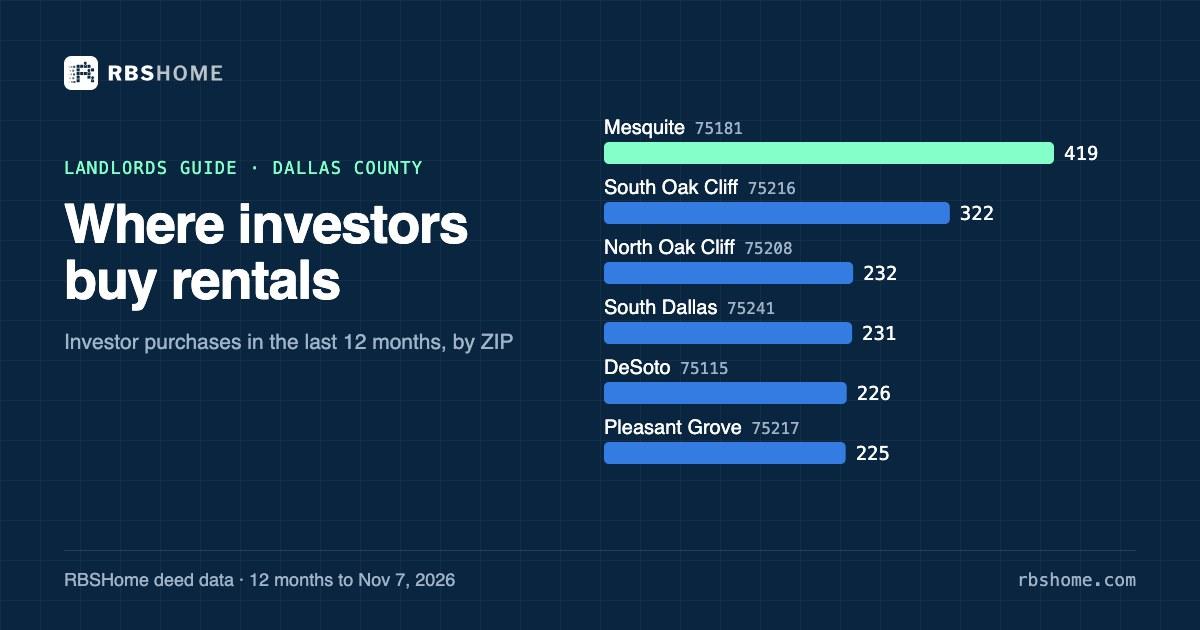
If you sell occupied, your likely buyer is an investor. RBSHome tracks deeds to buyers its data classifies as investors. As of November 7, 2026, these are the Dallas County ZIPs with the most investor purchases over the previous 12 months:
| ZIP | Area | Investor purchases (12 months) | Distinct investor buyers |
|---|---|---|---|
| 75181 | Mesquite | 419 | 100 |
| 75216 | South Oak Cliff | 322 | 233 |
| 75208 | North Oak Cliff | 232 | 136 |
| 75241 | South Dallas | 231 | 144 |
| 75115 | DeSoto | 226 | 121 |
| 75217 | Pleasant Grove | 225 | 163 |
| 75228 | Northeast Dallas | 223 | 148 |
| 75215 | South Dallas / Fair Park | 222 | 166 |
The second number matters as much as the first. In 75216, 322 purchases were made by 233 distinct buyers, so demand there is spread across many investors. In 75181, 419 purchases came from 100 buyers, so a smaller group is buying more each.
Collin County's investor counts are larger and concentrated in the same fast-growing ZIPs that lead builder purchases. As of November 7, 2026, the top Collin ZIPs for investor purchases over 12 months were Celina 75009 (3,699 purchases, 336 buyers), McKinney 75071 (2,818, 543 buyers), Princeton 75407 (2,637, 379 buyers), Anna 75409 (1,527, 252 buyers) and Lavon 75166 (1,144, 84 buyers). Across the county, RBSHome counted 19,650 investor purchases in that period, compared with 9,237 in Dallas County.
You can look up your own ZIP on the Dallas County hub or the Collin County hub. For example, the 75216 land market page and the 75181 page show recent investor and builder activity for those ZIPs. Higher investor activity in a ZIP generally means more potential buyers for an occupied rental, though it says nothing by itself about the price for your house.
A closing checklist for landlords
Pull these together before you sign a contract. A buyer who sees an organized rental file moves faster and asks for fewer concessions.
- Every lease and renewal, with all addenda, pet agreements and side letters.
- A rent roll: tenant name, unit, monthly rent, due date, paid-through date, and any balance owed.
- Deposit records: the exact security deposit and any pet deposit for each tenant, and how they'll be credited to the buyer.
- Move-in condition reports and photos for each tenant.
- Open maintenance requests and any repair promises you've made.
- Pending notices or evictions, with copies of notices sent and court filings.
- Utility arrangements: which utilities the tenant pays, which you pay, and account numbers to transfer.
- HOA documents, if the property is in an association, including any leasing rules.
- Keys, codes and remotes, including smart-lock credentials, to hand to the buyer at closing.
- A joint letter to the tenant introducing the new owner, the rent payment instructions and the deposit acknowledgment required by section 92.105.
If you use a property manager, ask them to prepare items 1 through 7 and to confirm in writing what they will hand over, and when their management agreement ends.
RBSHome buys houses and land as-is in Dallas County and Collin County. You get a written, itemized offer, usually within 24 hours. There are no agent commissions, you pick the closing date, and closing happens at a title company, which handles the rent proration and deposit credit on the settlement statement.
This article is general information, not legal or tax advice. For your situation, talk to a Texas attorney, CPA or your title company.
Written, itemized offer, usually within 24 hours. You pick the closing date.