TL;DR
Most Collin County home foreclosures are non-judicial: after a notice of default with at least 20 days to cure, the lender's trustee gives at least 21 days' notice and sells the house at auction on the first Tuesday of the month, on the steps of the Collin County Courthouse at 2100 Bloomdale Road in McKinney. You own the house until that sale, so you can still reinstate, apply for a loan modification, sell, or file bankruptcy. HOA and tax foreclosures follow different rules. The earlier you act, the more of these options you keep.
In this article
- 1. How a Texas foreclosure works
- 2. The timeline, step by step
- 3. Where Collin County posts notices and holds sales
- 4. What happens at and after the sale
- 5. HOA foreclosure in Collin County
- 6. Tax foreclosure is a separate track
- 7. Your options before the sale
- 8. Which option fits which situation
- 9. Avoiding foreclosure rescue scams
- 10. What to do the week a notice arrives
How a Texas foreclosure works
Most Texas home loans are secured by a deed of trust that gives a trustee the power to sell the house if the borrower defaults. Using that power of sale, a lender can foreclose without filing a lawsuit. This is called non-judicial foreclosure, and Property Code section 51.002 sets the rules: when the sale can happen, where, and what notice the owner must get.
Some loans and liens need a court order first. Under Article XVI, section 50 of the Texas Constitution, a home equity loan on a homestead must be secured by a lien that can be foreclosed only by court order. HOA assessment liens generally need a court order too, as explained below. Those cases add a court step, but the sale itself still happens at a public auction.
This guide covers Collin County. If your house is in Dallas County, read our Dallas County foreclosure guide instead; the state rules are the same, but the posting and sale locations are different.
The timeline, step by step
Here is the sequence for a typical first-lien mortgage on a home you live in, with the legal minimum at each step.
| Step | Legal minimum | Source |
|---|---|---|
| Missed payments; servicer outreach | No first foreclosure notice or filing until the loan is more than 120 days delinquent, with limited exceptions | 12 CFR 1024.41(f) |
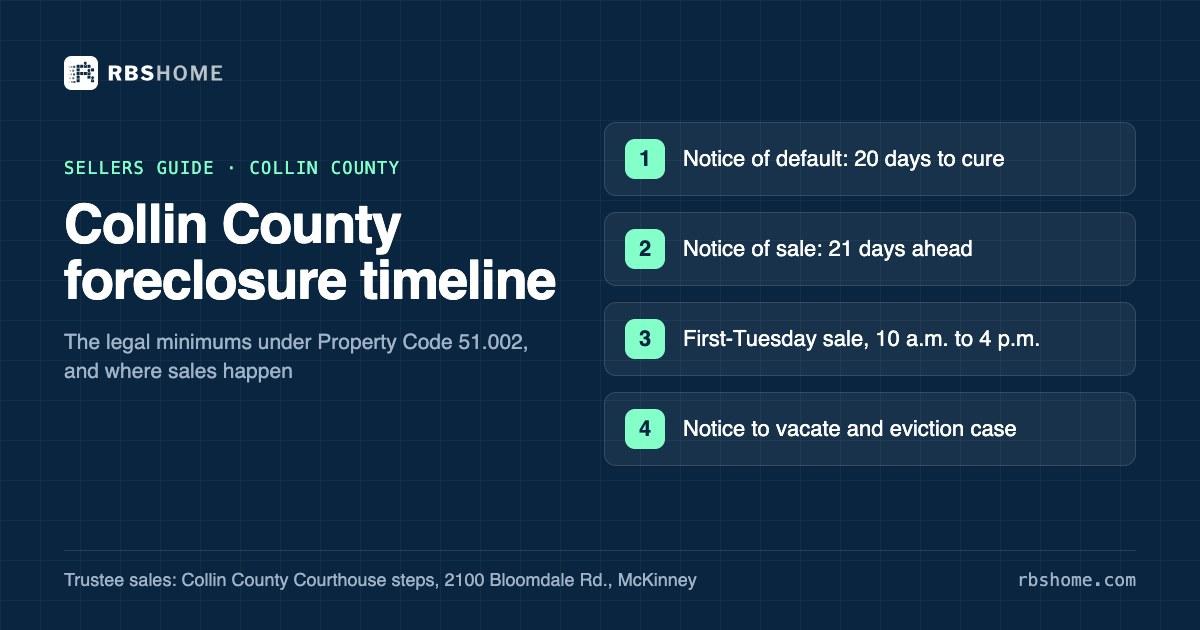
| Notice of default | Certified mail; at least 20 days to cure before notice of sale | Property Code 51.002(d) |
| Notice of sale | At least 21 days before the sale: posted at the courthouse door, filed with the county clerk, and mailed by certified mail to each debtor | Property Code 51.002(b) |
| Foreclosure sale | First Tuesday of the month, between 10 a.m. and 4 p.m. | Property Code 51.002(a) |
| After the sale | Written notice to vacate, then an eviction case in justice court if the occupant stays | Property Code ch. 24 |
A few details matter more than they look.
The 120-day rule is federal. Under 12 CFR 1024.41(f), a mortgage servicer generally may not make the first notice or filing required for a judicial or non-judicial foreclosure unless the loan is more than 120 days delinquent. The rule has exceptions, so don't rely on it as a guaranteed four months, but for most borrowers it is the first window to apply for help.
The 20-day cure notice is required for your residence. Section 51.002(d) says the servicer must send a debtor in default on a loan secured by the debtor's residence a certified-mail notice that the debtor is in default, giving at least 20 days to cure before notice of sale can be given. The day the notice is given counts; the day the notice of sale is given does not.
The 21-day sale notice has three parts. Section 51.002(b) requires the notice to state the earliest time the sale will begin and to be posted at the courthouse door, filed with the county clerk, and sent by certified mail to each debtor obligated on the loan, at least 21 days before the sale. Under section 51.002(e), certified-mail service is complete when the notice is mailed to your last known address, even if you never pick it up.
The sale date is fixed by law. Section 51.002(a) requires the sale to be a public auction between 10 a.m. and 4 p.m. on the first Tuesday of the month. If that Tuesday is January 1 or July 4, the sale moves to the first Wednesday. Section 51.002(c) says the sale must begin at the time stated in the notice or within three hours after it.
Military service changes things. Section 51.002(i) requires the notice to include a statement asking anyone on active military duty, or whose spouse is, to tell the sender immediately. Federal law gives servicemembers extra protections; if that applies to you, say so in writing right away.
Where Collin County posts notices and holds sales
Collin County's Sales and Auctions page says trustee sales are held on the steps of the Collin County Courthouse, 2100 Bloomdale Road, McKinney, TX 75071. The county is clear that it does not run these auctions: trustees appointed by the mortgage holders conduct them and set the times. County employees cannot advise anyone on how to bid.
Notices of sale are filed with the Collin County Clerk, and Property Code section 51.002(f-1) requires each county to post filed notices on its website, with the date, time and location of the sale. Collin County publishes them on its foreclosure notices site, which can be filtered by sale date, city, property type and filing date. If you think a notice has been filed on your house, search there for your address.
The same Sales and Auctions page describes constable sales, which are a different thing. Constable sales are normally held on the first Tuesday of each month between 10 a.m. and 4 p.m. at the courthouse, are published in the McKinney Courier Gazette or the Collin County Commercial Record, and are posted at the courthouse and the constable offices. Those are sales a constable conducts under court orders, including tax foreclosure judgments, not trustee sales under a deed of trust.
RBSHome does not yet track Collin County foreclosure postings, so this article doesn't give counts. If you want the Dallas County picture, our December 2026 Dallas County foreclosure postings report breaks down the notices we capture there.
What happens at and after the sale
At the auction, the trustee or substitute trustee conducts the sale and takes bids. Under Property Code section 51.0075, the trustee can set reasonable conditions for the sale if they are announced before bidding opens, and the price is due on acceptance of the bid or within a reasonable time the trustee agrees to. The trustee then disburses the proceeds as the law provides.
What follows depends on the sale price and who is in the house.
No redemption for a deed-of-trust sale. Property Code chapter 51 contains no right for the former owner to buy the house back after a trustee's sale. HOA sales and tax sales are different, as covered below. Once the gavel falls on a mortgage foreclosure, the realistic chance to keep the house has usually passed, so act before the sale date.
Possible deficiency. If the sale price is less than what you owed, the lender can sue for the shortfall. Under section 51.003, it must bring that action within two years of the sale, and you can ask the court to determine the house's fair market value on the sale date. If the court finds the value was higher than the sale price, you get an offset against the deficiency. A home equity loan is different: the Constitution requires it to be without personal recourse, except in cases of actual fraud.
Eviction is a court process. The buyer at the sale can't simply change the locks. Under Property Code chapter 24, the new owner must give written notice to vacate and then file an eviction case, which a justice court in the precinct where the property sits hears. A residential tenant who is paying rent and not otherwise in default generally gets at least 30 days' written notice if the new owner doesn't continue the lease.
HOA foreclosure in Collin County
If your home is in a subdivision with a mandatory property owners' association and you fall behind on assessments, Property Code chapter 209 controls what the association can do. The main protections:
- Notice before collection-agent fees. Under section 209.0064, the association can't hold you liable for a collection agent's fees unless it first sends a certified-mail notice listing each delinquent amount and the total due, describing payment plan options where required, and giving at least 45 days to cure.
- No foreclosure for fines alone. Section 209.009 bars foreclosure if the debt consists only of fines, attorney's fees tied solely to fines, or certain amounts added as assessments under the statute.
- Notice to your lender first. Under section 209.0091, before applying for a foreclosure order, the association must notify any inferior lienholder with a deed of trust, such as your mortgage lender, and give it the chance to cure the delinquency before the 61st day after mailing.
- A court order is generally required. Section 209.0092 says an association may not foreclose an assessment lien without first getting a court order through an expedited foreclosure process, unless the owner agrees in writing at the time to waive it, or the association chooses a full judicial foreclosure instead.
- Notice after the sale. Section 209.010 requires the association to send the owner and each lienholder of record a notice of the sale within 30 days, explaining the right to redeem.
- A 180-day redemption right. Under section 209.011, the owner can redeem the property within 180 days after the association mails that notice. Redeeming means paying what the statute lists, including amounts owed at the sale, interest, costs and attorney's fees, later assessments, and, if a third party bought the property, the price that buyer paid. The buyer can't transfer the property to anyone except the redeeming owner during that period.
The best time to deal with an HOA debt is long before any of this. Ask the association, in writing, for a payment plan and a full ledger of what it says you owe.
Tax foreclosure is a separate track
Unpaid property taxes lead to a different process. Typically, the taxing units file a delinquent tax suit, get a judgment, and the property is sold by a constable or sheriff. As of November 3, 2026, RBSHome's records show 20,345 Collin County accounts with a delinquent balance on the latest roll, including 1,026 with a delinquent-tax suit and 2,234 homesteads. Our data showed 6 pending constable sales and 1 future sale in Collin County. Our Dallas and Collin County tax delinquency report has more detail.
Three rules worth knowing:
- Taxes become delinquent if unpaid on February 1 of the year after they are imposed.
- After a tax sale, Tax Code section 34.21 gives the owner 2 years to redeem a residence homestead or agricultural land, and 180 days for other property.
- Owners who are 65 or older, disabled, or qualifying disabled veterans can defer taxes on their homestead under Tax Code section 33.06. Interest still accrues during the deferral, and the lien stays on the property.
If you are behind on both your mortgage and your taxes, tell your housing counselor and your servicer about both. A plan that fixes one problem can be undone by the other.
Your options before the sale
You own the house until the trustee's sale. Here are the options that can stop or replace a foreclosure, roughly from least to most drastic.
Reinstate the loan. Pay the past-due payments, late fees and the servicer's costs to bring the loan current. Ask the servicer for a written reinstatement quote good through a specific date, and pay with certified funds. If you have the money, or family who can help, this is the simplest fix.
Apply for loss mitigation. This covers repayment plans, forbearance and loan modifications. The federal servicing rules in 12 CFR 1024.41 reward applying early. If the servicer receives your application 45 days or more before a scheduled sale, it must acknowledge receipt in writing within 5 business days. If you submit a complete application more than 37 days before the sale, the servicer generally can't conduct the sale until it has evaluated you and any appeal has run its course. An incomplete application doesn't get that protection, so send every document requested and keep proof of delivery.
Sell the house. If the house is worth more than you owe, selling before the sale date pays off the loan and lets you keep the equity, instead of losing it at auction. The catch is time. A listing needs weeks of marketing plus a buyer's loan approval; a direct sale to a cash buyer can close faster if the title is clear. Either way, tell the title company about the sale date on the first day, and ask the servicer for a payoff quote. If a contract is signed but closing can't happen before the sale date, ask the servicer in writing to postpone the sale; they are not required to agree.
Short sale or deed in lieu. If you owe more than the house is worth, the lender may agree to accept a sale for less than the balance, or to take the deed instead of foreclosing. Both need the lender's approval, and you'll want to know in writing whether the lender waives any deficiency.
File for bankruptcy. According to the U.S. Courts guide to Chapter 13, the automatic stay stops a foreclosure as soon as a Chapter 13 petition is filed, and the debtor may then bring past-due payments current over a reasonable period. A Chapter 13 plan runs three to five years, and you must get credit counseling from an approved agency within 180 days before filing. Bankruptcy has long-term consequences; talk to a bankruptcy attorney before you decide.
Get a housing counselor on your side. The Consumer Financial Protection Bureau's housing counselor search lists approved agencies by ZIP code. It says they can advise on defaults, forbearances and foreclosures, often at little or no cost. A counselor can review your budget, explain your servicer's programs and help you put together a complete application.
The two dates that matter most
Write down the sale date from your notice of sale, then count back 37 days. A complete loss-mitigation application received before that point generally keeps the servicer from selling while it evaluates you. If you plan to sell, your closing has to happen before the sale date. Everything else in your plan should work backward from those two dates.
Which option fits which situation
| Your situation | Options to look at first |
|---|---|
| Short-term setback, income is back | Reinstatement, repayment plan |
| Lower income for the foreseeable future, want to stay | Loan modification, housing counselor, Chapter 13 |
| Equity in the house, can't afford to keep it | Sell before the sale date, by listing or direct sale |
| Owe more than the house is worth | Short sale, deed in lieu, housing counselor |
| Behind on HOA dues only | Written payment plan request, full ledger |
| Behind on property taxes | Payment agreement with the tax office, deferral if eligible |
If you have equity, the order of operations matters. Selling before the sale protects your equity; a foreclosure auction may not. If you aren't sure whether you have equity, compare your payoff quote with recent activity in your area. Our Collin County hub ranks every ZIP by recent builder and investor purchases, which gives you a quick read on demand before you call anyone.
Avoiding foreclosure rescue scams
Owners facing a sale date are targets. The Federal Trade Commission's mortgage relief scams page says it is illegal for a company to charge you upfront for promises to help you get mortgage relief, and that under the federal Mortgage Assistance Relief Services rule a company can't charge until it has given you a written offer of relief from your lender. The FTC lists warning signs:
- being told to stop talking to your lender, lawyer or housing counselor;
- being told to send your mortgage payments to the company instead of your servicer;
- being pressured to sign over the deed to your house;
- being asked to pay before any service is provided.
A legitimate buyer who purchases your house does take the deed, but only at a closing at a title company, with your loan paid off from the proceeds and a settlement statement you sign. Never sign a deed outside a title company closing, and never sign anything that hands over the house while you remain responsible for the loan.
What to do the week a notice arrives
- Find the dates. Note the date of the notice, the cure deadline in a notice of default, or the sale date and earliest sale time in a notice of sale.
- Call your servicer and ask for a reinstatement quote, a payoff quote and a loss-mitigation application. Write down who you spoke to.
- Contact a HUD-approved housing counselor through the CFPB search.
- Check the county record. Search your address on the Collin County foreclosure notices site to confirm what has been filed.
- Gather documents: pay stubs, bank statements, tax returns, a hardship letter and your mortgage statements.
- Decide whether you want to keep the house or sell it. If selling, get a payoff quote and offers right away.
- Talk to an attorney if the sale is close, if you're considering bankruptcy, or if you believe the notices were defective.
RBSHome buys houses and land as-is in Dallas and Collin County. You get a written, itemized offer, usually within 24 hours. There are no agent commissions, you pick the closing date, and closing happens at a title company, which pays off the loan from the sale proceeds. If keeping the house is realistic through reinstatement or a modification, pursue that first.
This article is general information, not legal or tax advice. For your situation, talk to a Texas attorney, CPA or your title company.
Written offer, usually within 24 hours. Tell us your sale date so we can plan the closing around it.