TL;DR
A direct as-is sale to a cash buyer tends to serve a client better when the house needs major work, title or estate paperwork is messy, tenants are in place, or the client needs a firm closing date. Listing usually wins when the house shows well and the client can wait for the market. If a cash buyer offers you something for a referral, Texas law says a sales agent can only be paid through their sponsoring broker, and brokers cannot pay unlicensed people for brokerage work. Ask your broker first, and get a written buyer representation agreement before you show a house to any buyer you represent.
In this article
- 1. When an as-is cash sale serves the client better
- 2. When listing serves the client better
- 3. Comparing the two for a client
- 4. Your duties stay the same when the buyer pays cash
- 5. How referral compensation works in Texas
- 6. The written buyer representation agreement
- 7. Questions to ask any cash buyer
- 8. Working with RBSHome
Most listing appointments end in a listing, and they should. But every agent in Dallas and Collin County meets a few sellers each year whose house, family situation or deadline doesn't fit the normal path: a house with a failed foundation, an estate with five heirs in four states, a rental with a tenant who won't allow showings. For those clients, an as-is sale to a cash buyer can be the better outcome. It can also be the worse one.
This guide is for agents who want a clear way to tell the two apart, and who want to know where Texas law draws the lines on referral pay and buyer representation before a cash buyer offers them something.
When an as-is cash sale serves the client better
A cash buyer who buys as-is is selling certainty: no lender, no appraisal, no repair list, and a closing date the seller chooses. That certainty costs money, because the buyer prices in the repairs, the holding time and the risk. The question for the client is whether certainty is worth more to them than the difference in price. These are the situations where it often is.
The house won't finance
If a lender won't make a loan on the house in its current condition, the buyer pool shrinks to cash buyers and renovation lenders anyway. Typical examples are an active roof leak, a foundation that needs piering, missing or failed HVAC, fire or water damage, or a house that's been stripped. Listing a house like that often produces a string of contracts that fall apart at the appraisal or inspection, and each failed contract costs the seller another month of taxes, insurance and utilities.
Title or paperwork problems
Some houses can't close quickly no matter who buys them. An unreleased lien from a paid-off loan, a missing heir, a divorce decree that never conveyed the house, a city lien for mowing or demolition, or years of delinquent taxes all have to be cleared by the title company before a sale closes. A buyer who has handled these files before will wait while the title company works, and won't walk away when the commitment comes back with a long list of requirements. A financed buyer with a rate lock may not.
A fixed deadline
Some clients need to close by a specific date: a job transfer, a move to assisted living, a divorce decree that orders the house sold, or a foreclosure sale set for the first Tuesday of next month. Texas non-judicial foreclosure sales happen on the first Tuesday of the month after at least 21 days' notice under Property Code section 51.002. A listing can't promise a closing date. A cash buyer with funds ready can usually commit to one. Our Dallas County foreclosure guide covers the timeline in more detail.
Tenants in place
A tenant-occupied rental is hard to show, hard to stage and hard to sell to an owner-occupant, who generally has to wait for the lease to end. Investors buy occupied houses all the time, and many prefer a paying tenant. If your client is a tired landlord, a sale with the tenant in place can save months of vacancy and turnover cost.
Estates and heirs
Estate houses often combine every issue above: deferred maintenance, a house full of belongings, heirs who live elsewhere, probate paperwork and a tax bill that keeps growing. Heirs may also disagree about price but agree on wanting the house gone. A direct sale lets them avoid clearing the house, making repairs and coordinating showings from out of state. Our guide to inherited property in 75216 and 75217 covers the neighborhood side of these sales.
Privacy and disruption
Some sellers don't want strangers walking through their home: an elderly owner, a seller in the middle of a divorce, or a family dealing with a hoarding situation. One walkthrough with one buyer is a different experience from weeks of showings. Our guide to selling during a divorce covers how that plays out when two owners have to agree.
When listing serves the client better
Be just as clear with clients about the other side. Listing on the open market usually produces a higher price when:
- The house is in reasonable condition. If a buyer's lender will finance it, the client is competing for the largest pool of buyers. A cash buyer's discount for repairs won't make sense if there are few repairs.
- The client can wait. If the seller can carry the house for a few months, time on market costs them less than a deep discount.
- The neighborhood is in demand. In ZIPs where owner-occupants compete for houses, the open market sets the price, and an off-market sale can leave money on the table.
- The repairs are cosmetic. Paint, flooring and landscaping are cheap relative to the price bump they bring. A cash buyer prices them in at a contractor's cost plus profit.
- The client wants to test the market. Listing reveals what buyers will pay. A single direct offer doesn't, unless the client collects several.
A fair rule of thumb: if the client's main problem is the house, a direct buyer may help. If the client's main problem is price, the open market usually helps more.
Comparing the two for a client
The comparison that matters is net proceeds and certainty, not headline price. In a hypothetical example, a $300,000 list price and a $255,000 cash offer aren't $45,000 apart once you subtract repairs the buyer will ask for, months of holding cost, and the chance that a financed contract fails. They might also be further apart than the client thinks, if the house would sell quickly in good condition.
A simple worksheet you can walk through with a client:
| Line | Listing on the market | Direct as-is sale |
|---|---|---|
| Expected price | Realistic sold price, based on comps | Written offer amount |
| Repairs and prep | Repairs to pass inspection and appraisal, cleaning, staging | Usually none; buyer takes it as-is |
| Holding costs | Months on market times taxes, insurance, utilities, loan interest | Days or weeks until the chosen closing date |
| Brokerage fees | Per the listing agreement and any buyer-side compensation offered | Per whatever the client agreed with you in writing |
| Fall-through risk | Financing, appraisal and inspection contingencies | Depends on the buyer's funds and option period |
If your client has a cash offer, put it on the same worksheet as your comparative market analysis and let the client decide.
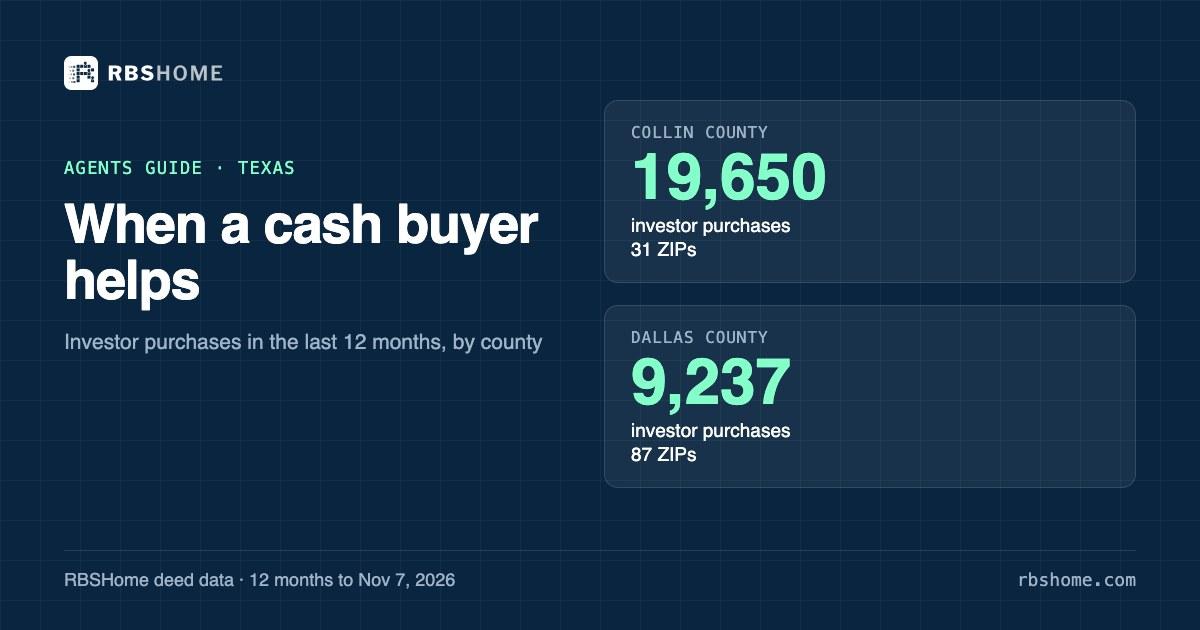
Cash buyers are active in both counties. As of November 7, 2026, RBSHome's records show 19,650 investor purchases in Collin County and 9,237 in Dallas County over the previous 12 months. The Dallas County and Collin County hubs rank every ZIP by recent investor and builder activity, which helps you judge whether a direct offer for a particular house is in a realistic range.
Your duties stay the same when the buyer pays cash
If you represent the seller, a cash buyer doesn't change what you owe your client. Texas law sets out a few points that matter in these deals.
Make your role clear. Under Occupations Code section 1101.558, a license holder who represents a party must disclose that representation at the first contact with another party or another party's agent. At the first substantive communication about a specific property, the license holder must also provide the written notice describing the ways a broker can represent a party (the Information About Brokerage Services notice that TREC prescribes). Section 1101.652(b)(7) allows discipline for failing to make clear to all parties whom the license holder is acting for.
Don't take money from both sides without consent. Section 1101.652(b)(8) allows discipline for receiving compensation from more than one party to a transaction without the full knowledge and consent of all parties. If a cash buyer offers to pay something on a deal where you represent the seller, that has to be disclosed and agreed to by your client, and it still has to run through your broker.
If you would represent both sides, use the intermediary rules. Under section 1101.561, a broker who agrees to represent both a buyer and a seller in the same transaction must act as an intermediary, and section 1101.559 requires the broker to get written consent from each party, stating the source of any expected compensation. TREC's FAQ is direct about it: Texas law does not permit dual agency.
The seller's disclosure still applies. Property Code section 5.008 requires a seller of a single-dwelling home to give the buyer a written disclosure notice. Selling as-is isn't an exemption. The exemptions cover specific transfers, such as those by a fiduciary administering a decedent's estate, transfers under a court order or foreclosure, and transfers between co-owners. If the notice isn't delivered before the contract is signed, the buyer can terminate within seven days after receiving it.
Advise on title. Section 1101.652(b)(29) requires a license holder to advise a buyer in writing, before closing, to have the abstract examined by an attorney or to obtain a title policy. That applies to a buyer you represent, cash or not.
Know who the buyer really is. Some cash buyers close themselves. Others put the house under contract and then assign the contract or resell it before closing. Assigning a contract without a license is allowed in Texas under section 1101.0045 if the buyer doesn't use the contract to practice brokerage and discloses the nature of its interest in writing to the seller and to any potential buyer. Your client deserves to know which kind of buyer they're signing with, so ask to see the disclosure.
How referral compensation works in Texas
This is the part agents ask about most, and the rules are stricter than many people assume. Everything below comes from the Real Estate License Act and TREC's published guidance. Your broker's policy may be stricter still.
A sales agent is paid only through their sponsoring broker
Occupations Code section 1101.651(b) says a sales agent may not accept compensation for a real estate transaction from anyone other than the broker sponsoring them, or the broker who sponsored them when the compensation was earned. Section 1101.651(c) says a sales agent may not pay a commission to anyone except through their current sponsoring broker.
In practice, a cash buyer cannot hand a sales agent a check, a Venmo payment or a gift card for a referral. If any payment is allowed at all, it goes to the broker, under a written agreement the broker approves, and the broker pays the agent under their own arrangement. TREC's guidance on rebates and referrals makes the same point in its discussion of referral offices: any referral fee must be paid to the sponsoring broker.
Brokers can't pay unlicensed people for brokerage work
Section 1101.651(a) says a licensed broker may not pay a commission or otherwise compensate a person for performing an act of a broker unless that person is a license holder or a broker licensed in another state who doesn't conduct the negotiations in Texas. Section 1101.652(b)(11) allows discipline for paying or splitting a fee with someone other than a license holder for services as a real estate agent.
The definition of "broker" in section 1101.002 includes someone who, for a fee or the expectation of one, procures or assists in procuring a prospect, or aids in locating real estate for purchase. That's why paying a friend, a client or a contractor for sending you a seller is a problem. TREC's guidance says a license holder who pays cash to an unlicensed person for a referral is subject to disciplinary action, and the person who receives it can be treated as an unlicensed person engaged in brokerage. TREC does treat small merchandise gifts differently: gifts of merchandise worth $50 or less are not considered valuable consideration, but a bank gift card that converts to cash is not allowed.
An expired or inactive license changes the answer
TREC's guidance says you can be paid for a referral after your license lapses if the license was active when you did the brokerage work, such as when you made the referral. Doing new brokerage work is different. Section 1101.351(c) bars a sales agent from engaging in brokerage unless a licensed broker sponsors them and they're acting for that broker. If your license is inactive, ask your broker or TREC before you refer anyone.
Put any agreement in writing
Section 1101.806(c) says a person can't sue in Texas to recover a commission on the sale or purchase of real estate unless the promise is in writing and signed by the party being sued. If a buyer promises your broker anything, get it in writing before the referral, not after closing.
What to do with an offer from a cash buyer
If any cash buyer, including us, talks about paying for a referral, stop and take it to your broker. Ask three questions: Is this allowed under our brokerage's policy? Does it have to be disclosed to my client? Who signs the agreement, and how is it paid? This article doesn't promise that RBSHome pays referral fees. Talk to your broker, then contact us if you have a client you think we should talk to.
The written buyer representation agreement
Since January 1, 2026, Texas has required a written agreement before a license holder works with a buyer of residential property. If you represent cash investors as buyers, this applies to you.
Occupations Code section 1101.563 covers a single-family house, a duplex, triplex or fourplex, and a condominium or cooperative unit. A license holder who performs any act of real estate brokerage for a prospective buyer of that kind of property must enter into a written agreement with the buyer before showing any property, or, if nothing will be shown, before presenting an offer on the buyer's behalf.
The agreement must state:
- the services the license holder will provide;
- the agreement's termination date;
- whether it is exclusive or non-exclusive;
- whether the license holder represents the buyer as the buyer's agent, or does not represent the buyer because the only service is showing property under section 1101.562;
- the amount or rate of compensation the broker will receive and how it is determined.
It must also say, in conspicuous language, that broker compensation is not set by law and is fully negotiable.
Section 1101.562 allows a narrower option: a broker can show property to a buyer without representing them, if the broker hasn't agreed to represent them, gives no opinions or advice, and performs no other brokerage for them. A showing-only agreement can't be exclusive and can't run more than 14 days. If you then want to do more for that buyer, section 1101.563(d) requires a separate agreement. Failing to enter into the required agreement is grounds for discipline under section 1101.652(b)(34).
For agents who work with investors, the practical effect is simple. If an investor asks you to show them a house, write an offer or find them deals, sign the agreement first. "They're paying cash" doesn't change the requirement, and "it's just a friend" doesn't either.
Questions to ask any cash buyer
Before you bring a cash buyer to a client, or present a cash offer, ask for answers in writing:
- Who is the buyer of record? Get the exact name of the person or entity on the contract, and whether that entity has bought in Dallas or Collin County before. Deed records will show it.
- Will you close, or might you assign? If the buyer may assign the contract or resell before closing, Texas law requires written disclosure of that interest to the seller. Your client should know before signing.
- Where are the funds? Ask for proof of funds dated within the last few days, in the buyer's name.
- Which title company? A buyer who uses an established local title company and opens title promptly is easier to work with. Ask when title will be opened and when the earnest money will be deposited.
- How long is the option or inspection period? A long option period with a small deposit lets a buyer tie up the house while it shops the deal. A short period with meaningful earnest money shows commitment.
- Is the offer itemized? A written offer that shows how the buyer arrived at its price lets your client see what's being deducted for repairs, and lets you check those numbers against your own.
- What happens to belongings and tenants? Many as-is buyers will handle leftover contents or buy with tenants in place. Get that in the contract, not in a phone call.
A buyer who answers all seven quickly and in writing is usually a buyer who closes.
Working with RBSHome
RBSHome buys houses and land as-is in Dallas County and Collin County. Sellers get a written, itemized offer, usually within 24 hours. There are no agent commissions on a direct sale to us, the seller picks the closing date, and every closing happens at a title company. If your client is better served by listing, we'd rather you tell them so.
If you have a client whose house fits one of the situations above, or you want a second number to put next to your CMA, reach out through our contact page. Talk to your broker first about how any arrangement would be handled. We don't promise referral fees in this article, and nothing here changes what you owe your client.
This article is general information, not legal or tax advice. For your situation, talk to a Texas attorney, CPA or your title company.
Tell us about the property and your client's situation. Talk to your broker first about any compensation.