TL;DR
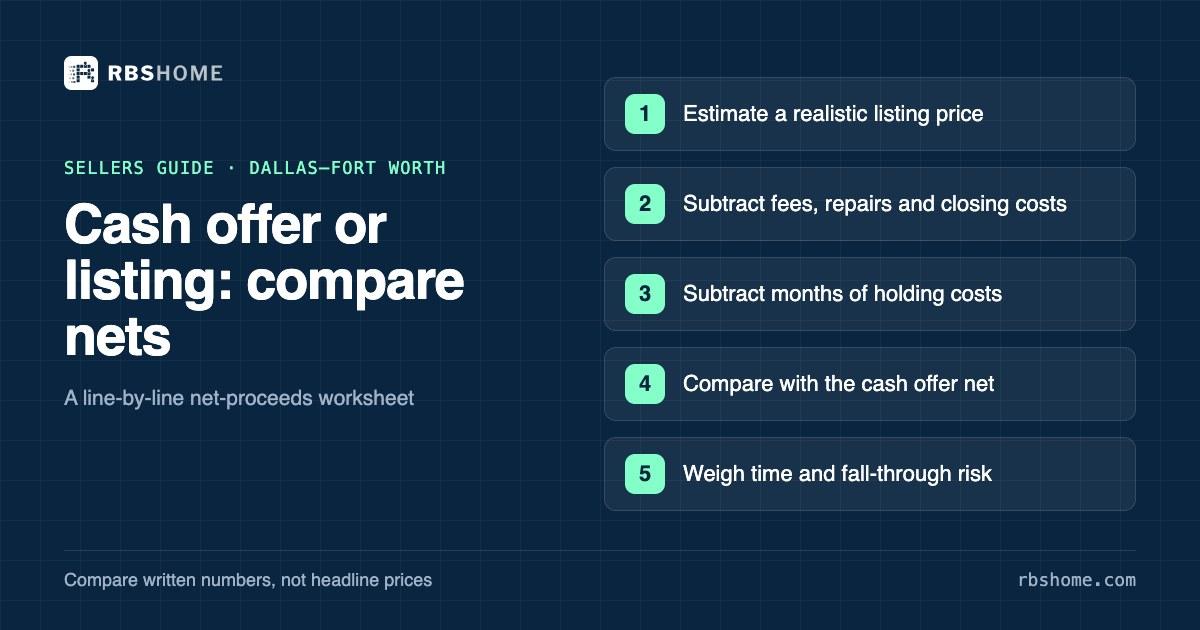
Compare net proceeds, not headline prices. Start from a realistic listing price and subtract commissions, pre-listing work, repair credits, concessions, closing costs and the cost of carrying the house until it closes; then compare that with the cash offer minus its own, smaller list of costs. For a house in good shape, listing usually nets more. For a house that needs major work, or a seller who can't carry it for months, the gap shrinks and sometimes flips. Every number in the examples below is hypothetical.
In this article
- 1. What net proceeds means
- 2. The worksheet, line by line
- 3. Worked example A: a move-in-ready house
- 4. Worked example B: a house that needs major work
- 5. Commissions in Texas after 2024
- 6. Repairs: the line that moves the most
- 7. Holding costs and the value of time
- 8. The risk that the deal falls through
- 9. When listing nets more
- 10. When a direct sale can make sense
- 11. How to compare real offers side by side
What net proceeds means
Net proceeds is the money that reaches your bank account after everything is paid at closing and after everything you spent to get there. It is the only fair way to compare two ways of selling.
Two offers rarely look alike. An agent might suggest a list price that is far above a cash offer, and that gap is real. But the list price is not what you take home. Between the list price and your net sit the broker fees, the repairs a buyer's inspector finds, the concessions a buyer's lender allows, the months of mortgage, taxes and utilities while the house is on the market, and the closing costs. A direct buyer's offer has fewer of those deductions, but starts lower.
Two items appear in both columns and cancel out, so you can leave them off the worksheet: your mortgage payoff (you owe the same balance either way) and, in most cases, the property tax proration, which credits the buyer for the part of the year you owned the house. They matter for your final number, but not for the comparison.
The worksheet, line by line
Use this list for each option you are considering. For the listing column, ask the agent for an estimate on every line. For the cash column, ask the buyer to put each line in writing.
- Expected sale price. For a listing, use a price the agent can support with recent sales, not the hoped-for list price. For a cash offer, use the written offer.
- Listing broker compensation. Whatever you agree to in the listing agreement.
- Contribution toward the buyer's broker. Optional and negotiable; zero if you don't offer it.
- Pre-listing work. Paint, cleaning, landscaping, repairs, staging, hauling away belongings.
- Repairs or credits after the buyer's inspection. Requests come after the option period begins.
- Seller concessions. Money toward the buyer's closing costs, if you agree to it.
- Owner's title policy. The contract says whether the seller or buyer pays.
- Seller's half of the escrow fee, deed preparation, tax certificates and lien release recording.
- Holding costs. Mortgage interest, taxes, insurance, utilities, HOA dues and lawn care for every month until closing.
- Other liens and past-due amounts. Past-due taxes, HOA balances or city liens get paid from either sale, but some cash buyers price them in rather than deducting them.
Net = line 1 minus lines 2 through 10.
Two lines deserve a closer look before you fill them in. For the title policy, Texas premiums are set by the state, so the number is easy to check: the Texas Department of Insurance title rate chart effective March 1, 2026 lists a basic premium of $1,768 for a $300,000 policy and $2,015 for a $350,000 policy, and TDI's title FAQ says all title companies charge the same premium for a policy. Escrow fees, by contrast, are not set by the state and differ between companies.
Worked example A: a move-in-ready house
These numbers are hypothetical
The prices, fee percentages and costs in both examples are made up to show the math. They are not market data, quotes or typical rates for Dallas or Collin County. Replace every line with your own estimates and written offers.
Imagine a three-bedroom house in good condition. An agent believes it would sell for $350,000 after about three months of preparation, marketing and closing. A direct buyer offers $290,000 as-is, closing in about a month.
| Line (hypothetical) | Listing | Cash offer |
|---|---|---|
| Expected sale price | $350,000 | $290,000 |
| Listing broker (2.5% in this example) | $8,750 | $0 |
| Contribution to buyer's broker (2.5% in this example) | $8,750 | $0 |
| Owner's title policy (TDI basic premium) | $2,015 | $1,719 |
| Seller's half of escrow fee (example) | $500 | $500 |
| Pre-listing paint and cleanup | $4,000 | $0 |
| Repair credit after inspection | $3,000 | $0 |
| Concessions toward buyer's closing costs | $3,500 | $0 |
| Holding costs at $2,500 a month | $7,500 (3 months) | $2,500 (1 month) |
| Estimated net before payoff | $311,985 | $285,281 |
In this example the listing nets about $26,700 more. That is a real difference, and for a seller who has the time and a house that shows well, it is the better choice. The cash offer would need to be roughly $317,000 to match the listing net, and few direct buyers can pay that for a house that needs nothing.
Notice what drove the result: the house needed little work, so the repair and preparation lines were small, and the seller could carry it for three months without stress.
Worked example B: a house that needs major work
Again, every figure here is hypothetical and exists only to show the method.
Now imagine a house that needs a roof, foundation work and updated electrical and plumbing. The seller has three choices: renovate and then list, list as-is, or take a direct offer.
| Line (hypothetical) | Renovate, then list | List as-is | Cash offer |
|---|---|---|---|
| Expected sale price | $320,000 | $255,000 | $230,000 |
| Broker compensation, both sides (5% in this example) | $16,000 | $12,750 | $0 |
| Renovation budget | $45,000 | $0 | $0 |
| Owner's title policy (TDI basic premium) | $1,867 | $1,546 | $1,422 |
| Seller's half of escrow fee (example) | $500 | $500 | $500 |
| Repair credit and concessions | $7,000 | $2,000 | $0 |
| Holding costs at $2,000 a month | $12,000 (6 months) | $6,000 (3 months) | $2,000 (1 month) |
| Estimated net before payoff | $237,633 | $232,204 | $226,078 |
On paper, renovating still wins by a few thousand dollars over the as-is listing and by about $11,500 over the cash offer. But look at what the seller has to do to earn that: put up $45,000 in cash or credit, manage contractors for months, and hope the renovation stays on budget and the market doesn't soften before the house sells. A 20 percent overrun on the renovation in this example, $9,000, would wipe out its advantage over the as-is listing and most of its lead over the cash offer.
The as-is listing and the cash offer end up about $6,000 apart. For many sellers, that is a fair price for a faster close, no showings and no chance of a buyer walking away after inspection.
The point of example B is not that one answer is right. It is that the further a house is from move-in ready, the more the costs and risks of listing eat into the higher price.
Commissions in Texas after 2024
Broker compensation has always been negotiable in Texas, but the paperwork now says so directly, and the buyer side is handled separately.
Since the 2024 national settlement over real estate commissions, buyer-agent pay has become a more visible, separate negotiation. Texas has written that into its standard forms and its licensing law:
- The current TREC One to Four Family Residential Contract (Resale), form 20-19, says in paragraph 12B that brokerage compensation is not set by law and is fully negotiable, and that each party pays its own broker under separate written agreements. It then gives two optional boxes: the seller can agree to pay an amount toward the buyer's broker, or the buyer can agree to pay an amount toward the seller's broker.
- Occupations Code section 1101.563, which took effect January 1, 2026, requires a license holder working for a prospective buyer of a house to sign a written agreement with that buyer before showing a property. The agreement must state the broker's compensation and disclose in conspicuous language that broker compensation is not set by law and is fully negotiable.
For a seller, this means three separate questions, each negotiable: what you pay your listing broker, whether you contribute anything toward the buyer's broker, and whether that contribution is a flat amount or a percentage. Buyers who have agreed to pay their own agent may ask you to cover some of it as part of their offer. You can say yes, no or something in between, and the right answer depends on how much competition there is for your house.
With a direct buyer, there is usually no broker on either side, so lines 2 and 3 of the worksheet are zero. If you do use an agent to sell to a direct buyer, include that fee in the cash column too.
Repairs: the line that moves the most
In most comparisons, repairs decide the outcome. Commissions are a percentage you can estimate in advance. Repairs are the unknown.
They show up in three places when you list:
- Before listing. Work you choose to do so the house photographs and shows well.
- After the buyer's inspection. Under the TREC contract, a buyer who paid an option fee has an unrestricted right to terminate during the option period, so inspection findings usually turn into a request for repairs or a price reduction. Accepting the house as-is in the contract doesn't stop a buyer from inspecting, negotiating repairs or terminating during that period.
- When the lender requires it. Paragraph 7E of the TREC contract says that unless agreed otherwise, neither party has to pay for lender-required repairs, including wood-destroying insect treatment. If nobody agrees to pay, the contract terminates. If those repairs cost more than 5 percent of the sales price, the buyer may terminate.
A direct buyer prices the repairs into the offer instead. That is why the offer is lower, and why it doesn't move after inspection. When you compare, the question is whether the buyer's discount for repairs is larger or smaller than what the repairs, the time and the risk would cost you. Get one or two contractor bids for the big items before you decide. They are free or cheap, and they turn the biggest unknown into a number.
Holding costs and the value of time
Every month the house is yours, you pay for it. Add up the monthly cost of:
- mortgage interest (the principal part of your payment is your own equity, so leave it out);
- property taxes, which keep accruing whether or not the bill has arrived;
- homeowners insurance, which may cost more or be harder to get if the house is vacant;
- utilities, lawn care and pool service;
- HOA dues;
- for a vacant house, security checks and the risk of break-ins.
Multiply by the realistic number of months from today to closing for each option. For a listing, include prep time, time on the market, and the time between contract and closing. For a direct sale, use the closing date in the offer.
Time also has value that doesn't show up on a closing statement. A seller facing a job move, a divorce, a foreclosure date or two mortgages at once may reasonably value a certain closing date over a possibly higher price. If foreclosure is the driver, the timeline is set by law and is short; see our Dallas County foreclosure guide. If you are selling as part of a divorce, our guide to selling a home during a Texas divorce covers the extra steps.
The risk that the deal falls through
A contract is not a closing. When a listing deal falls apart, the seller loses time, keeps paying holding costs, and often relists at a lower price because buyers see a house that came back on the market.
Common reasons a financed sale fails include:
- the buyer terminates during the option period after inspection;
- the buyer's loan isn't approved, or the appraisal comes in below the price and the parties can't agree on how to close the gap;
- lender-required repairs that neither side agrees to pay for;
- title problems, such as an old lien or an heir who hasn't signed.
You can account for this on the worksheet with a simple adjustment. Ask yourself how likely the first contract is to close, then add a cost for the bad case: two or three more months of holding costs and a possible price cut. A house with obvious defects carries more risk of this than a house in good shape.
A direct cash sale removes the loan and appraisal risk. It does not remove title risk; the title company still has to clear title before anyone closes. Ask any cash buyer how much earnest money they will deposit and whether their contract lets them walk away for any reason during an inspection or option period. A buyer who can cancel freely for weeks is offering less certainty than the word "cash" suggests.
When listing nets more
Be honest with yourself about this, because it is often the case. Listing with an agent usually nets more when:
- the house is in good condition, or only needs cosmetic work;
- the house is in a neighborhood where retail buyers compete for homes like it;
- you can carry the house for several months without strain;
- you have no deadline, such as a foreclosure sale date, a tax suit or a job start;
- the title is clean and the owners are all available to sign.
In these cases, the extra price a retail buyer pays usually exceeds commissions and the other costs of a listing, as example A shows. If you fit this list, get two or three listing presentations, negotiate the fees, and list.
When a direct sale can make sense
A direct sale can be the better net, or the better trade, when:
- the house needs structural, roof, foundation or system work that would make a financed buyer's lender hesitate;
- you can't or don't want to fund repairs before selling;
- the house is vacant and the holding costs or break-in risk are rising;
- there is a deadline: a foreclosure notice, a tax suit, a probate timeline or a move;
- the house is full of belongings you don't want to sort and haul;
- the title needs work, such as an heirship, and you want a buyer who will wait for it. Our guide to selling inherited property in 75216 and 75217 covers that situation.
If you want a sense of how active investors and builders are in your area before you decide, our Dallas County and Collin County hubs rank every ZIP by recent investor and builder purchases.
How to compare real offers side by side
Once you have a listing estimate and one or more direct offers, put them in the worksheet with these rules:
- Use written numbers only. Ask the agent for a written net sheet, and ask each buyer for a written offer that lists every fee and credit.
- Use the same closing date assumption for holding costs, adjusted for how long each option really takes.
- Put repairs at contractor bid prices, not guesses.
- Read the termination terms. Note the option period length, the earnest money, and any right for the buyer to cancel.
- Check who pays what at closing. The owner's title policy, the escrow fee, past-due taxes, HOA transfer fees and city liens can each be assigned to either side.
- Add a risk cost to any option that can fall through, sized to your own situation.
The option with the highest net after those adjustments is usually the right one. When two options are close, choose the one with the timeline and certainty that fit your life.
RBSHome is one of the direct options. We buy houses and land as-is in Dallas and Collin County. You get a written, itemized offer, usually within 24 hours, so every line of the worksheet is visible. There are no agent commissions, you pick the closing date, and closing happens at a title company. If our number doesn't beat your listing net after you've filled in the worksheet, list the house.
This article is general information, not legal or tax advice. For your situation, talk to a Texas attorney, CPA or your title company.
Get a written, itemized number to put in the cash column of your worksheet.