TL;DR
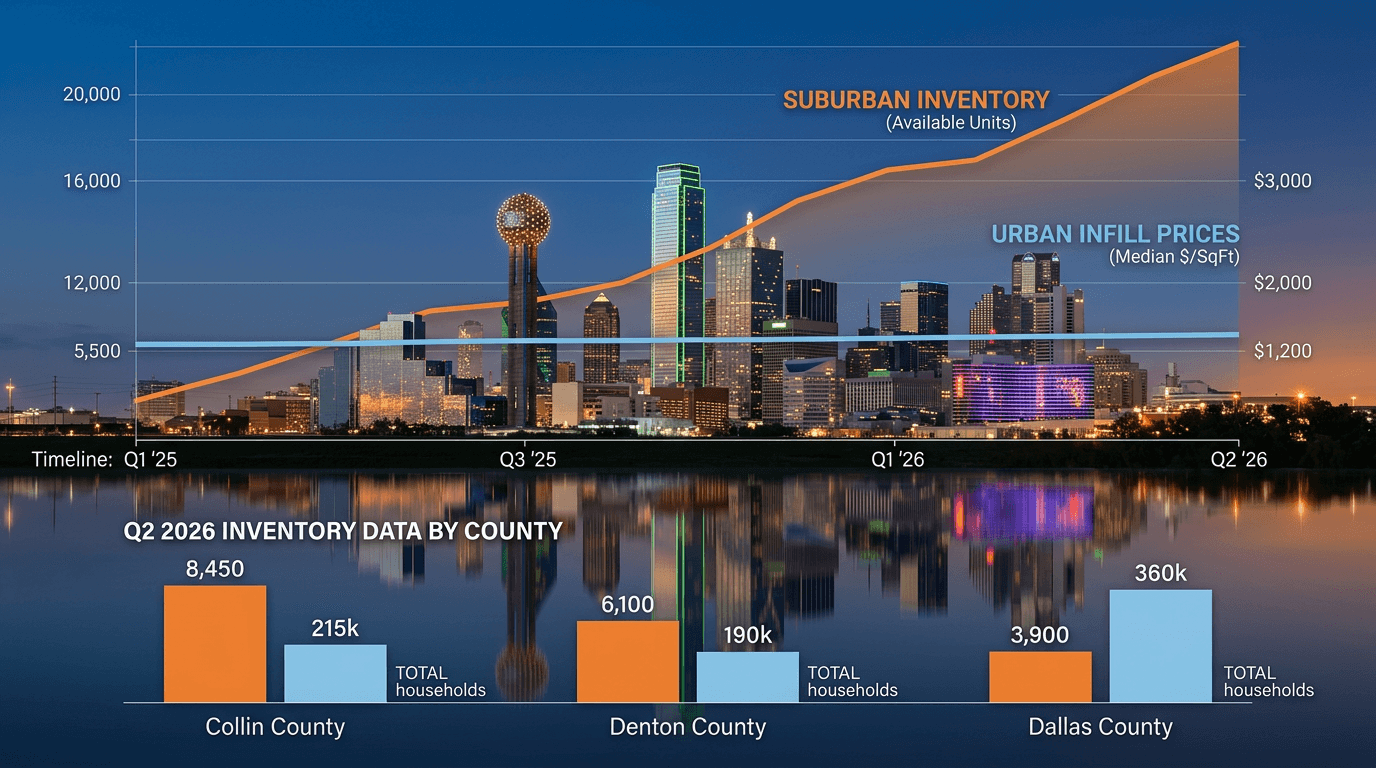
The Q2 2026 Dallas-Fort Worth real estate market is defined by a massive bifurcation. While suburban counties see inventory surging over 40% and aggregate home prices cooling, the Dallas urban core defies this trend entirely. Core infill properties continue to appreciate, driven by a $639 million surge in residential construction permits and severe land scarcity. This report breaks down the contradictory data, new municipal housing policies, and what it means for buyers and sellers.
Navigating the Dallas-Fort Worth (DFW) real estate market in the spring of 2026 requires looking past the national headlines. If you read standard economic reports, you will see a story of a cooling Texas housing market. However, if you are an infill builder trying to source a teardown lot in Preston Hollow, or a legacy homeowner in Oak Cliff watching your property taxes skyrocket, the reality on the ground feels drastically different.
The DFW market has entered a period of extreme bifurcation. We are witnessing two entirely different economic ecosystems operating within the same metropolitan area. To successfully invest, build, or sell in this environment, you must understand the difference between suburban sprawl dynamics and urban core scarcity.
In this comprehensive Q2 2026 Dallas Housing Market Report, we synthesize the latest data from the Texas Real Estate Center, the S&P CoreLogic Case-Shiller Index, local permit activity, and new municipal policies to explain exactly where the market is heading.
The Macro View: DFW Inventory Hits Post-2011 Highs
From a macroeconomic perspective, the broader Texas housing market is currently navigating a precarious balancing act between flattening aggregate prices and rapidly surging inventory.
Following the unsustainable, hyper-competitive bidding wars of the pandemic era, the market has undergone a multi-year stabilization phase. In April 2026, the S&P CoreLogic Case-Shiller Index reported that single-family home sales prices in Dallas dropped by a marginal 0.21% compared to a year earlier. This represents a gradual deceleration, placing Dallas alongside Tampa as one of the few major metros showing slight negative price growth in the aggregate index.
This cooling effect is directly tied to a massive surge in active listings across the Metroplex. We are currently seeing inventory levels reach their highest point since 2011.
The Suburban Inventory Surge (April 2026)
Data from Republic Title and local MLS aggregations reveal staggering year-over-year increases in active listings, primarily concentrated in the suburban peripheries:
- Collin County: Active listings jumped by an astonishing 43.7% year-over-year.
- Denton County: Inventory rose by 40.5%.
- Dallas County (Broad): Active listings increased by 33.8%.
With mortgage interest rates hovering around an average of 6.26%, retail buyer affordability has been severely compressed. In the sprawling exurbs and master-planned communities of Collin and Denton counties, builders and sellers are facing longer days on market (DOM). For instance, Collin County homes are averaging 52 days on market, while areas like Rockwall are topping out at 85 days. Buyers in these peripheral markets finally have the leverage to negotiate concessions, rate buy-downs, and repairs.
The Micro Reality: Why Infill Dallas Defies the Suburban Trend
If the macro data shows falling prices and surging inventory, why are teardown lots in Highland Park and transition homes in East Dallas still commanding massive premiums? The answer is geographical scarcity and the specific demands of high-net-worth buyers.
While the aggregate Dallas-Fort Worth statistical area may show a 0.21% decline, the hyper-local reality within the Dallas city limits is remarkably strong. Recent datasets indicate that homes in Dallas proper are selling for a median price of $499,000, representing a robust 14.7% year-over-year increase. Furthermore, homes in the urban core are selling at a faster clip, averaging 45 days on the market compared to the slower suburban counterparts.
The Infill Paradox
Nationally, new home construction continues to prop up the real estate market, accounting for roughly 27.7% of all real estate sales as of April 2026. However, the West South Central region of the United States (which includes Texas) has a surprisingly low infill development rate of just 9.7%, compared to a national average exceeding 20%.
Because Texas builders have the luxury of vast open land on the fringes of the metroplex, they naturally gravitate outward to build at scale. This creates an artificial scarcity of new inventory inside the established Dallas city limits.
For buyers who demand the cultural vibrancy of Bishop Arts, the school districts of the Park Cities, or the estate privacy of Preston Hollow, moving to Celina or Forney is not an option. Because there is zero vacant land left in these premium urban corridors, builders must acquire older homes and bulldoze them. This intense, concentrated demand for teardown dirt completely insulates these micro-markets from the broader suburban cooling trend.
DFW Submarket Velocity Report: Q1 2026 Permit Activity
To truly understand where institutional capital and builder confidence are flowing, we must look at municipal permit activity rather than MLS listings. Builders do not pull expensive permits in a declining submarket.
In recent months, Dallas posted the second-highest permit volume statewide, but crucially, it surpassed Houston in total residential construction value. The city generated over $639 million in residential construction value in a single month, with an exceptionally high average permit value of $389,500.
This data signals a massive concentration of mid-to-upper-tier infill projects. We are seeing intense teardown and value-add renovation activity in specific ZIP codes:
- 75220 (Preston Hollow) & 75205 (Highland Park): Dominated by custom luxury spec homes with finished exit values ranging from $1.6M to $3.75M+. Builders here are paying premiums strictly for the land value.
- 75212 (West Dallas / Trinity Groves): This area is experiencing an explosive level of commercial and residential redevelopment, heavily skewing permit data as large-scale multi-family and townhome projects replace legacy structures.
- 75208 (Bishop Arts / Oak Cliff): Permit activity here leans heavily toward high-end historic renovations rather than teardowns, primarily due to the strict enforcement of the Oak Cliff Demolition Delay Overlays (DDO-1 and DDO-3), which mandate a 45-day delay for demolishing older structures.
The Policy Impact: Understanding the "Dallas is Home" Framework
Real estate is not just driven by supply and demand; it is heavily influenced by municipal policy. In April 2026, the Dallas City Council received an extensive briefing on a new, sweeping housing framework titled "Dallas is Home".
This policy represents a defining shift in how the city views development, gentrification, and affordability. For both real estate investors and distressed sellers, the details of this framework are critical.
The Affordability Crisis
The city officially recognizes a severe housing crisis. Data presented alongside the policy reveals:
- The average Dallas renter now spends 39% of their income on housing.
- There is a deficit of more than 12,000 for-sale single-family homes that are deemed "attainable" for median-wage earners.
- It is projected that by 2032, Dallas homebuyers earning the median income will only be able to afford 2% of the homes on the market.
The 8 Strategic Pillars and $100M Fund
The "Dallas is Home" framework guides the city's efforts through eight strategic pillars, including the citywide production of attainable housing, preserving the existing housing stock, and directing investments to areas with the greatest vulnerability to displacement.
A central component of this initiative is a $100 million housing fund established in partnership with the Communities Foundation of Texas. Furthermore, non-federally funded programs like the Anti-Displacement Homebuyer Assistance Program (DHAP 10) are expanding to offer up to $50,000 in assistance for residents who have lived in the city for over 10 years.
What this means for investors: The city is actively attempting to slow down the aggressive gentrification seen in areas like West Dallas and South Dallas. Builders will face increased scrutiny regarding affordable unit allocations and preservation efforts.
What this means for sellers: While the city is offering assistance, property taxes in gentrifying areas will continue to rise. If you are sitting on a distressed or inherited property, relying on slow-moving municipal grants to stop an imminent tax foreclosure is a risky gamble.
Predictions for the Second Half of 2026
As we move through the remainder of 2026, the DFW market will remain fiercely divided.
- Federal AML Regulations Will Slow Amateur Flippers: Effective March 1, 2026, new FinCEN regulations (89 Fed. Reg. 70.258) mandate strict reporting for cash transfers of real estate to LLCs. This will bottleneck inexperienced wholesalers and flippers, leaving the market open for sophisticated, legally compliant acquisition firms to dominate.
- Infill Land Values Will Hold Firm: Because the geographical borders of Dallas, Highland Park, and University Park cannot expand, dirt in these core areas will remain immune to the price drops seen in the outer suburbs.
- Distress in Transition Zones Will Peak: Neighborhoods like Trinity Groves (75212) and Pleasant Grove (75217) will see an increase in off-market cash sales as legacy homeowners seek to liquidate their assets to escape skyrocketing property tax burdens and code compliance liens before county foreclosure auctions.
If you are a builder looking to navigate the complex zoning of the Dallas infill market, or a homeowner seeking a fast, compliant cash exit from a distressed property, relying on standard MLS data is no longer sufficient. You need a partner who understands the micro-economics of your specific ZIP code.
Learn more about our data-driven acquisition process →
We underwrite properties based on hyper-local 2026 data.