TL;DR
For capital allocators, builders, and real estate investors operating in Dallas in 2026, the market offers two highly distinct, highly profitable acquisition strategies. You can either pursue high-margin, low-volume teardown lots in the established luxury corridors of Preston Hollow (75220), or you can navigate the high-volume, hyper-distressed gentrification wave sweeping through Trinity Groves and West Dallas (75212). This guide breaks down the economics, risks, and municipal hurdles of both approaches.
In this article
- 1. Two cities, one metroplex: The bifurcation of Dallas real estate
- 2. The Preston Hollow Play: High-margin teardown economics (75220)
- 3. The Trinity Groves Play: Navigating the 9M sq ft redevelopment wave (75212)
- 4. Risk profile comparison: Zoning strictures vs. title clouding
- 5. Which strategy fits your 2026 capital allocation?
The Dallas real estate market is vast, complex, and notoriously difficult to summarize with broad, metro-wide statistics. To truly succeed as a real estate investor or luxury builder in 2026, you must become a micro-market specialist.
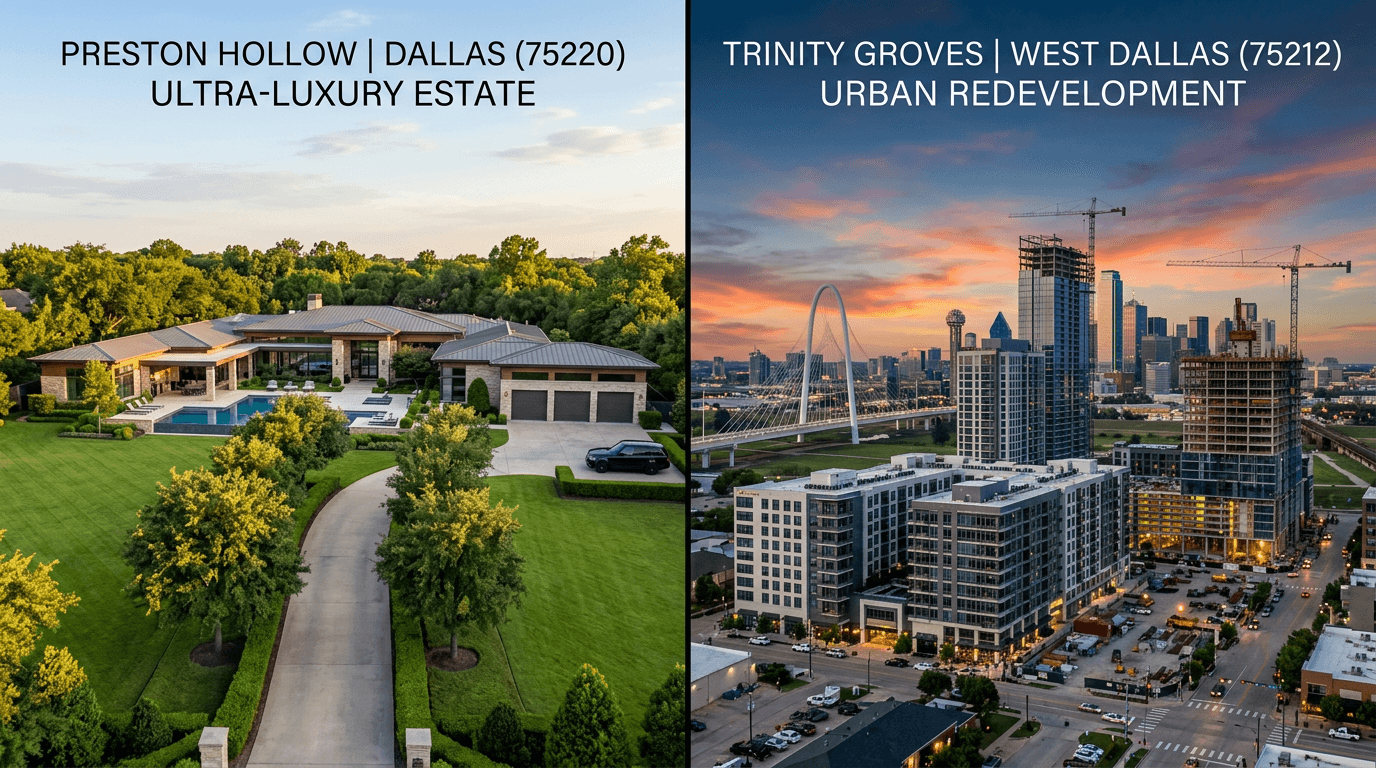
If you analyze the capital currently flowing into the city, you will notice it heavily favors two distinct strategies, represented perfectly by two completely different ZIP codes located just miles apart: Preston Hollow (75220) and Trinity Groves (75212).
Preston Hollow represents the pinnacle of established, institutional wealth, where investment strategy relies on acquiring ultra-premium dirt for custom vertical construction. Trinity Groves, on the other hand, is the epicenter of explosive, commercial-led gentrification, where investors navigate deep neighborhood distress to acquire undervalued assets.
For out-of-state capital allocators, local developers, and sophisticated wholesalers, understanding the divergent economics, municipal regulations, and demographic pressures of these two zones is the key to unlocking massive ROI. Here is a comparative masterclass on Dallas real estate investing in 2026.
Two Cities, One Metroplex: The Bifurcation of Dallas Real Estate
The defining characteristic of Dallas real estate in 2026 is its stark bifurcation. While the outer suburban counties are seeing inventory surge by over 40% and prices cool, the urban core is experiencing a massive supply constraint. However, even within the urban core, the types of opportunities vary wildly based on historical neighborhood development.
Preston Hollow (75220) and the Park Cities have been fully developed for decades. The only way to create new housing inventory here is through the demolition of functionally obsolete structures.
Conversely, West Dallas and Trinity Groves (75212) operated for decades as neglected industrial and low-income residential zones. It wasn't until the construction of the Margaret Hunt Hill Bridge and the subsequent commercial redevelopment that the area became viable for institutional capital.
These divergent histories dictate two entirely different acquisition playbooks.
The Preston Hollow Play: High-Margin Teardown Economics (75220)
Investing in the 75220 corridor—which encompasses the sprawling, heavily treed estates of Old Preston Hollow—is a low-volume, high-margin game. Acquisitions here are almost never driven by traditional financial distress (such as a seller facing a tax foreclosure or a job loss). Instead, the motivation to sell is driven by the age of the structure relative to the astronomical value of the land.
The Underwriting Economics
Builders and investors in Preston Hollow underwrite acquisitions based strictly on a "finished exit band." In 2026, new vertical construction in these premier enclaves consistently commands finished retail values between $1.6 million and $3.75 million, with custom estates reaching much higher.
Because the exit values are so robust, the underlying dirt is incredibly valuable. Investors here are targeting mid-century ranch homes built in the 1950s or 60s that sit on lots ranging from 0.3 to 1.5+ acres.
The Preston Hollow Strategy
- The Goal: Source off-market land at wholesale value before it hits the MLS.
- The Value-Add: The physical house holds zero contributory value. The ROI is generated purely by bulldozing the structure, securing a clean Certificate of Occupancy (CO) path, and either assigning the lot to a luxury custom builder or erecting a $3.5M spec home.
- The Filter: Serious buyers utilize strict adjacency filters, immediately blacklisting any property situated on or backing up to major arterials like Walnut Hill Lane, Northwest Highway, or Midway Road.
This strategy requires significant capital deployment upfront, but it shields the investor from the unpredictability of low-income tenant management or neighborhood crime rates. The risk here is entirely tied to construction costs and interest rates.
The Trinity Groves Play: Navigating the 9M Sq Ft Redevelopment Wave (75212)
Just a few miles south across the Trinity River, the 75212 ZIP code presents a completely different investment landscape. West Dallas is currently experiencing one of the most intense, institutional-scale gentrification shifts in the nation.
The area was pioneered by a unique "restaurant-first" redevelopment model. By creating a massive dining and entertainment hub at the base of the bridge, developers artificially induced foot traffic and demand before residential density existed.
In 2026, this catalyst effect has culminated in a massive acquisition play by Goldenrod Companies, which purchased nearly 90 properties encompassing over 35 acres. Goldenrod's ambitious 9-million-square-foot master plan includes the construction of 2,419 residential units, a boutique hotel, and high-rise office towers with unobstructed skyline views.
The Underwriting Economics
The introduction of this multi-billion dollar commercial project has caused residential lot values in West Dallas to skyrocket—increasing by an astonishing 900% in recent years. Despite this underlying land appreciation, the median home value in 75212 remains artificially suppressed around $246,000 to $310,000, due to the deteriorated condition of the legacy housing stock.
The Trinity Groves Strategy
- The Goal: Volume-based distressed acquisitions.
- The Value-Add: Acquiring heavily distressed legacy homes from motivated sellers, resolving complex title and tax issues, and either executing a value-add "fix and flip" for incoming young professionals or assigning the lot to mid-tier townhome developers.
- The Demographic Distress: Over 6,000 properties in West Dallas have recently become tax delinquent, with over 400 households owing more than $10,000 in back taxes. Investors provide immediate cash exits for families facing county auction.
This strategy offers much lower barriers to entry compared to Preston Hollow, but it requires an incredibly high level of operational grit. Investors must navigate anti-displacement activism, heavy code violations, and intense neighborhood transition.
Risk Profile Comparison: Zoning Strictures vs. Title Clouding
The true test of an investor in Dallas is not finding a property, but successfully navigating the municipal and legal hurdles to close the deal. The obstacles in Preston Hollow are vastly different than those in Trinity Groves.
The Hurdles in Preston Hollow (75220)
In 75220, the primary risks are municipal zoning codes and physical lot constraints.
- Setbacks and Zoning: You must understand the difference between R-7.5 and R-10 zoning, and how Dallas setback requirements dictate the maximum buildable footprint.
- Article X Tree Ordinance: Dallas aggressively protects its urban canopy. If a legacy Oak tree sits in the middle of a 75220 lot, you cannot simply cut it down. Removing it requires expensive municipal mitigation, which can kill a builder's margin.
The Hurdles in Trinity Groves (75212)
In 75212, the primary risks are legal and social.
- Clouded Titles: It is estimated that over 200 properties in West Dallas currently suffer from clouded titles. Homes are often passed down informally without probate. Investors must possess the legal infrastructure to file Affidavits of Heirship or execute Quiet Title actions to legally transfer the deed.
- Tax Foreclosure Timelines: Because so many properties are severely tax delinquent, investors are constantly racing against the clock to close the deal before the property is struck off at the First Tuesday Dallas County Tax Auction at the George Allen Courts Building.
The Universal Hurdle: 2026 AML Regulations
Regardless of whether you are buying a $2M lot in Preston Hollow or a $150K distressed home in West Dallas, all investors utilizing LLCs or Trusts must now comply with the new federal Anti-Money Laundering (AML) regulations (89 Fed. Reg. 70.258) enacted in March 2026. These rules mandate strict FinCEN reporting for cash transfers of residential real estate, adding a layer of federal compliance to all off-market transactions.
Which Strategy Fits Your 2026 Capital Allocation?
Choosing between Preston Hollow and Trinity Groves comes down to your capital structure and operational capabilities.
If you are a well-capitalized builder or a high-net-worth investor seeking stable, high-yield luxury exits with minimal tenant interaction, the teardown economics of Preston Hollow provide a clean, calculable path to ROI.
If you possess a strong acquisitions team, deep legal resources for clearing complex titles, and the operational stamina to manage high-volume distressed assets, the explosive gentrification of Trinity Groves offers unparalleled ground-floor opportunities.
At RBS Home Buyers, our acquisitions infrastructure is uniquely designed to serve both markets. We source premium, adjacency-screened infill dirt for our luxury builder network in North Dallas, while simultaneously providing ethical, compliant cash exits for distressed legacy homeowners in the southern and western corridors.
Explore our off-market inventory and investment strategies →
Looking to deploy capital in Dallas? View our off-market inventory.